
There’s a kind of problem that doesn’t show up in any report. It doesn’t trigger an alert, it doesn’t stop a booking, and it doesn’t cause a visible on-screen error. It’s simply there, every day, consuming time, creating rework, and limiting your agency’s ability to grow. That problem has a name: operating with outdated systems in travel agencies.
This isn’t about having old technology in the literal sense. It’s about running on tools that no longer match the scale, speed, or complexity that modern travel operations demand. And the hardest part is recognizing it because, when you’re in it, everything seems to “work.” The team adapts. Processes get improvised. Customers don’t complain too much. But the agency doesn’t grow either.
If you feel like your operation has hit a ceiling, that scaling means hiring more people instead of improving processes, or that your agency’s information is scattered across emails, spreadsheets, and WhatsApp conversations, this article is for you.
What an outdated system really is in a travel agency
The word “outdated” sounds technical. In practice, an outdated system isn’t necessarily decades-old software or a tool that’s no longer sold. It’s any solution that can no longer support the operation your agency needs.
A legacy program for travel agencies might be desktop software that has to be installed on every computer. It might be an Excel spreadsheet that works perfectly for ten bookings a month but collapses when you reach fifty. It might be a booking system that covers the basics but doesn’t connect with your suppliers, doesn’t generate automatic itineraries, and doesn’t centralize your customer history.
What all these cases have in common is the same: the tool forces the team to do manually what the system should do. That has a cost. Not always in money, but always in time, errors, and missed opportunities.
Why agencies keep using tools that already limit them
Here’s something worth saying plainly: most agencies running on outdated systems aren’t doing it out of ignorance. They do it because the system “still works,” because the team already knows how to use it, and because changing feels more expensive than staying.
That logic makes sense in the short term. The problem is that it ignores what the outdated system is already costing you quietly.
Think about how many hours per week your team spends on tasks that could be automated: resending quotes in Word format, manually updating rates across multiple documents, confirming availability by phone with suppliers, or copying information from one system to another to issue an invoice. None of those tasks add value for the customer. All of them add cost to your operation.
On top of that, there’s another less visible effect. When the operation depends on manual processes, scaling becomes synonymous with hiring. If you want to serve more customers, you need more people. If you want to launch a new product line, you need more coordinators. The operation doesn’t grow efficiently; it grows by piling on human effort. And that has a clear limit.
To dive deeper into how that limit affects the decision to go digital, you can read when to stop using free software and switch to a professional one.
Signs your legacy system has reached its limit
There’s no exact moment when a system becomes outdated. It happens gradually, and by the time you recognize it, it’s been affecting operations for a while. These are the most common signs:
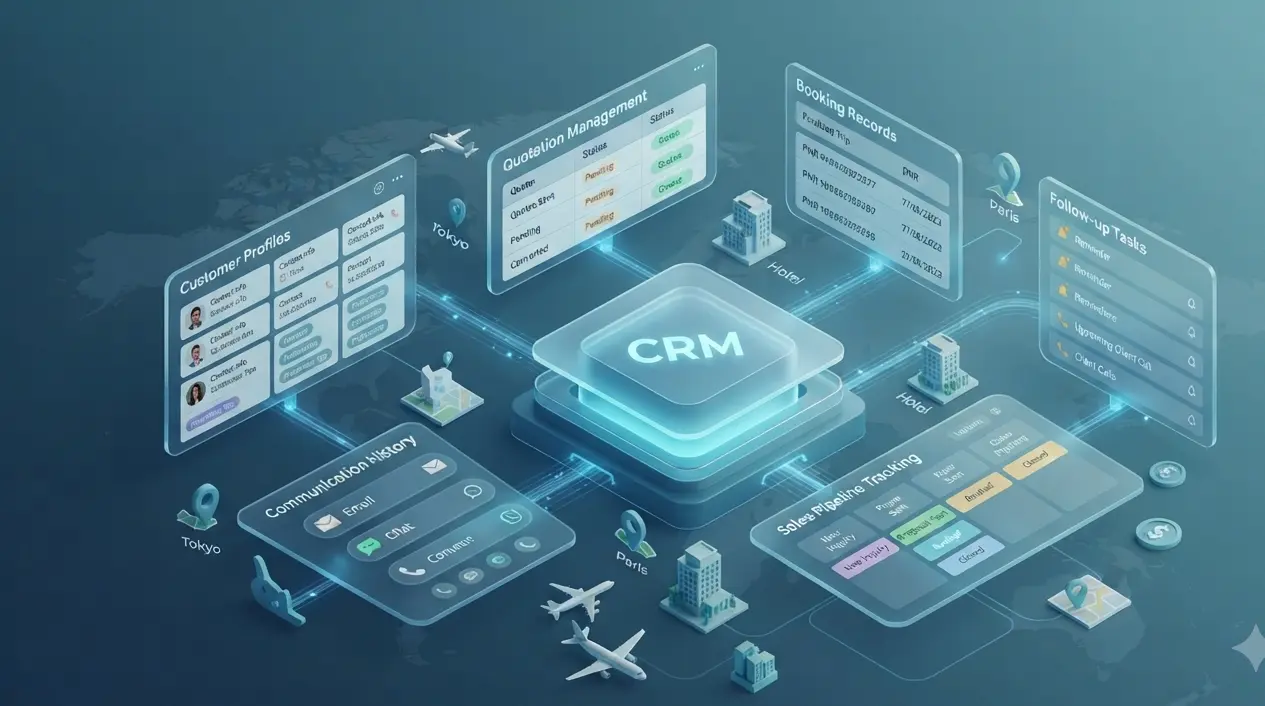
Information lives in several places at once. Customer data is in the CRM, in a separate spreadsheet, in email, and in the head of the agent who handled them. When that agent is out, the information is lost or has to be rebuilt from scratch.
Every quote is handcrafted. Preparing a proposal for a customer means opening multiple documents, checking rates in different sources, calculating margins manually, and building the document from scratch every time. What should take minutes takes hours.
You can’t see the real status of your operation in real time. To know how much you sold this week, how many bookings are confirmed, or what the margin is on a specific package, someone has to sit down and consolidate information from different sources. There’s no centralized dashboard that shows it.
Errors keep happening even if the team is good. Double-booking a service. An outdated rate sent to the customer. A payment that wasn’t recorded in time. Those errors aren’t the team’s fault: they’re a direct consequence of manual processes and disconnected systems.
Adding a new service or entering a different market feels impossible. If expanding the operation requires manually redesigning every workflow, the system isn’t scalable. And an agency that can’t scale has its growth limited by its own infrastructure.
If you recognize two or more of these situations in your operation, you’re not facing a management or team problem. You’re facing a structural technology problem.
What your operation loses while the system doesn’t change
A useful exercise to understand the real impact of running on outdated travel software is to calculate how much weekly time your team spends on tasks a modern system would automate.
You don’t need to be exact. Estimate how many hours your agents spend resending documents, updating prices manually, following up on payments via WhatsApp, or rebuilding customer information that should be available in seconds. Multiply that by the number of people on the team and by the weeks in the year. The result isn’t just a number of hours. It’s operational capacity your agency is spending on admin tasks instead of selling, designing better products, or serving customers better.
There’s another cost many agencies don’t calculate: the cost of errors. A quote with the wrong rate that’s already been sent to the customer. A booking confirmed twice with the same supplier. A payment that wasn’t recorded and caused a cash-flow issue at the end of the month. Each of those errors has a direct cost, and almost all are a predictable consequence of managing with manual processes and disconnected tools.
The third cost is the hardest to quantify but the most important long term: opportunities that don’t materialize. The customer who requested a complex quote and got the response too late. The group that went with a competitor because you didn’t have real-time availability. The expansion into a new market that didn’t move forward because the operation couldn’t handle more.
An agency with outdated systems doesn’t just lose efficiency. It loses competitive position.
Agency with an outdated system vs. a digitalized agency: how operations change
To understand what it means to move away from an outdated system, it helps to see what the same operation looks like in two different scenarios.
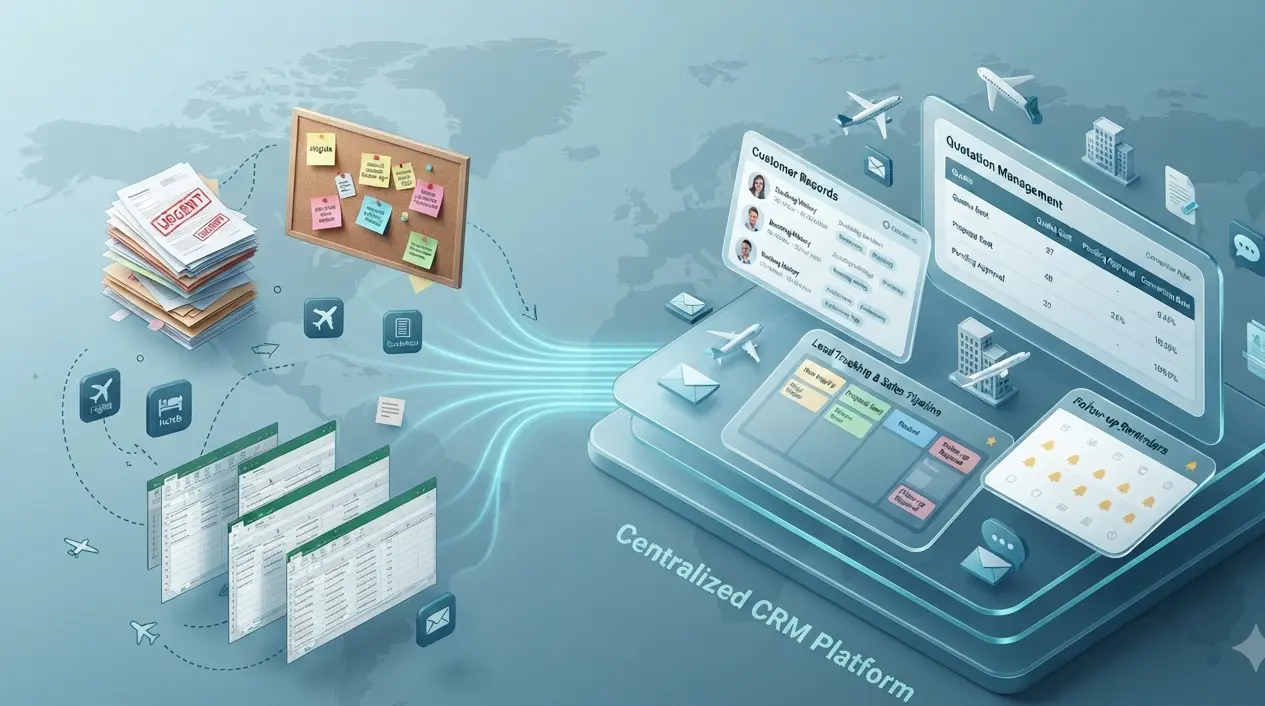
Fragmented operation
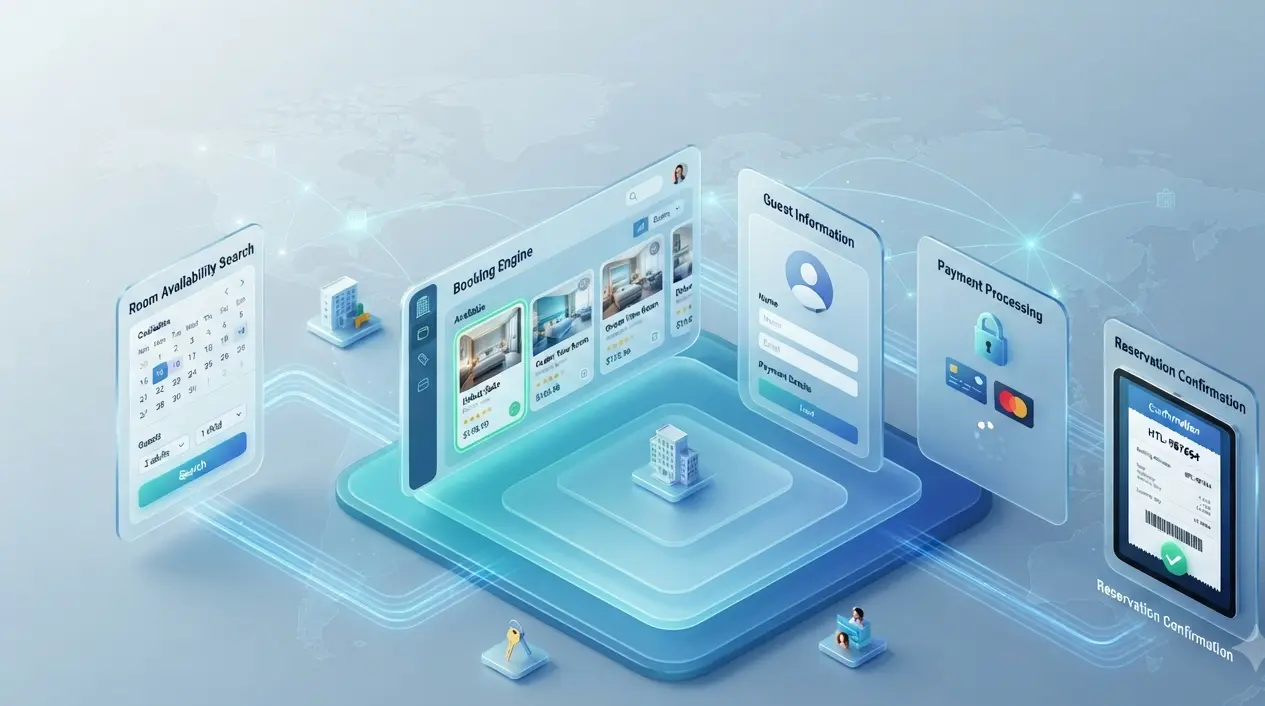
A customer writes asking for a package for eight people to a specific destination. The agent opens the email, looks up rates in a spreadsheet, checks availability with the hotel supplier by phone, builds the itinerary in Word, calculates the margin in another spreadsheet, generates the quote as a PDF, and sends it. If the customer asks to change dates, the process starts again. If they confirm, the booking has to be recorded in another document, the confirmation sent to the supplier, the payment recorded when it arrives, and the status updated manually.
Every step depends on one person. If that person isn’t there, the process stops.
Connected operation
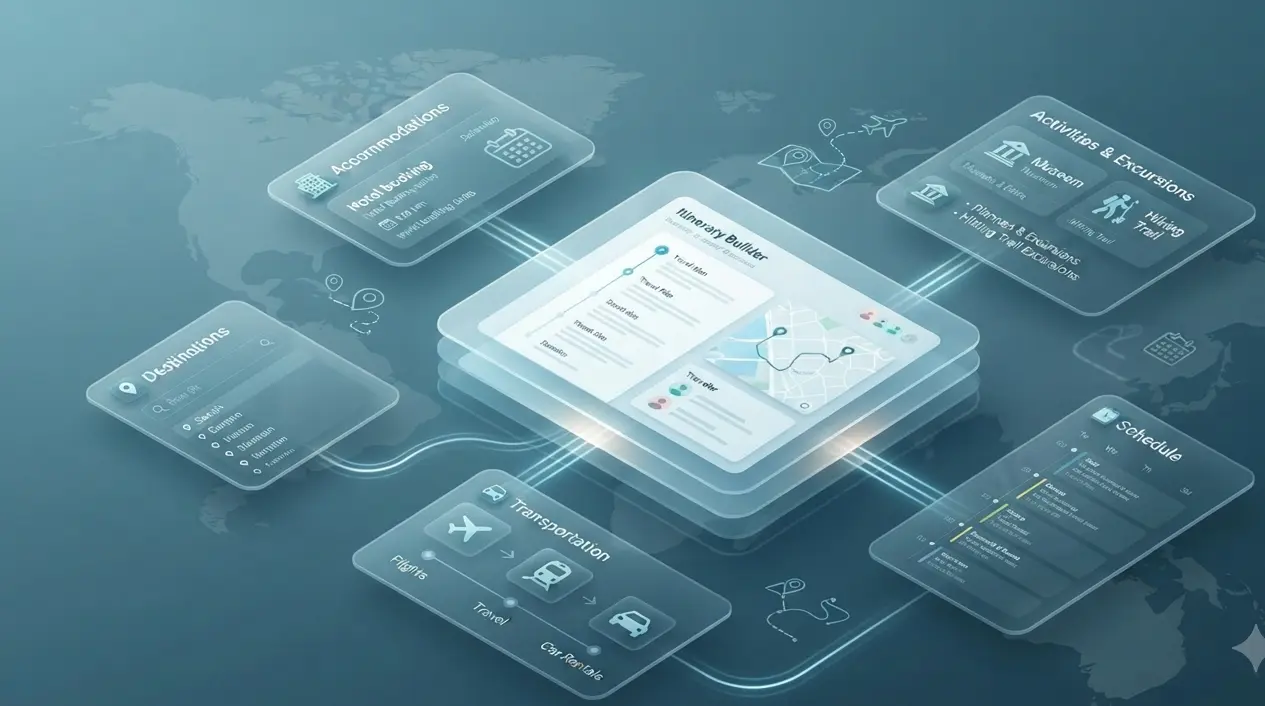
The agent logs into the system, selects services with preloaded rates and real-time availability, generates a visual itinerary from a template, calculates the margin automatically, and sends the quote from the same platform. If the customer confirms, the booking is created, the supplier is notified, and the financial transaction is recorded automatically. The status of every operation is visible to the whole team at any time.
The difference isn’t cosmetic. It’s structural. And it has a direct impact on response speed, conversion rate, and the agency’s ability to grow without relying on every process passing through the hands of one specific person.
To better understand how that difference plays out in day-to-day operations, you can read the differences between a generic system and a platform specialized in inbound travel.
Why a legacy program is more limiting in tourism than in other sectors
Replacing management software in a generic services company is a challenge. Doing it in a travel agency is a different challenge, because travel operations follow a logic most systems don’t understand.
Bookings aren’t simple transactions. They’re combinations of services with dates, seasonal rates, supplier-specific cancellation policies, different margins by customer type, pending confirmations, and payments in multiple currencies. A generic system can record those operations, but it can’t manage them with the logic tourism requires.
A legacy program for travel agencies that’s been in use for years often has an additional problem: it was designed for a way of operating that no longer exists. Tourism has changed. Customers expect faster responses, more visual proposals, and more personalized experiences. Operations need to connect with suppliers in real time, work in multiple currencies and languages, and generate accurate financial information without manual consolidation processes.
That gap between what the system can do and what the operation needs is exactly what defines an outdated system. It doesn’t matter whether the software is three years old or twenty. If it can’t support that operation, it’s a brake.
When to change your travel agency management system
There’s no single answer. But there’s one question that works as a diagnostic: does your system limit what your agency could do, or does it enable it?
If the honest answer is that the system imposes limits—on speed, scale, the ability to manage information, or the ability to connect with the supplier ecosystem—then the time to review it is now, before those limits become even more costly than they already are.
The change doesn’t have to be abrupt or traumatic. The agencies that transition best are the ones that plan ahead, with clarity about what they need and the right support during implementation. Tourism-specific platforms—like those that integrate the entire operation in a single environment—make it possible to transition in stages, without stopping operations while the team adopts the new system.
Digitize your agency before the outdated system decides for you
Recognizing that a system is no longer enough isn’t a management failure. It’s a sign that the agency grew, or that the market changed, or that customer expectations evolved. In any of those cases, the answer isn’t to demand more from the system than it can deliver. It’s to understand what kind of technology foundation the operation you want requires. That’s the real starting point of any well-executed digitalization process: not which tool to choose, but what operation you want to build. If you’re starting to think about that process, a good next step is to understand how to digitize an agency step by step with online software.