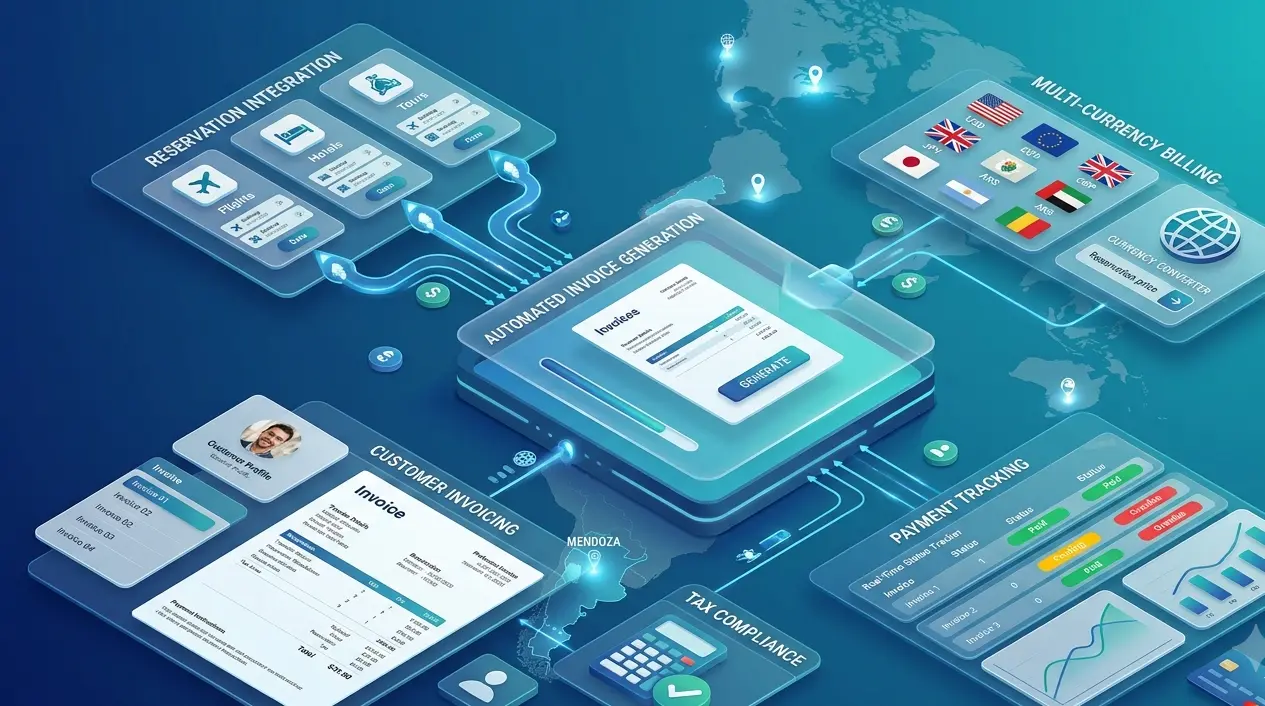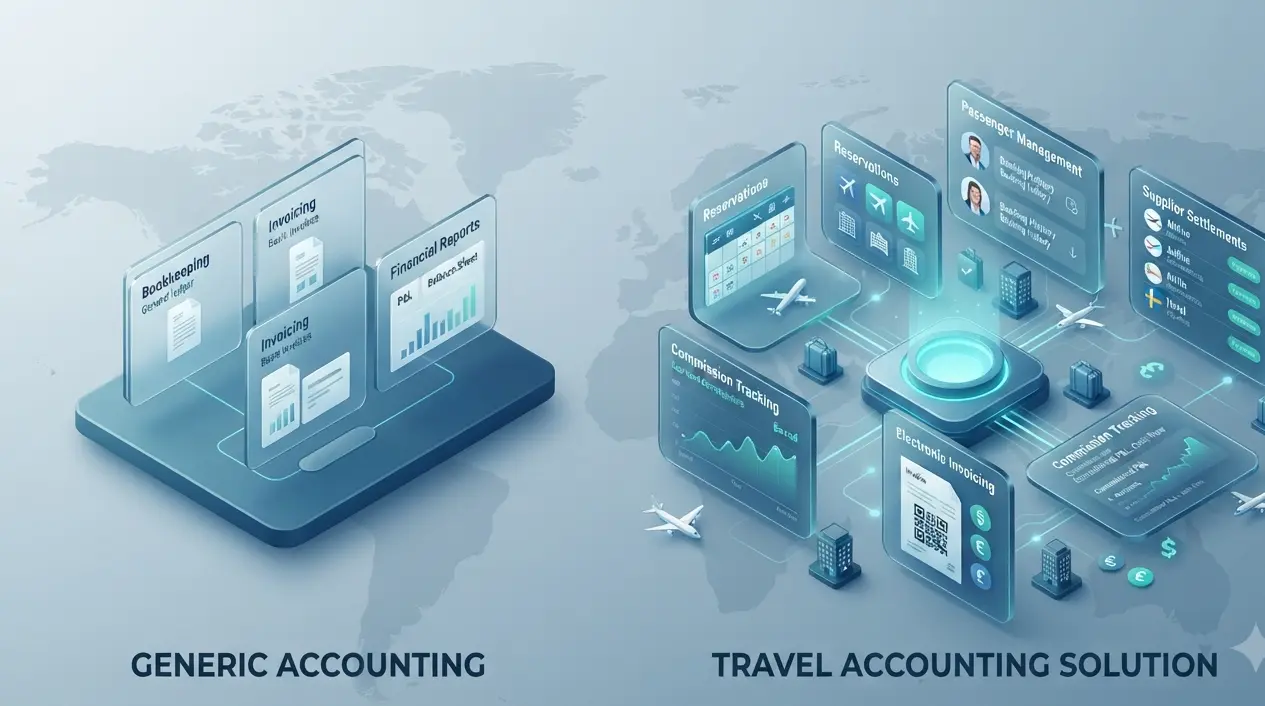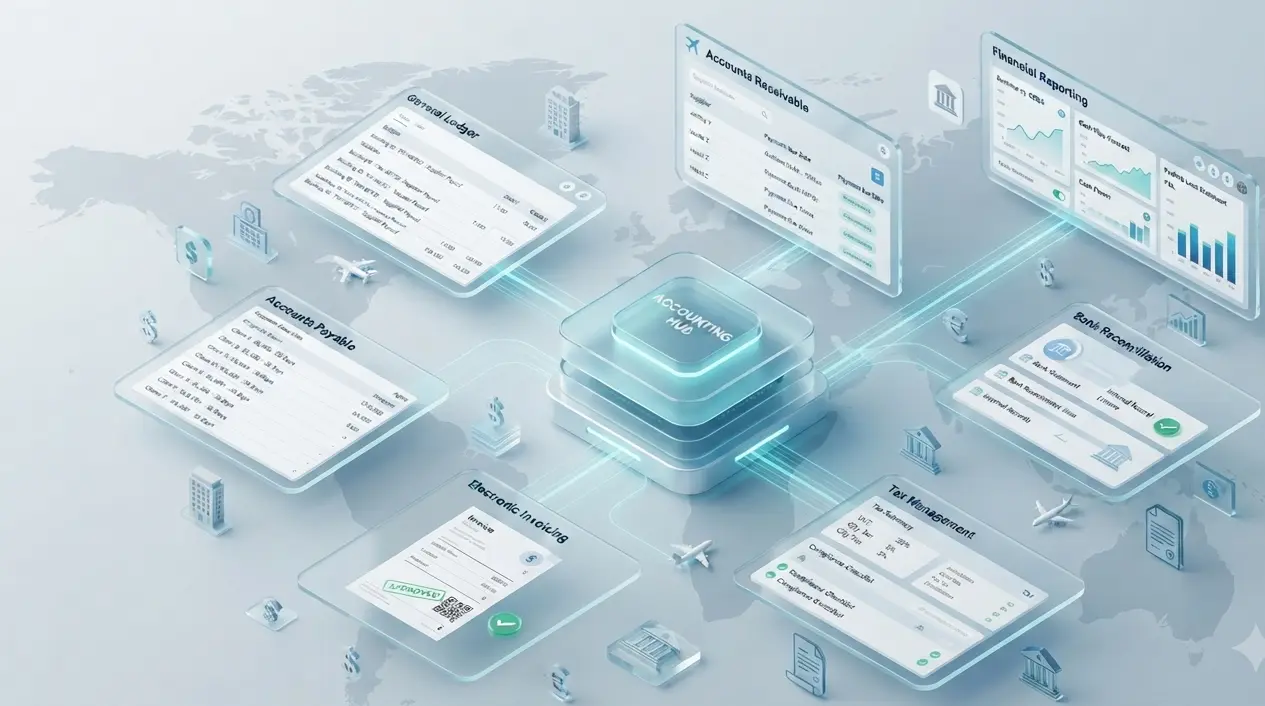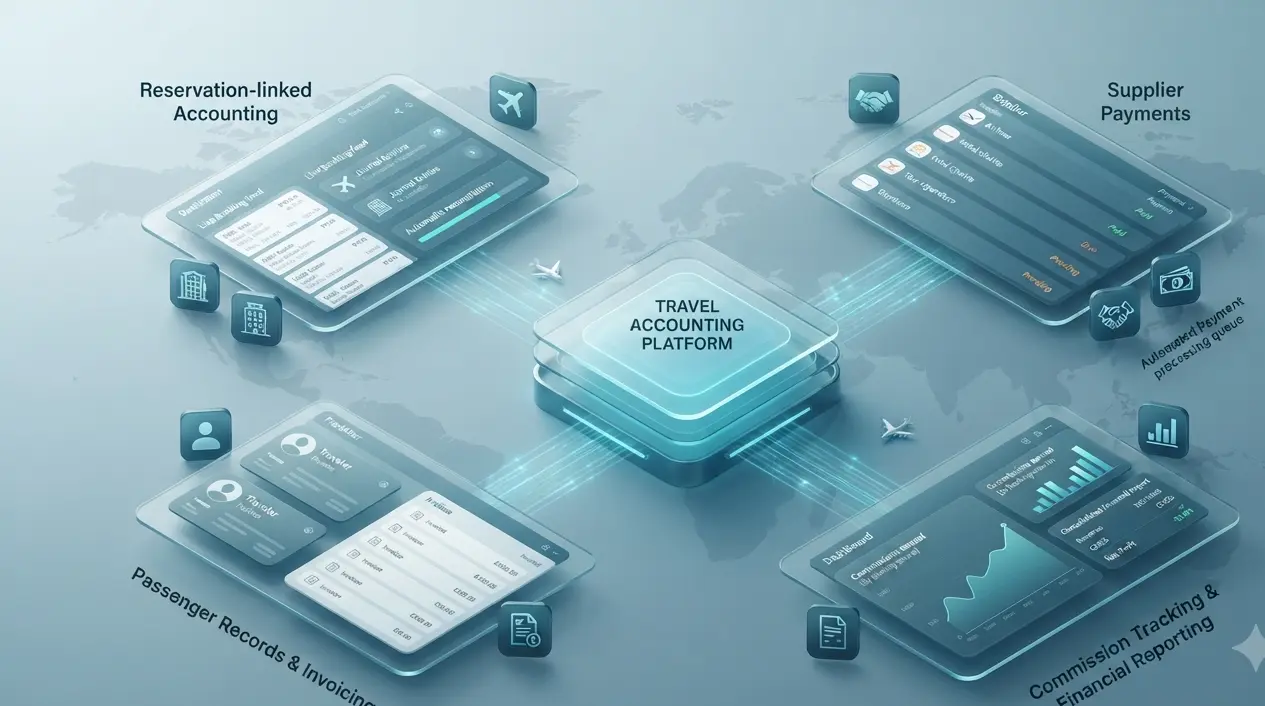

A spreadsheet, a commercial CRM, or a standard accounting system records a sale the same way regardless of what was sold: a customer, an amount, a date. That logic works well for most businesses. In a travel agency, however, the object being sold is rarely a single thing. Generic software can process the payment, but it cannot always represent what actually happened behind that payment: a package assembled with multiple providers, a ticket that depends on another service, and a date that moves for everyone at once if it moves for one.
What selling a tour package means for generic software
For a generic system, a sale is a single event: an income is recorded, associated with a customer, and the process ends there. A tour package does not behave this way. Selling a package means committing, in a single operation, services that come from different providers, with different currencies, and their own calendars. The flight may be confirmed in minutes. The hotel may take a day. The excursion may depend on a minimum passenger allotment that is not yet guaranteed.
Generic software does not distinguish between confirming the sale and confirming each component of that sale. It treats the package as if it were a single service, when in reality it is a collection of commitments with different levels of certainty. This difference determines whether the team can know, at any time, which part of the trip is resolved and which is still pending. Before evaluating what type of system solves this, it is worth understanding how this logic changes according to the type of agency, something developed in this analysis on software types according to the business model.
Why a tour is not just another line item in a generic tool
A tour almost never exists in isolation. It is usually tied to a minimum number of participants, a fixed schedule shared with the rest of the group, and a local provider who confirms the departure within their own timeframe. A generic tool can save the tour name and its price as just another data point, but it cannot automatically warn that the departure is no longer viable because the minimum allotment wasn’t met, or that a tour’s schedule conflicts with a transfer that the provider hasn’t confirmed yet.
A typical package may include, for example:
- A flight with its own fare and conditions.
- A hotel with a cancellation policy different from the flight’s.
- A transfer that depends on the flight’s arrival time.
- A tour with a minimum participant allotment and a fixed schedule.
- Travel insurance with validity tied to the itinerary dates.
Each of those components has its own lifecycle. Generic software was not built to track five different lifecycles within a single sale. Therefore, when something changes (a date, a provider, an allotment), the adjustment ends up being made outside the system, in an email or a manual note that no one else sees. This friction point is usually the first to appear when an agency begins to evaluate if its current booking system is still sufficient for the volume it handles.
How a generic system manages a combined service
A combined service—for example, a transfer that includes a meal, or an excursion that includes tickets and transport—poses an additional problem: the internal cost does not match the sales price to the customer, and both numbers must coexist without mixing. A generic system usually forces a simplification: it records the final price but loses the cost breakdown that originated it.
| Generic System | Combined travel service | |
| Sales unit | One line, one amount | Multiple components with their own cost and provider |
| Currency | One per transaction | Can vary by component |
| Cancellation | One general policy | A different policy per component |
| Margin | Calculated on the total | Calculated component by component |
Without this breakdown, calculating the real margin of a sale becomes a manual exercise. And a margin calculated manually is, sooner or later, calculated incorrectly. To understand what solving this implies in the day-to-day of an implementation, this guide on how to implement a booking system goes into operational detail.
What operations break when generic software doesn’t separate components
When a system does not separate the components of a sale, three daily operations start to fail before anyone notices. The first is reconciliation: if a customer’s payment covers the flight but not the excursion, and the system only sees “a payment,” someone has to manually reconstruct what was covered and what wasn’t. The second is partial modification: changing only the hotel in a package, without touching the rest, requires correcting a sale that the system treated as a single block. The third is settlement with providers: paying each provider what is owed, in the correct currency, after the trip has already taken place, requires reconstructing information that the system never stored separately.
These three situations do not happen every day, but when they do, the cost of resolving them falls on a person rather than the system.
Where the limits of a generic system appear in daily operations
The impact is not the same for all agency models. An outbound agency that builds custom packages feels the limit during quoting: recalculating an entire itinerary because a single date changed can take more time than it should if the system doesn’t understand that the components are interconnected. An inbound agency coordinating services at the destination feels it in operations: confirming guides, transport, and activities for a large group requires visibility of each component separately, not a generic total. A wholesaler designing their own product feels it in availability control: if the system doesn’t know how many units of each component are committed, the risk of selling something that no longer exists grows with every new package.
In all three cases, the cause is the same: the system was designed for simple transactions and the business produces composite transactions. The solution isn’t always to add more manual controls. At some point, those controls stop scaling.
Recognizing the limit before growth exposes it
Most agencies don’t discover this limit by reading about software. They discover it in the middle of a high season, when the volume of active packages exceeds what one person can reconstruct from memory. By then, the cost is no longer just time: it’s errors that reach the customer.
Understanding how a travel sale is composed—by provider, currency, date, and cancellation policy—is the first step to identifying what type of system can sustain it without depending on manual adjustments. Within the category of software designed to represent travel services as parameterized units, rather than loose lines, is Toursys, which connects hotel availability through bed banks instead of managing rooms directly.
The first diagnosis is not choosing a provider. It is mapping how many components coexist today in each sale and how many of them the current system actually distinguishes.