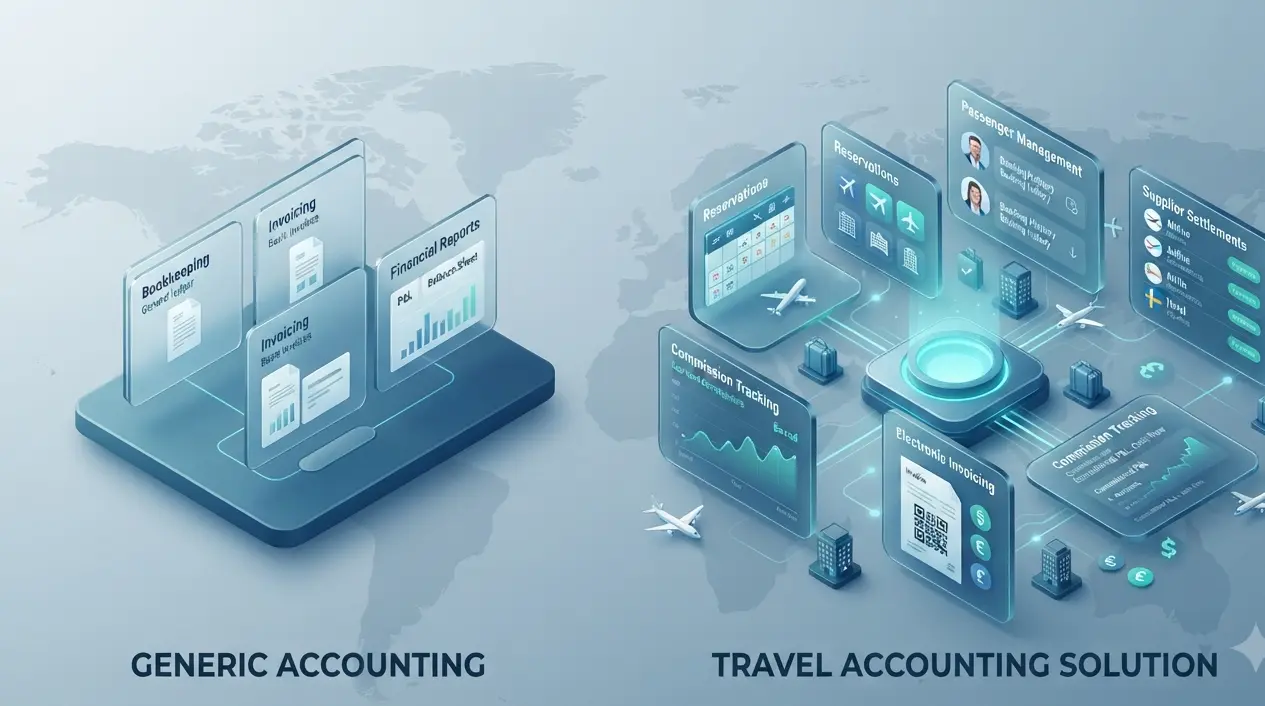

Billing software for travel agencies cannot operate with the same logic as a traditional retail business. This is the primary misconception that often leads an agency to make the wrong choice: they think they need a system that issues receipts, when in reality, they need one that understands how money is generated in this industry.
In a common retail business, the sale and the invoice occur almost simultaneously. In a travel agency, weeks or months can pass between these two moments. A client confirms a package in January for travel in July. They pay a deposit, then a second installment, and only at the end is the full invoice issued. Meanwhile, the agency also pays one or more suppliers on dates that do not coincide with client payments. A program designed for retail does not account for this discrepancy because it was not built to handle it.
This article reviews the features that make billing software truly effective for a travel agency, following the logic of how an invoice is actually generated in this sector.
Why Billing Software for Travel Agencies Doesn’t Work Like That of a Common Business
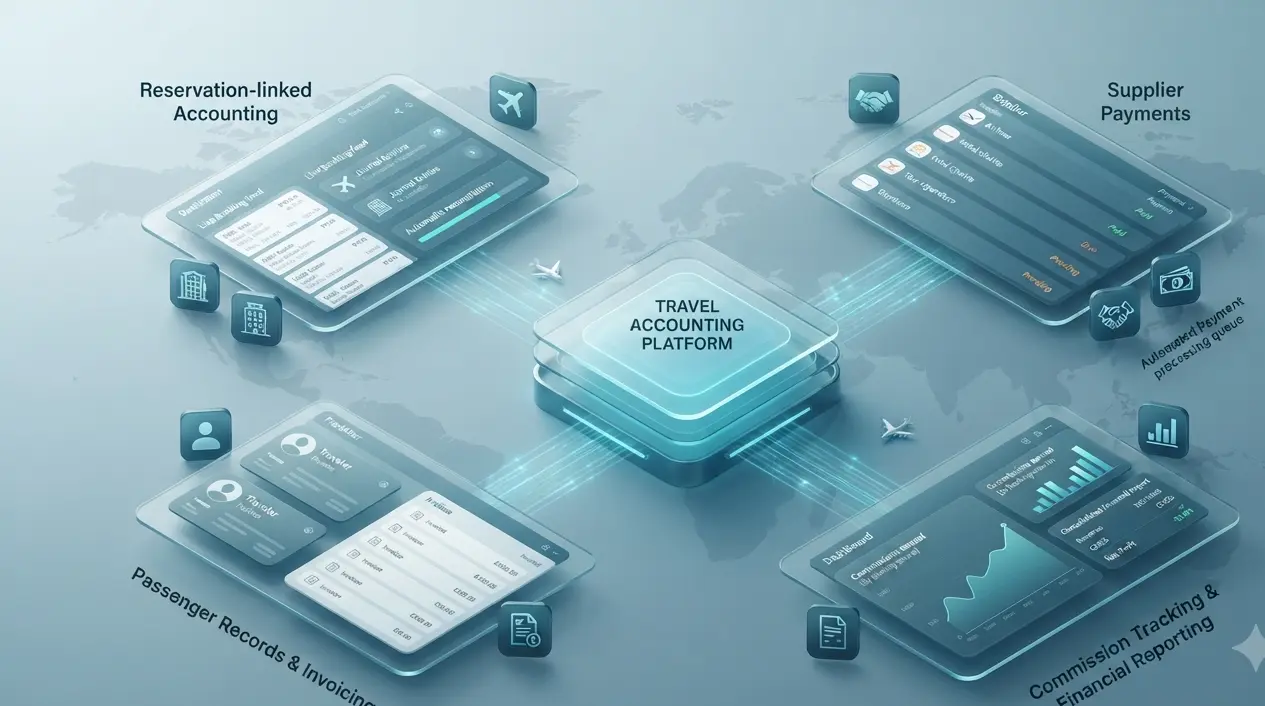
The root of the problem isn’t accounting; it’s operational. Generic software invoices based on a single sale: product, price, customer, done. Billing software designed for tourism must start from a different unit: the booking. Everything that happens afterward (partial payments, supplier payments, commissions, adjustments) stems from that booking and must be traceable back to it.
What happens when that connection doesn’t exist? The administrative team ends up manually reconstructing a history that the system should have recorded automatically. And this manual reconstruction is, in most cases, the real source of billing errors attributed to “the system.”
An accounting software that truly understands this tourism logic starts from this distinct premise in its design, not as a later adjustment.
What a Booking with Multiple Suppliers Demands from Billing Software
A package to Peru might include flights with one airline, accommodation with a local provider, transfers with another, and an excursion with a fourth. Each invoices differently, collects payments at different times, and in some cases applies a different commission on the same service.
If the billing software cannot disaggregate this information by supplier within the same booking, someone on the team ends up tracking these numbers in a parallel spreadsheet. And a parallel spreadsheet is, almost always, the first symptom that the main system has fallen short.
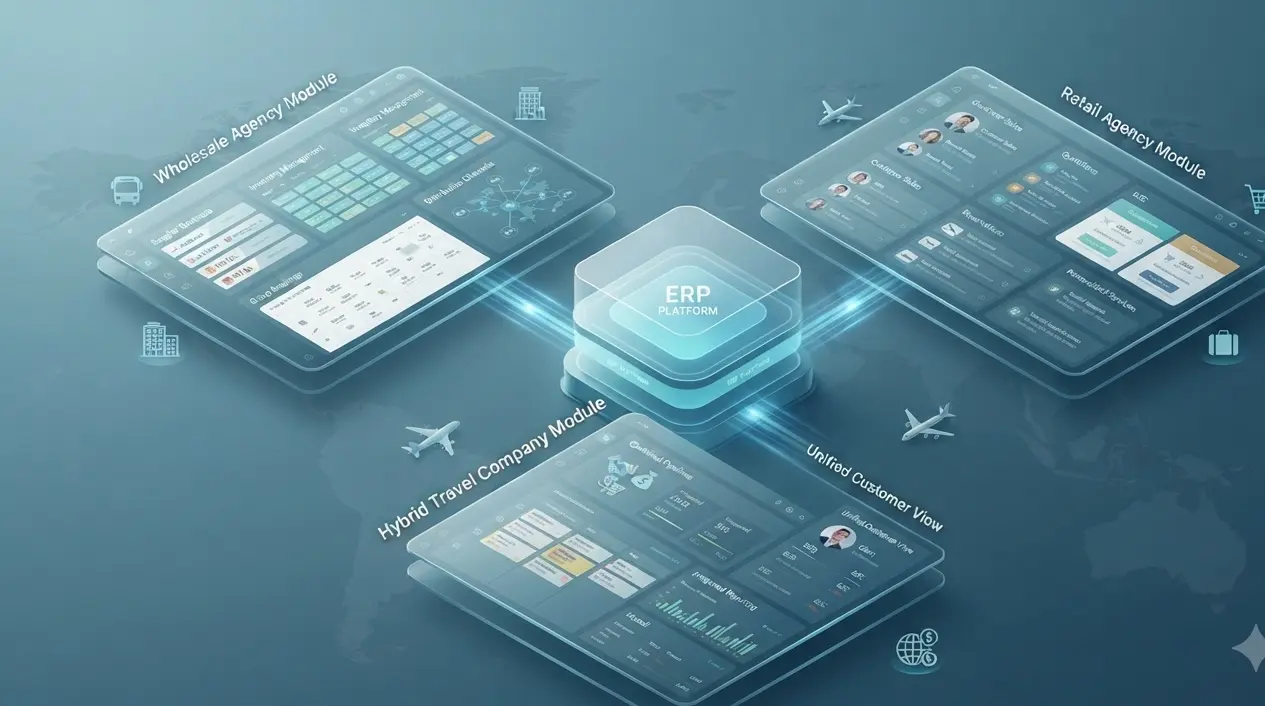
This becomes more evident in inbound agencies and wholesale operators, where a single sale can involve half a dozen different suppliers, each with their own payment scheme. The key feature here is not how many suppliers the system abstractly supports. It’s whether it can show, booking by booking, who collected what, how much is owed to each supplier, and how much of that has already been invoiced to the end customer. Without this supplier-specific traceability, the real margin of each sale remains hidden until someone manually calculates it at month-end.
This type of disaggregation is precisely what separates accounting software designed for travel agencies from a spreadsheet that merely sums columns without distinguishing their origin.
The Discrepancy Between Collections and Payments That Good Billing Software Must Resolve
Advance payments are a normal part of tourism operations. So are payments to suppliers made before the service is rendered. Billing software needs to distinguish, at all times, between what has already been collected, what has already been paid, and what does not yet have a confirmed service behind it.
Without this distinction, the team loses track of outstanding prepayments, over-invoices or under-invoices, and the cash flow ceases to reflect the agency’s reality. It’s not an accounting problem in the strict sense. It’s a visibility problem: the money is there, but no one knows precisely its status.
For those who have reached this stage and are evaluating specific providers, it is advisable to review the guide on how to choose billing software for travel agencies, which delves into the specific criteria for comparing options once this need has been identified.
Multi-currency: What Tourism Billing Software Needs to Handle
An outbound agency selling to Europe, an inbound agency collecting in dollars and paying local suppliers in their own currency, or a wholesaler working with clients in three different countries: all need more than just a field to select the currency.
They need the exchange rate to update automatically, not for someone to manually enter it every time they invoice. They need margins to be calculated in the correct currency for each operation, even when the client’s payment and the supplier’s payment occur in different currencies. And they need financial reports not to mix operations in pesos with operations in dollars without explicit clarification, because that mix is what makes a balance appear correct when it isn’t.
Poorly managed multi-currency creates a silent problem. The numbers appear to balance. The real margin of each booking, however, becomes distorted until someone reviews it operation by operation, something no agency with significant volume can sustain manually.
What It Means for Billing to Be Connected to Operations
All of the above converges at one point. Billing software connected to operations automatically generates financial movements when a sale is confirmed, without anyone having to copy data from one system to another. Each confirmed booking produces its own receipts and accounting records at the moment it occurs, not at the end of the month when someone sits down to reconstruct the information.
This connection is the difference between a system that supports daily operations and one that simply issues papers at the end of the process, when it’s already too late to correct what was lost along the way.
How Toursys Billing Software Responds to These Features
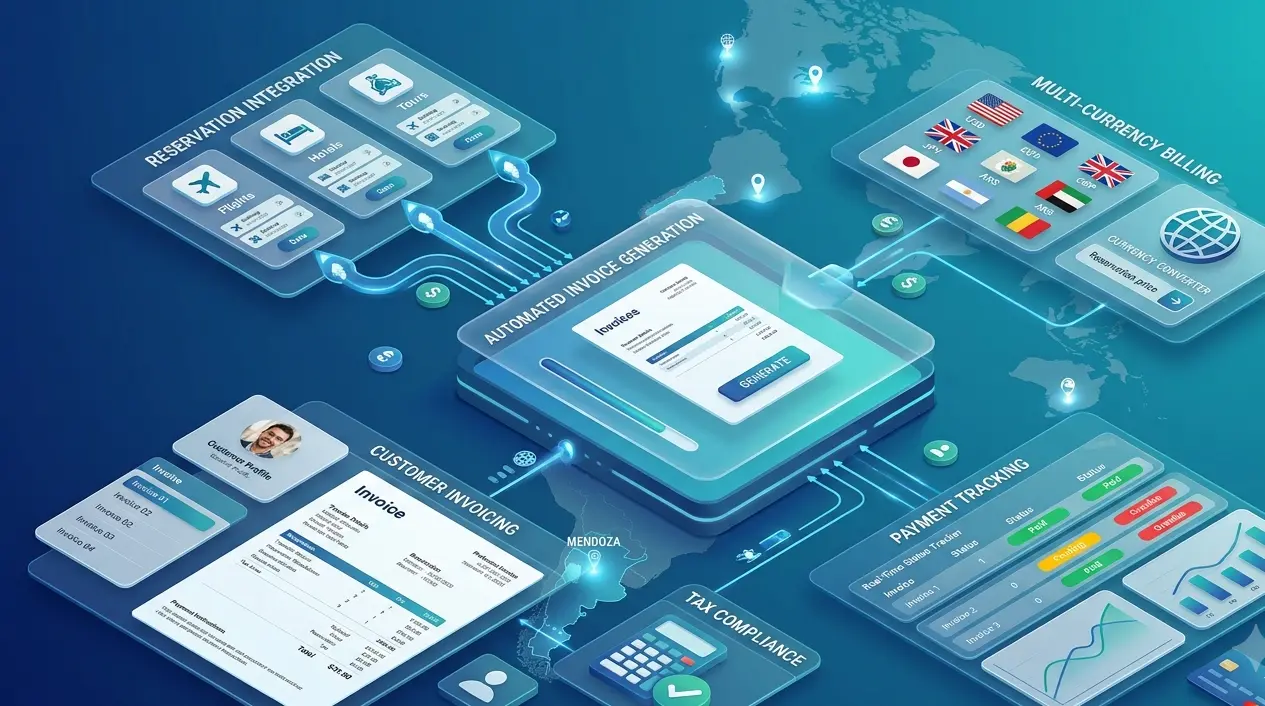
Among specialized platforms for travel agencies, Toursys builds its billing module on this very logic. It is integrated with bookings, accounts receivable and payable, and general accounting: when a sale is confirmed, financial movements are generated automatically, without duplicated manual entry.
The system also allows real-time viewing of pending collections, due supplier payments, and received prepayments that do not yet have a confirmed service behind them. It manages multi-currency billing with updated exchange rates, and in markets where electronic invoicing exists, it handles its issuance in an integrated manner with the rest of the system.
None of these features solve billing on their own. What truly changes an agency’s operation is that they all function interconnected, following the same rhythm with which services are sold and provided.