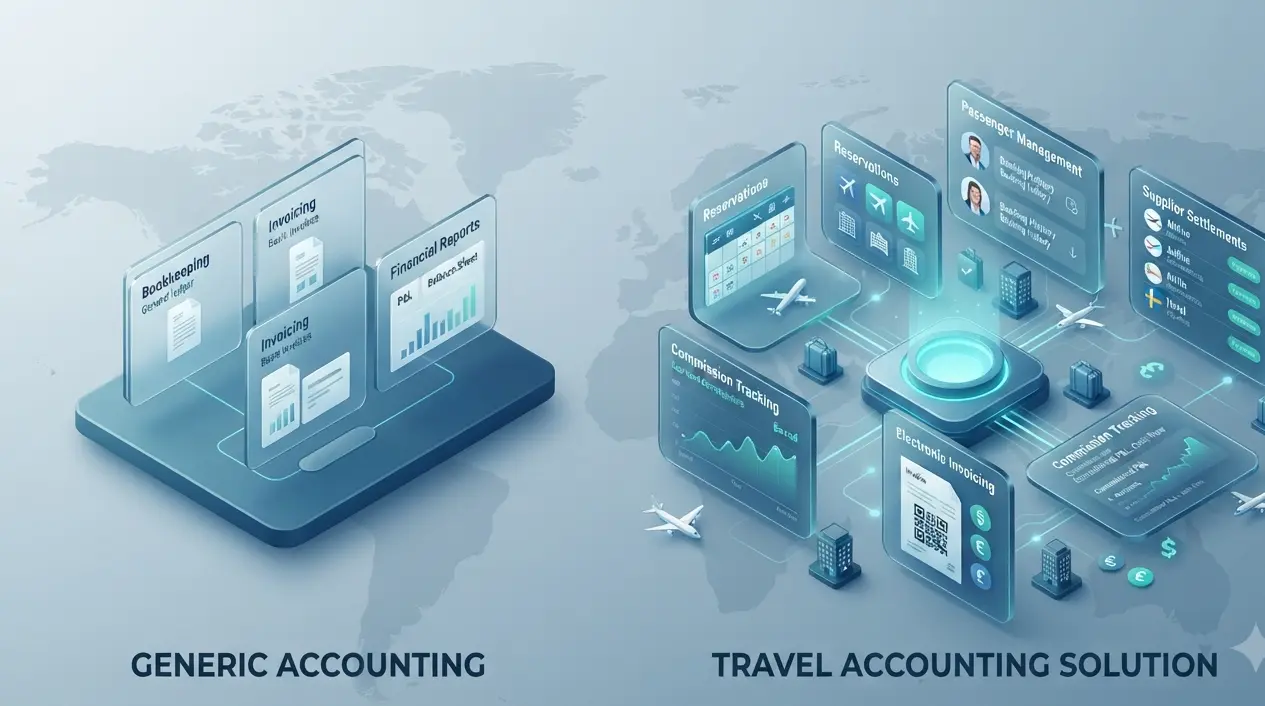
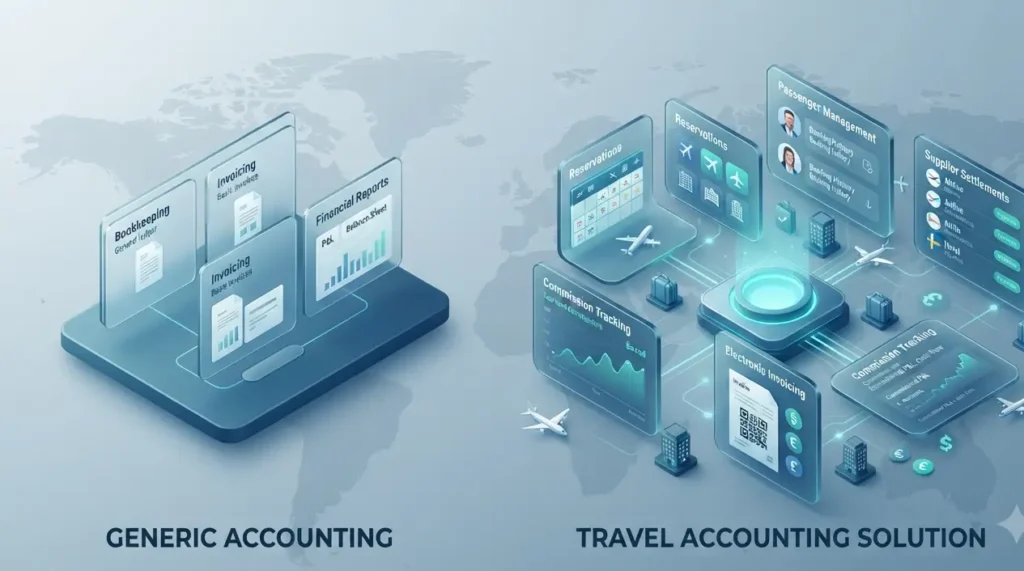
Comparing generic accounting software vs. travel accounting software can seem, at first glance, like a discussion of nuances: different modules, different pricing, different learning curves. But the problem starts earlier—in how each system understands what it means to sell something. A chart of accounts designed for a conventional business takes certain things for granted about when money comes in, who actually receives it, and when a sale is considered closed. A travel agency breaks those assumptions from the very first transaction.
Generic vs. travel accounting software: the question almost no agency asks in time
Most agencies don’t choose an accounting system based on the type of business they run. They choose the one they already know, the one their accountant uses, or the one that was most affordable when they started. For a while it works: the numbers add up, invoices go out, nobody asks questions. The problem shows up when volume grows and the system starts requiring manual adjustments to represent something as simple as a booking that was collected in January and delivered in August.
That mismatch is very similar to what we looked at when reviewing how to centralize an agency’s management without falling into operational chaos, and accounting is one of the areas where it shows the most. The system isn’t poorly designed—it was simply built for a different kind of operation, one where selling and collecting happen at the same time.
Selling a product and selling a trip don’t work the same way
Let’s think about two everyday businesses. One sells a physical product—an appliance store, for example. The customer walks in, chooses, pays, and leaves with the product. The sale closes in a single move: there’s revenue, a cost that’s already known, and immediate delivery. The other sells a trip. The agency collects today for a package the customer will use in three months, involving a hotel, an airline, and a transfer provider that still haven’t received their share of the payment.
In the first case, the money that comes in belongs to the store from the moment the sale is recorded. In the second, a large part of that money doesn’t yet belong to the agency. It’s an advance that must be passed on to suppliers who will deliver the service later. From an accounting standpoint, that’s not a minor detail: it’s the difference between a closed sale and a service promise being financed upfront.
| Aspect | Store selling a product | Agency selling a trip |
| Payment timing | Along with delivery | Weeks or months before the service |
| When the cost occurs | Known and paid before selling | Settled with suppliers after collecting from the customer |
| Who the collected money really belongs to | The store, from the very beginning | Partly the supplier’s, until it’s paid |
| Accounting close of the sale | Immediate | Completed once the trip has been delivered |
What generic accounting software assumes about any business
A generic accounting system almost always assumes that the sale and the payment happen at the same time, that there’s a single supplier per transaction, and that the cost of goods sold is already known when revenue is recorded. Those three assumptions work well for a store, a clinic, or a workshop. In an agency, none of the three holds true nearly as often.
When the system doesn’t account for that logic, the team ends up compensating outside of it. One spreadsheet to track supplier advances. Another to calculate the real commission on each sale. A manual reconciliation between what the customer paid and what’s still owed to a hotel or an airline. The system keeps working, but it stops being the business’s single source of truth.
That kind of rework is exactly what’s usually reviewed when evaluating what accounting software designed for travel agencies should offer, beyond basic income and expense tracking.
How the difference between generic and travel accounting software shows up in practice
The difference becomes visible in very specific moments: when a customer changes dates and you need to recalculate what portion of the payment is still an advance and what portion has already become a cost; when a booking involves three different suppliers, each with its own payment terms; when you need to know—without opening five files—how much the agency actually earned on a package after deducting commissions and prepayments.
A generic system can record each of those movements separately. What it doesn’t do naturally is connect them to each other, because it wasn’t built to read a travel booking as a financial unit with its own timelines.
The consequences of forcing product logic onto travel logic
Forcing that logic has a cost that doesn’t always show up in a report. It shows up in a month-end close that takes longer than expected. In a commission that was calculated wrong because nobody matched the advance with the final supplier payment. In the feeling—more and more frequent as the operation grows—that the numbers are there, but nobody fully trusts them without double-checking.
Treat accounting as part of the operation, not a separate admin task
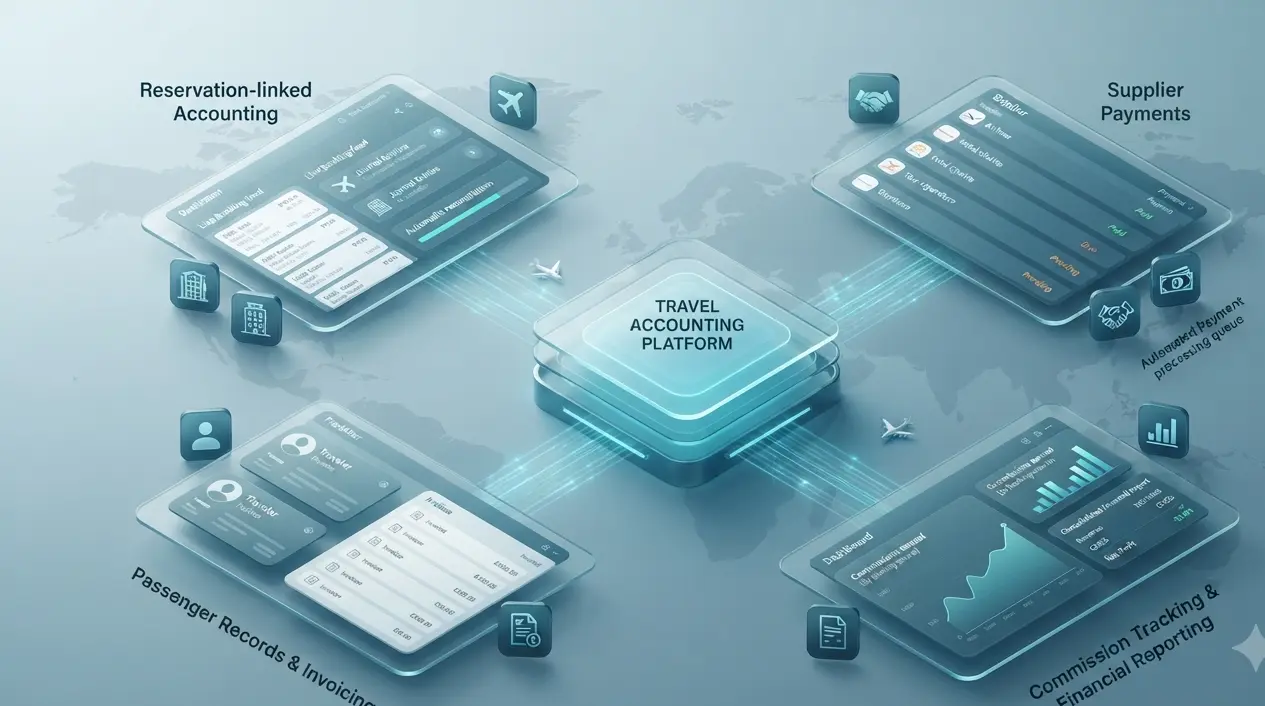
The real question isn’t which accounting system is better in the abstract, but which business logic it needs to reflect. Platforms like Toursys, built from the ground up with travel operations in mind, bake that distinction into the system design—not as a patch added later. That allows each booking to translate into coherent financial movements, without the team having to manually reconstruct what the system should solve on its own.
Understanding this difference before comparing specific features helps you make a more honest assessment of what your agency actually needs.