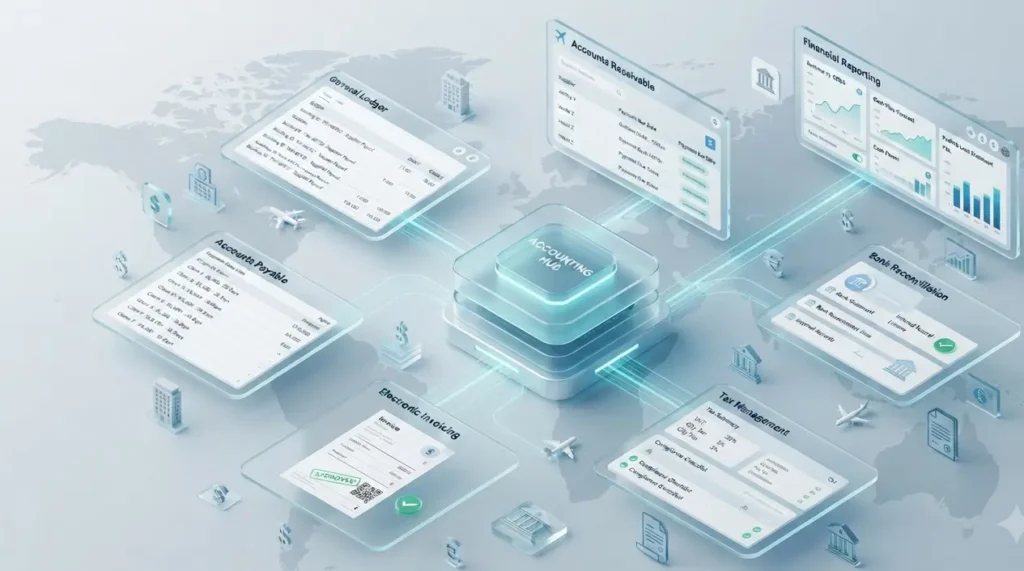
“Accounting software” sounds like a single piece, but it actually comprises several functions that are rarely considered separately: who owes the agency, whom the agency owes, which bank reflects each transaction, and which document formalizes each sale. When an agency starts mapping the key features of tourism accounting software, it usually looks for a fixed list of characteristics. It’s more useful to ask what each function solves individually and what breaks when that function is isolated from the rest of the operation. Many agencies arrive at this question after dragging along for years with tools that no longer support business growth, without noticing it in time.
Accounts Receivable: The Function that Organizes Collections in Tourism Operations
A reservation is rarely paid for all at once. There’s an advance payment, a balance, sometimes an extension agreed with the client. The accounts receivable function exists to answer a simple question: who owes what and since when. Without it, that answer is scattered across WhatsApp, an Excel sheet, and the memory of the person who sold the package.
When accounts receivable is connected to the reservation, each pending payment is automatically associated with the client, the service, and the due date, instead of relying on someone remembering or manually looking it up. This doesn’t eliminate the work of collecting. It eliminates the work of reconstructing who needs to collect what.
Accounts Payable and Commissions: The Function that Organizes Payments to Suppliers
The other side of the equation is less visible to the client, but just as critical for the agency. Each confirmed reservation almost always implies a future payment to a supplier: a hotel, a carrier, a local guide. Added to this are internal or third-party commissions that are rarely calculated the same way from one service to another.
The accounts payable function organizes these commitments by supplier and due date, allowing you to anticipate how much cash will go out and when. This type of automation is one of the points where an integrated system begins to differentiate itself from a spreadsheet, something that can be reviewed in more detail in how a system connects operations with accounting. Calculating a commission without that connection means reviewing the reservation, the client’s payment, and the supplier agreement separately, every time it’s needed.
Banks: The Piece that Reconciles Inflows with Outflows
Accounts receivable and accounts payable describe commitments. Banks describe what actually happened: what was collected, what was paid, and in which account. Bank reconciliation is the point where both lines intersect with the reality of money movement.
When this function is connected to the rest of the system, each deposit or transfer can be directly linked to the corresponding collection or payment, instead of being manually searched in a bank statement. Agencies that still reconcile manually often spend up to 15 hours per week on this verification process, according to industry estimates for 2026. That time directly competes with the hours the team could dedicate to sales or operations.
Keeping this criterion in mind, beyond the system’s price, is what distinguishes a well-thought-out decision from a rushed one, a point worth reviewing calmly when it comes to choosing accounting software for the agency.
Electronic Invoicing: The Function that Connects Sales, Collections, and Tax Obligations
Invoicing is usually the most visible part of the accounting process because it’s what the client receives. But its function goes beyond issuing a receipt: it’s the point where sales, collections, and tax obligations should align seamlessly.
In countries with electronic invoicing, this alignment is not optional. The receipt must accurately reflect what was sold and what was collected, at the correct time. When invoicing is disconnected from accounts receivable, a discrepancy between what was sold and what was invoiced can appear, which is rarely detected in time if no one manually cross-references both records.
What Accounting Software Features Break When They Work in Isolation
Each previous function solves something specific within the operation. The problem usually arises at the connection point between them, rather than from the absence of any particular one.
| Function | What Breaks Manually Without It | What Changes When Connected |
| Accounts receivable | No one knows for sure who owes what without checking multiple sources | Each pending balance is linked to the reservation and date |
| Accounts Payable | Commissions are recalculated manually, service by service | Commitments to suppliers are organized by due date |
| Banks | Reconciliation consumes hours of cross-verification | Each bank transaction is linked to the actual collection or payment |
| Invoicing | Discrepancies can appear between what was sold and what was invoiced | Sales, collections, and receipts are aligned |
Tourism Accounting Software: Organize Before You Grow
None of these functions replace the administrative team’s judgment or an accountant’s work. What changes is where the information originates: function by function, manually reviewed each time, or connected from the moment a reservation is confirmed.
There are tourism management platforms that integrate these functions from the system’s design, such as Toursys, designed so that accounts receivable, accounts payable, banks, and invoicing share a single data source instead of relying on separate uploads.
Organizing this part of the operation usually progresses with the agency’s growth. When all four functions share the same data source, that growth is sustained with less friction.