Free programs for travel agencies are not an inferior category. They are a stage. The problem is not using them; it’s failing to recognize when your operations have outgrown them.
This distinction matters because the difference between a free and a paid program is not measured by price. It is measured by the type of operation each can support, which processes remain within the system, and which end up residing in emails, spreadsheets, or the memory of the people managing them.
The differences between free and paid programs for travel agencies are not technical; they are operational. Understanding them from this perspective allows you to know when a change makes sense—and when it does not yet.
If your agency is still identifying how far its current operational limits have been reached, it may be useful to start with the signs that indicate your agency needs a management system.
What Free Programs Solve for a Travel Agency and Where Their Limits Appear
A free program fulfills a real and legitimate function. For an agency that is starting, reorganizing its operations, or wanting to professionalize its commercial presentation without an initial investment, it offers a concrete starting point.
What it solves well: organizing basic client and booking information, generating documents with a better presentation than manual ones, managing a low volume of operations without the need for complex processes.
What starts to fail is not the tool itself; it’s the gap between what the agency needs and what the program can support. This gap appears at specific moments.
When a quote requires manual recalculation of prices because the system does not have updated supplier rates. When two agents work on different versions of the same booking because there is no shared real-time environment. When monthly accounting requires reconstructing operations one by one because there is no integration between sales and administration.
None of these problems are dramatic the first time they appear. They become structural when they recur in every operation.
The Structural Differences Between a Free and a Paid Program for Agency Management
The following table organizes the differences not by price but by actual operational capacity. The goal is not to compare tools; it is to identify what type of operation corresponds to each model.
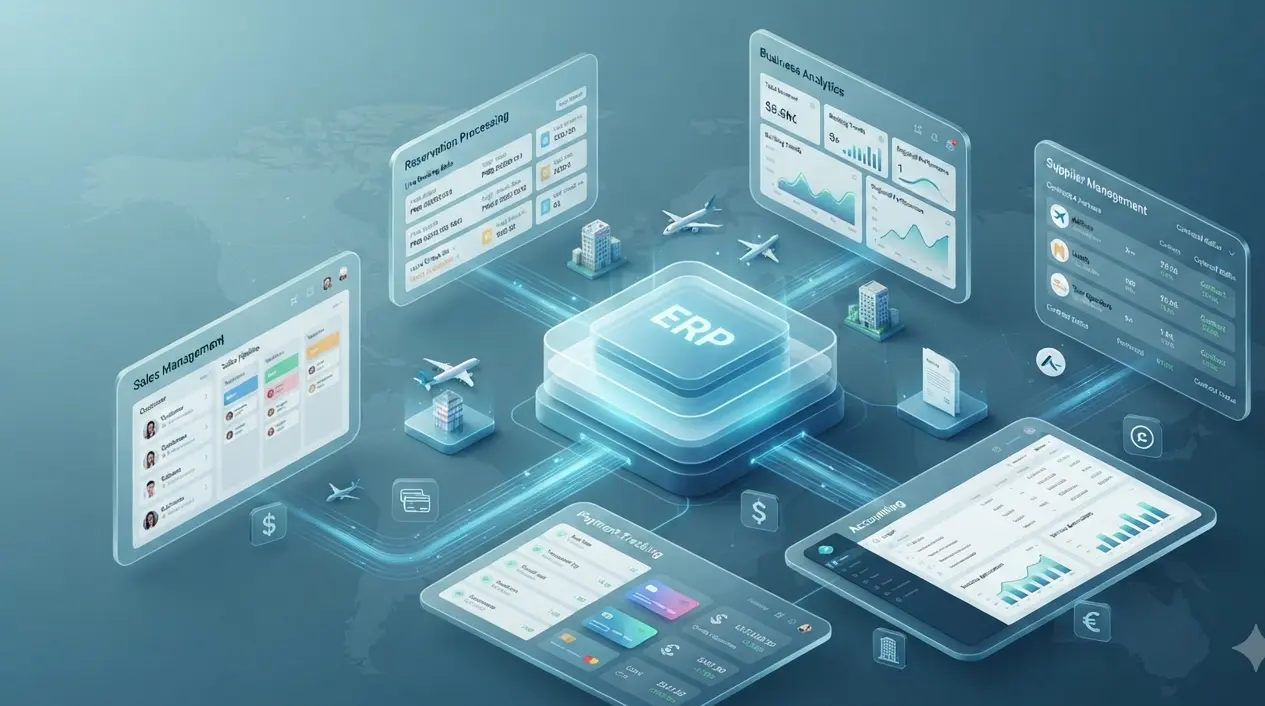
| Dimension | Free Program | Specialized Paid Program |
| Centralization | Partial information — clients or bookings, rarely both integrated | Complete operation in a single environment: clients, bookings, suppliers, finances |
| Rate Updates | Manual entry. Risk of quoting outdated prices | Real-time connection with suppliers. Updated rates without intervention |
| Financial Control | Basic record-keeping. No integration between bookings and accounting | Each booking generates automatic movements in accounts receivable and payable |
| Multi-user | Limited or with restrictions on simultaneous access | Differentiated profiles by area with simultaneous, conflict-free access |
| Scalability | Works well up to a certain volume. No additional modules | Modular architecture: capabilities are added without changing platforms |
| Support | Documentation or forums. No implementation support | Human support included, live training, post-implementation assistance |
| Multi-language / Multi-currency | Absent or very limited | Native. Essential for receptive agencies and international operations |
| Automation | Recurring manual tasks: follow-ups, reminders, confirmations | Automated workflows: confirmations, alerts, statements, reports |
The right-hand column does not describe luxuries. It describes the capabilities an agency needs when its volume, team, or market exceed what a free tool can frictionlessly support.
What the Use of a Free Program Reveals About an Agency’s Operational Stage
An agency using a free program says nothing about its size or ambition. It says something about its current stage.
An agency that is starting, restructuring processes, or operating with a controlled volume can function perfectly well with free tools for months. There is nothing wrong with this model as long as the actual operation fits within what the system can manage.
The problem arises when the agency continues to use free tools after its operations have outgrown them. This mismatch has a cost that is not always accounted for: time the team invests in processes that the system should automate, errors generated by fragmented information, and growth opportunities missed because the operational structure cannot support them.
A free program used beyond its suitable stage is not a saving; it is an opportunity cost that grows with each passing month.
The following flowchart shows how the relationship between the agency’s stage and the appropriate tool evolves at each step:
STAGE 1: New or Restructuring Agency
Low volume · Small team · Simple processes
→ Free program: sufficient for organization and professionalization
↓
STAGE 2 — Initial Growth
Medium volume · More agents · First operational frictions
→ Free program: starts to show limits in coordination and control
↓
STAGE 3 — Consolidated Operation
High volume · Distributed team · Multiple suppliers · Financial control needed
→ Specialized paid program: operational necessity, not a luxury
↓
STAGE 4 — Scale and Expansion
New markets · Multi-language · Automation · External integrations
→ Paid program with modular architecture: the platform grows with the agency
The timing of the change is not defined by the system’s price. It is defined by the gap between what the operation needs and what the current tool can provide.
When Investing in a Paid Program Makes Sense for a Travel Agency
The question of when to invest in a paid program for your agency does not have a universal answer. It has indicators.
It is not a matter of size. There are small agencies with complex operations that need a professional system from early stages. And there are larger agencies that can still operate with basic tools if their business model is simple and their volume is controlled.
The signs that indicate the time for change has come are operational, not financial. They appear when the team spends more time maintaining updated information than working with it. When pricing or availability errors become recurrent. When accounting requires manual reconciliation work at the close of each period. When onboarding a new agent involves weeks of informal training because processes are not recorded in any system.
Each of these signs describes the same problem from a different angle: the operation has grown faster than the tool supporting it.
To identify more precisely where your agency stands, the article on when to stop using free software and switch to professional software details each of these signs.
What Differentiates a Generic Paid Program from One Specialized in Tourism
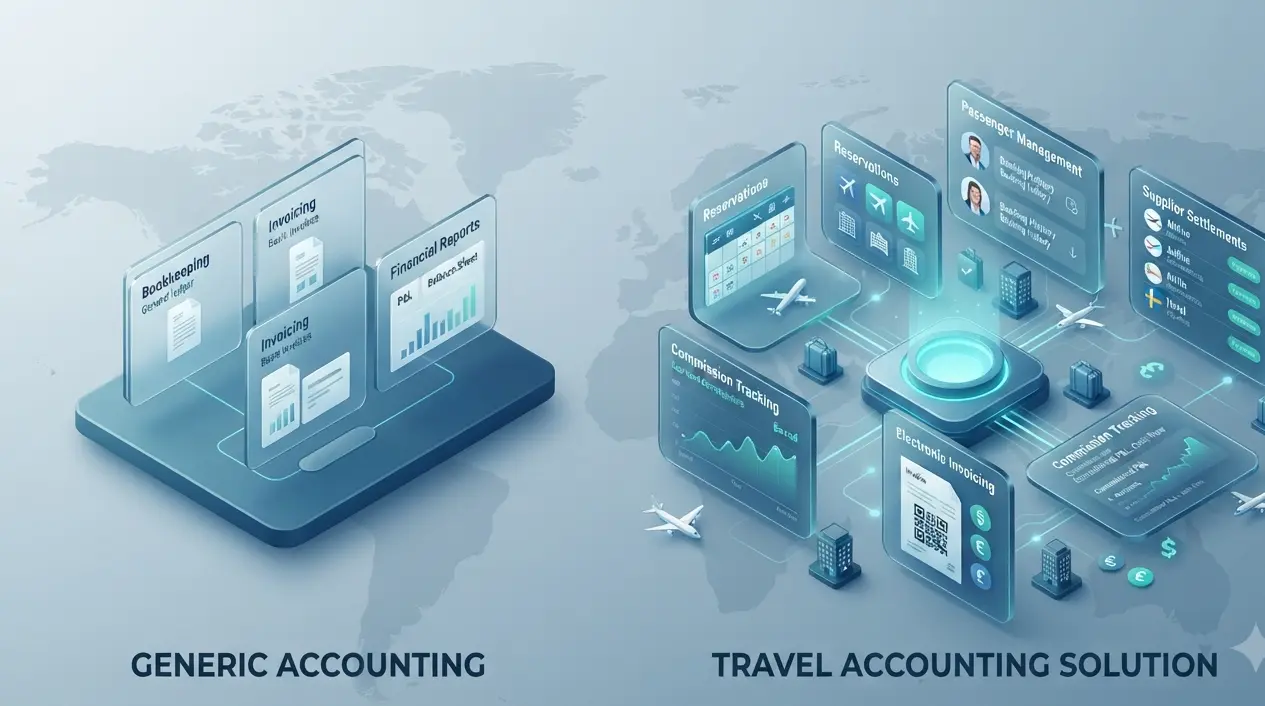
Not all paid programs solve the same problems for a travel agency. There is a structural difference between a generic management system adapted to tourism and one designed from the operational logic of the sector.
A generic system can manage clients, issue invoices, and record payments. But it does not understand the difference between a confirmed booking and a prepayment to a supplier, it lacks allotment logic or seasonal rates, it doesn’t know how to connect a quote with a DMC’s destination operation.
A tourism-specialized program is not a more expensive version of the same thing; it is a tool built to solve problems that a generic system cannot anticipate.
This difference translates into shorter implementation time, less need for manual adaptations, and a faster adoption curve for the team. Platforms like those designed specifically for outbound, inbound agencies, and operators—with included human support and an architecture that integrates sales, operations, and accounting from the ground up—represent this category. The travel agency management program you adopt should be able to demonstrate this during implementation.
The Right Time to Understand the Difference Between a Free and a Paid Program
The differences between free and paid programs for travel agencies are not well understood by looking at feature lists. They are understood by looking at the agency’s actual operation: which processes are within the system, which live outside, and what cost that gap incurs in terms of time, errors, and growth capacity.
From this diagnosis, the decision about which type of tool corresponds to the agency’s current stage becomes clearer. And the conversation about when to invest in a paid program stops being a question about budget and becomes a question about what kind of operation you want to build.