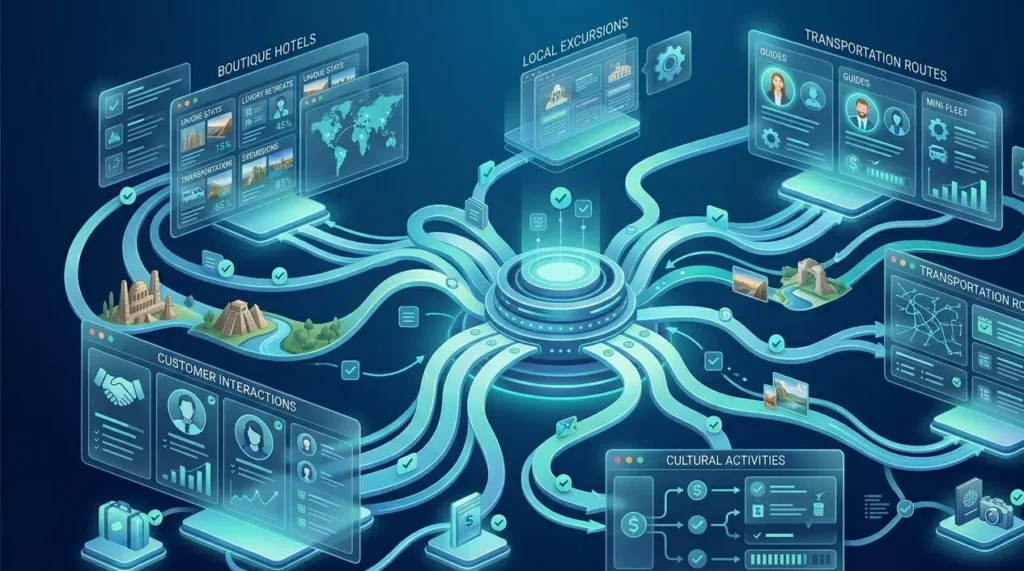
The features of a good platform for inbound tour operators are not the same as those of a generic tourism management system. Many platforms work well for outbound agencies, wholesalers, or online travel agencies. However, inbound operations have a distinct operational logic — and this difference directly impacts what the accompanying platform must offer.
A DMC does not sell experiences to the end traveler. It sells services to outbound agencies and tour operators who trust that everything will be coordinated when the passenger arrives at the destination. This responsibility involves managing local suppliers with variable conditions, services customized for each operation, multiple currencies and languages, and operational coordination that must function precisely even when last-minute changes occur.
A platform not designed for this logic is not an incomplete tool; it is a tool for a different problem. Understanding what characteristics make a platform good for inbound tour operators begins by understanding what makes their operations different.
If your DMC or inbound travel agency is in the process of understanding how a specialized platform works before thinking about specific requirements, it may be helpful to first review what an inbound tourism platform does and how it can help your business grow.
The Core Feature of an Inbound Tour Operator Platform: Adaptability to Personalized Services
Inbound tourism does not work with fixed catalogs. It works with combinations.
A European tour operator requests a twelve-day itinerary for a group of twenty people with a French-speaking guide, private transfers, specific dietary preferences, and an optional excursion that depends on the availability of a local supplier. None of these elements are standard. All are variables that the inbound operator must be able to parameterize, quote, and coordinate from the same system.
A platform that does not support this variability forces the team to work outside the system to resolve what doesn’t fit. And when that happens, the operation loses traceability: changes are not recorded, confirmations get lost in emails, and the documentation that reaches the guide may not reflect what was actually confirmed.
Adaptability to personalized services in an inbound tour operator platform is not a decorative feature. It is the operational condition that allows each booking to be unique without generating administrative chaos.
This implies being able to parameterize services by season, group type, age, and specific commercial conditions for each client. It means that a modification to a service is automatically reflected in all related documents — quote, itinerary, voucher, supplier order — without the team having to update each one separately.
What Local Supplier Management Reveals About the Maturity of an Inbound Platform
The network of local suppliers is the heart of any inbound operator. Hotels, guides, transporters, restaurants, activity operators: each has its own rates, conditions, availabilities, and confirmation methods.
Managing this network without a centralized platform creates a problem that grows with volume: each new supplier adds a layer of complexity that the team absorbs with more emails, more files, and more manual coordination.
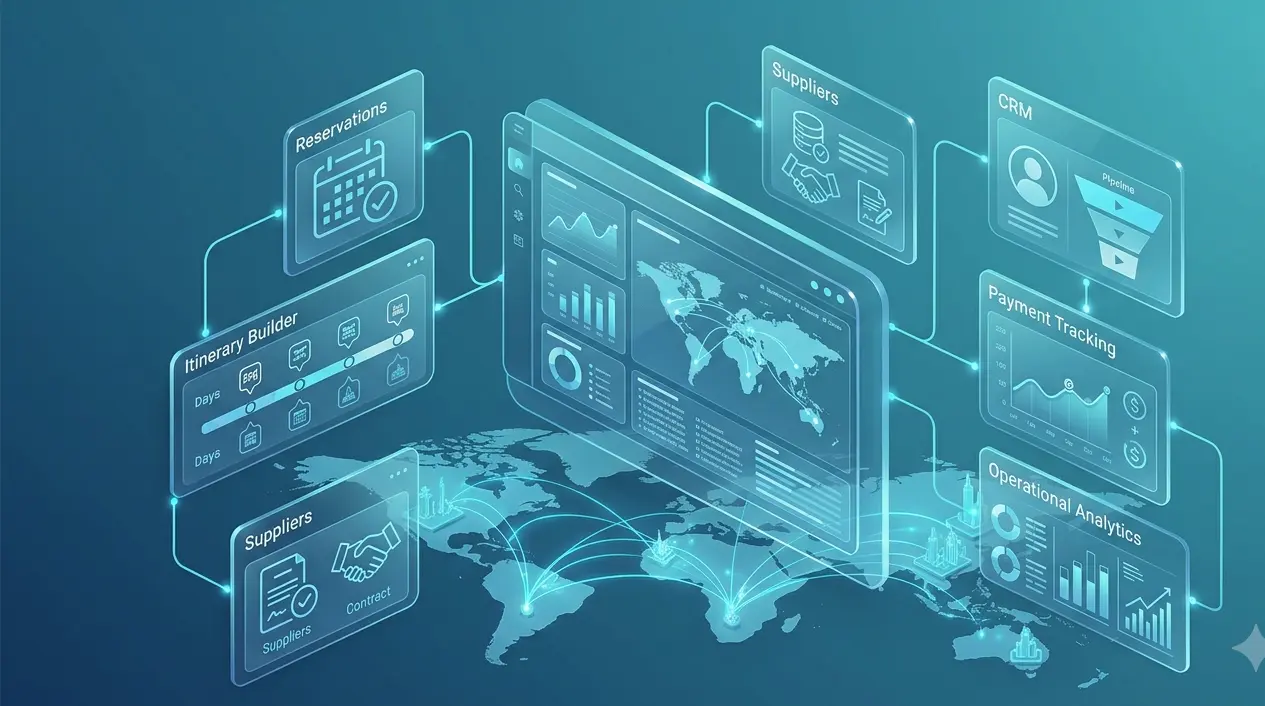
A good platform for inbound tour operators does not just record suppliers; it connects supplier information with each active operation in real time.
This means that when a supplier updates their rate or reports a change in availability, this information directly impacts the quotes and bookings that depend on that service. It means that allotments — the quotas committed with each supplier — are visible from the system without needing separate verification. And it means that the history of each commercial relationship is accessible to any team member, not just the one who usually manages it.
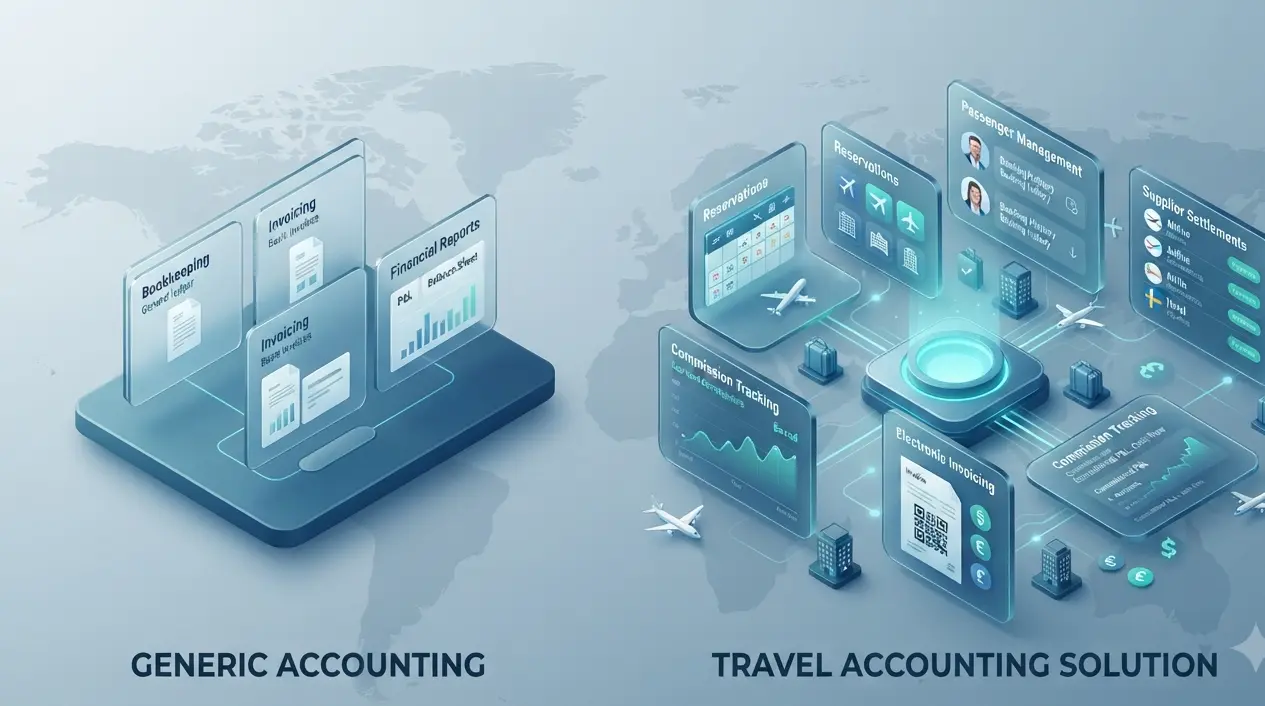
The following table shows how this management performs in a system well-designed for inbound operators versus a generic one:
| Dimension | Generic System | Specialized Inbound Platform |
| Supplier Registration | Basic contact details | Complete profile: seasonal rates, conditions, history |
| Rate Updates | Manual, via file or email | Dynamic and parameterizable from the system, with automatic impact on active operations |
| Availability Control | External verification outside the system | Visible in real time from the platform |
| Service Confirmation | Via email, without traceability | From the platform, with booking record |
| Supplier Access | No dedicated access | B2B Portal: supplier uploads products, rates, and confirms bookings |
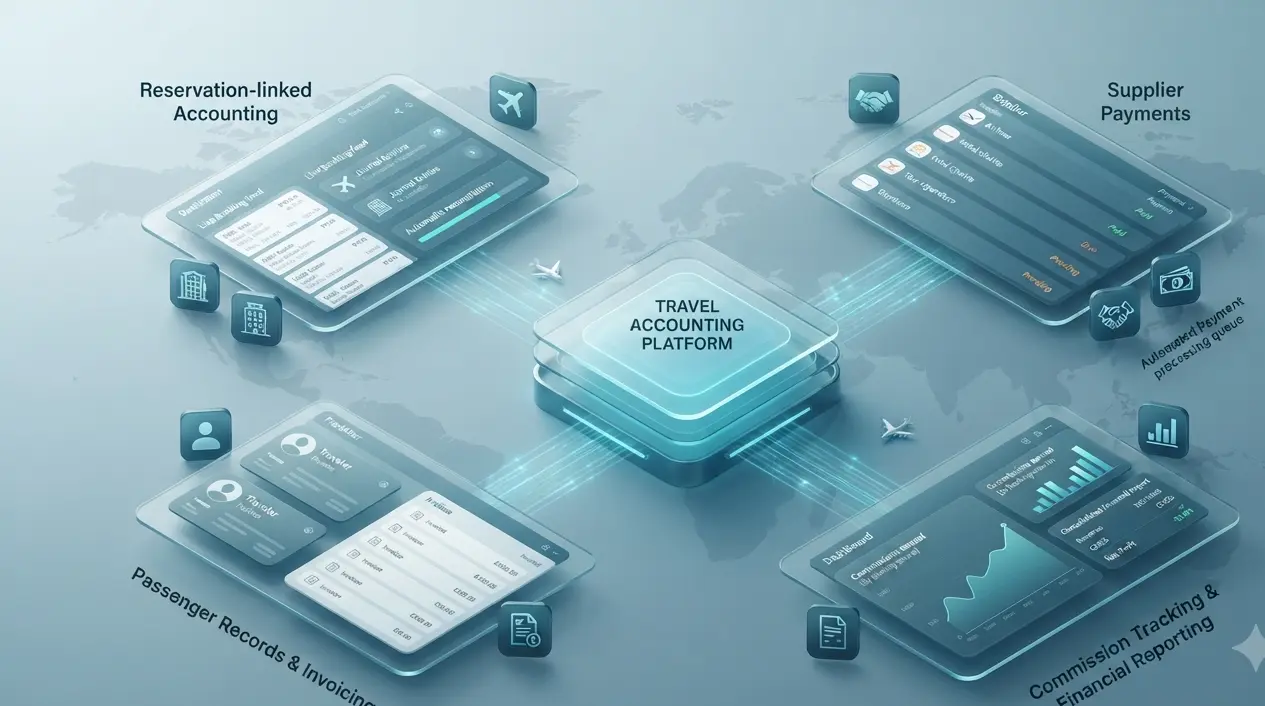
| Supplier Payments | Separate record from the operation | Linked to each booking, visible in accounts payable |
The B2B portal for suppliers deserves special mention. When the supplier has direct access to the platform to update their information and confirm services, the inbound operator eliminates an entire layer of manual intermediation. Fewer emails, fewer verification calls, less risk of working with outdated data.
The risks of operating with isolated systems become especially visible in local supplier management: when each supplier resides in a different system, coordination depends on the team’s memory and reflexes, not on clear processes.
Why Multilingual and Multi-currency Capabilities Are Structural Requirements in an Inbound Platform
An inbound operator working with outbound agencies from different countries faces a significant communication challenge: their clients do not speak the same language, do not operate with the same currency, and do not have the same expectations about how a commercial proposal should be presented.
A platform that requires manual work to adapt documents to each language or convert rates to each currency is not neutral; it generates operational friction that multiplies with every international client.
Multilingual capability in an inbound tour operator platform is not just about translating the interface. It is the ability to generate quotes, itineraries, vouchers, and operational documentation in the client’s language, from the same environment and without additional steps. A proposal sent in the language of the European tour operator receiving it has a different commercial impact than one sent in Spanish with a clarifying note.
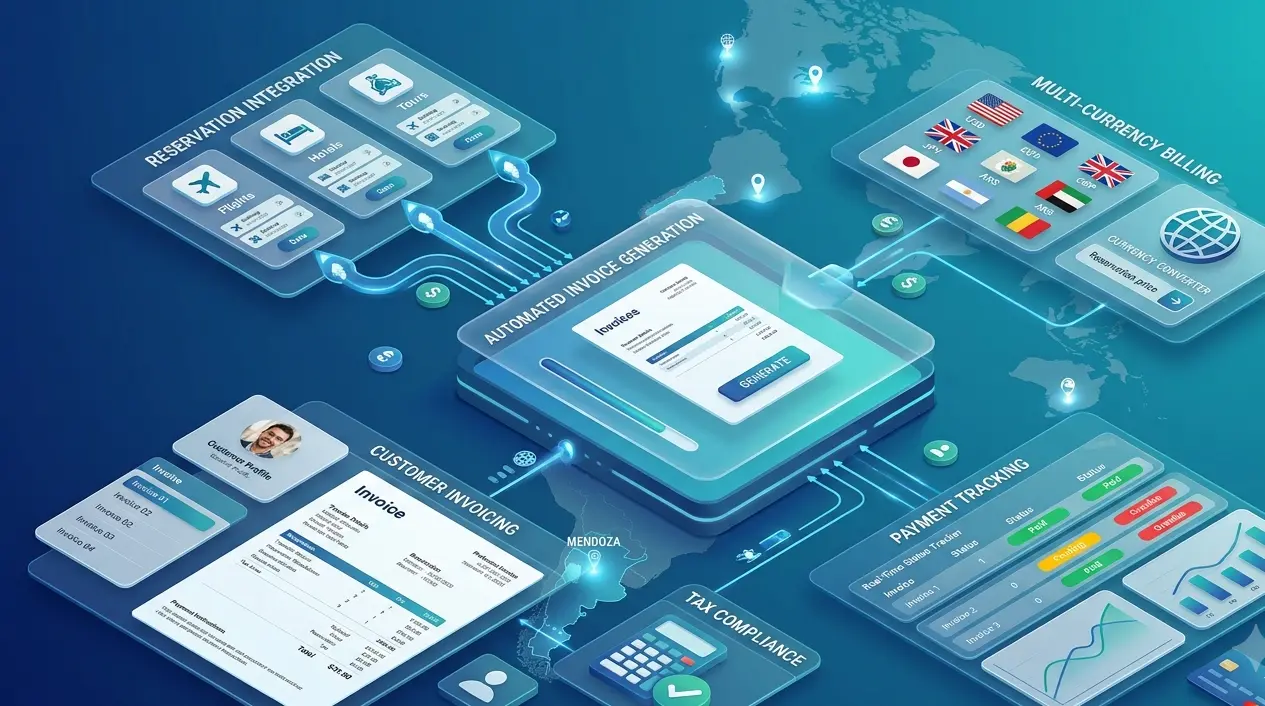
Multi-currency is not just a matter of presentation either; it’s financial control. An inbound operator working with clients in dollars, euros, and reals simultaneously needs the system to calculate margins, record payments, and generate reports considering exchange rate differences, without requiring manual reconciliations at the end of each period.
On-Destination Operational Coordination: The Requirement That Most Differentiates Inbound Platforms
There is a dimension of inbound operations that generic systems almost never consider: what happens on the day the passenger is at the destination.
Assigning guides and transporters, coordinating schedules when last-minute changes occur, communicating with the field team, verifying that each service was provided as confirmed — all of this is part of a DMC’s real operation and must have a place within the system.
When this coordination happens outside the platform — in WhatsApp groups, phone calls, or parallel emails — the information generated never reaches the central system. The real status of the operation remains invisible to those not in the field. And when something goes wrong, reconstructing what happened and when is a time-consuming task.
A good platform for inbound tour operators must be able to record this operational layer: resource allocation, status of each service at the destination, incidents, and last-minute changes. Not as a decorative module, but as part of the flow that connects sales, operations, and finance in a single environment.
Features That Reveal if an Inbound Tour Operator Platform Can Support Growth
A growing DMC faces a familiar tension: more operational volume, more suppliers, more destinations, more international clients — and the same operational structure that worked well when everything was simpler.
This tension has a name: the platform doesn’t scale. The features that allow an inbound platform to support growth without forcing a migration are not the most visible in a demo. They are the structural ones: modular architecture that allows adding capabilities without changing systems, differentiated access profiles for growing teams, support for multiple destinations from a single environment, and continuous updates without operational interruptions.
An inbound operator working in one destination today and wanting to expand to three in the next two years needs to know that the platform they adopt can support this growth without requiring a re-implementation. This capability is not evaluated in a demo; it is evaluated by asking what happens when the operation scales.
Specialized inbound tourism platforms — built from the operational logic of DMCs and operators with multiple destinations — start with this architecture as a baseline condition. Toursys’s inbound operator platform was designed for this type of growth: modular, multilingual, with human support included, and total connection between sales, operations, and finance.
What Distinguishes a Well-Designed Inbound Platform from One Adapted from Another Model
The difference between a platform designed for inbound operators and one adapted from a generic model is not always apparent in the feature list. It becomes clear when the operation gets complicated.
A supplier change 48 hours before the group’s arrival. An itinerary modification requested by the tour operator the night before. A service that cannot be confirmed and must be replaced while maintaining the margin and updating all documentation.
In these moments, the difference between a platform that understands the inbound logic and one that does not becomes concrete. One responds with workflows that already account for these scenarios. The other forces the team to resolve issues outside the system — with all the operational cost that implies.
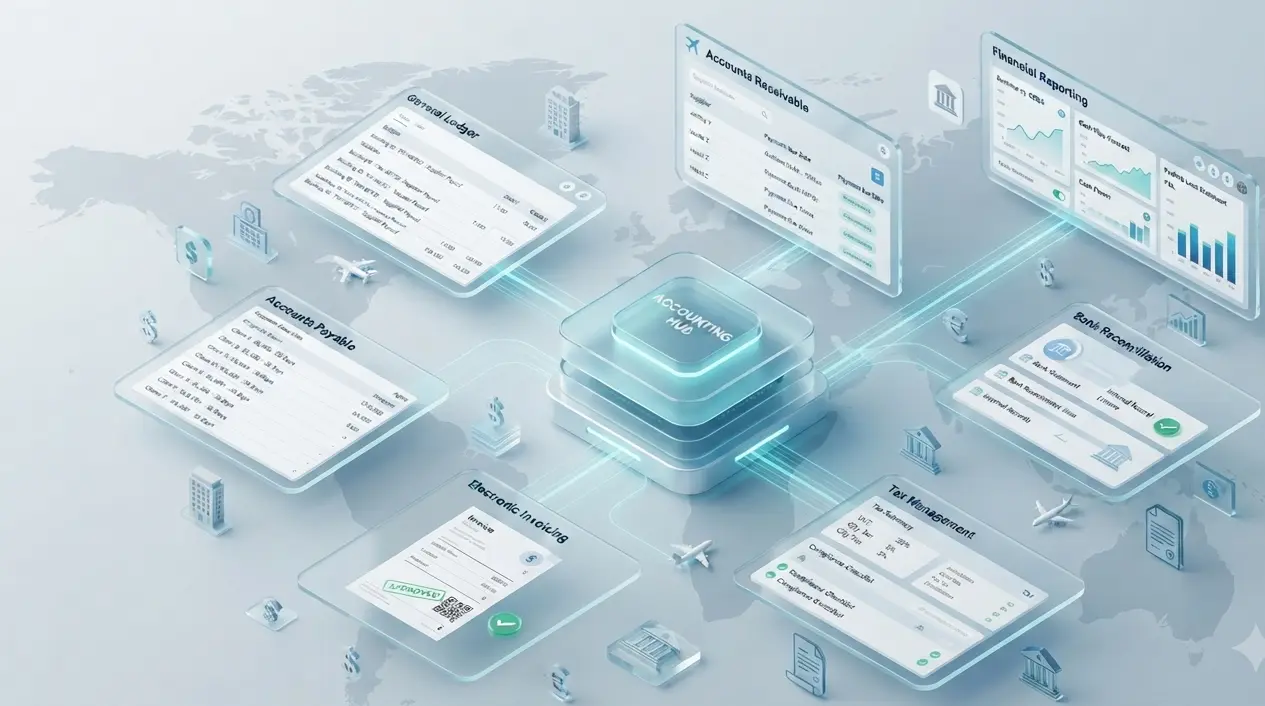
The characteristics of a good platform for inbound tour operators are not a list of modules. They are the result of designing the system by understanding how a DMC truly works: with changing local suppliers, international clients with their own demands, operations in multiple currencies and languages, and on-destination coordination that must function precisely even when plans change.