An agency starting to look into e-invoicing in tourism usually starts with the wrong question: which program complies with the law. The question that actually organizes the problem is different: What type of operation is the agency invoicing for each sale? Because that is where everything else starts to get complicated.
In most sectors, invoicing is an almost mechanical step: something is sold, and a receipt is issued for that item. In tourism, this logic breaks down early because what the agency sells is almost never its own service. It is a combination of third-party services (hotels, transport, excursions, insurance) packaged and resold under conditions that vary by provider, destination, and client type.
E-invoicing for a sale involving multiple providers
In general, the agency always invoices in its own name: it centralizes the operation and issues the final invoice to the client, regardless of how many providers are behind that booking. That point is not up for debate. What does complicate things is everything hidden behind that single invoice.
A one-week booking can include a hotel, transfers, an excursion, and insurance, each contracted with a different provider and under different conditions: net rate, commission, currency, payment terms. The client sees a single invoice for a total amount. Internally, the agency must maintain the details of each component to know how much that sale actually cost and how much was earned.
When those details are not recorded with the same clarity as the invoice is issued, the receipt ends up being a correct number that doesn’t tell the full story behind it. And that story is exactly what is needed later to calculate margins, declare taxes, or resolve a provider claim. A well-integrated e-invoicing system doesn’t replace that background work, but it does prevent it from getting lost along the way.
E-invoicing when payment and service occur at different times
The second factor that complicates things is time. A booking is collected today, a provider is paid at another time, and the service is provided weeks or months later. In between, partial prepayments, rate adjustments, and commissions that are only settled when the trip ends can appear.
This time gap doesn’t easily fit into an invoicing logic designed for simultaneous sale and delivery. If the agency’s system doesn’t connect the booking, the payment, and the invoice in the same thread, each of those moments ends up being recorded separately, and reconstructing what belongs to which booking later becomes manual work that no e-invoicing tool can solve if it isn’t integrated with the operation.
At its core, this is a traceability problem rather than a tax problem. Automating the agency’s accounting without turning the whole team into accountants is usually the necessary first step so that invoicing, electronic or otherwise, has an organized foundation to lean on.
E-invoicing in operations crossing more than one country
An incoming agency charging a foreign operator, a wholesaler reselling to agencies in other markets, or a DMC invoicing for services provided in a different country from their client face an additional variable: each jurisdiction defines its own requirements, and those requirements change with a frequency that rarely coincides between countries.
There’s no need to memorize every regulation to understand the underlying problem. It’s enough to recognize that a single booking can touch more than one tax framework at once: that of the country where the service is provided, that of the country where the end client is registered, and sometimes, that of the country where the provider operates. The more international an agency’s portfolio, the more this variable multiplies.
That’s why evaluating an ideal invoicing program for travel agencies requires looking beyond whether it issues receipts correctly. You have to understand if that system can coexist with operations that don’t always fall within a single regulatory framework.
Questions to diagnose how prepared your agency is
Almost no agency reaches this point without having resolved invoicing in some way. Rarely is the problem an absence of receipts. More often, what fails is the foundation on which the invoicing is based—something that no one quite finished organizing and that only appears when a specific symptom arises: a booking where it’s unclear if it has been invoiced, a client claiming a receipt that doesn’t match what was charged, or a regulatory change that arrives without anyone on the team seeing it coming.
Before thinking about tools, it helps to answer some questions about your own operation. There isn’t a single correct answer, but there are answers that reveal where the weak point lies:
- Does your team clearly distinguish, booking by booking, whether they are selling in their own name or acting as an intermediary for a third party?
- Can you reconstruct today, without searching through three different systems, what was collected, what was paid, and what is left to invoice for a specific booking?
- Do you know in which countries your agency operates under mandatory e-invoicing requirements and in which it doesn’t?
- When a tax rule changes in one of your markets, how does your administrative team find out?
- If an international provider changes their invoicing method, is that change reflected in how your agency records the operation, or does it stay isolated in an email that no one looks at again?
None of these questions have an answer that can be improvised on the spot. Agencies that answer them with confidence usually share something in common: financial information is connected to the operation, not spread across parallel files that someone reconciles at the end of the month. Those who hesitate, on the other hand, usually discover that what was missing, rather than a good invoicing program, was a clear criterion on how each type of sale is recorded from the start.
Organizing e-invoicing before regulations force you to
Faced with this scenario, the temptation is to wait until the obligation formally arrives before moving, but that usually turns out to be expensive later on. If that happens, the fine for not complying with the new regulations on time is just the first cost. The heaviest cost is usually the time it takes later to reconstruct information that was never organized at the source, right when there is the least margin to do it calmly.
This reorganization doesn’t depend solely on technology. It depends first on the agency being clear, for each type of sale, whether it is invoicing in its own name or through intermediation, how the timing is distributed between collection and service, and in which markets it operates under different rules. Without that foundation, any system ends up inheriting the same disorder it intended to solve.
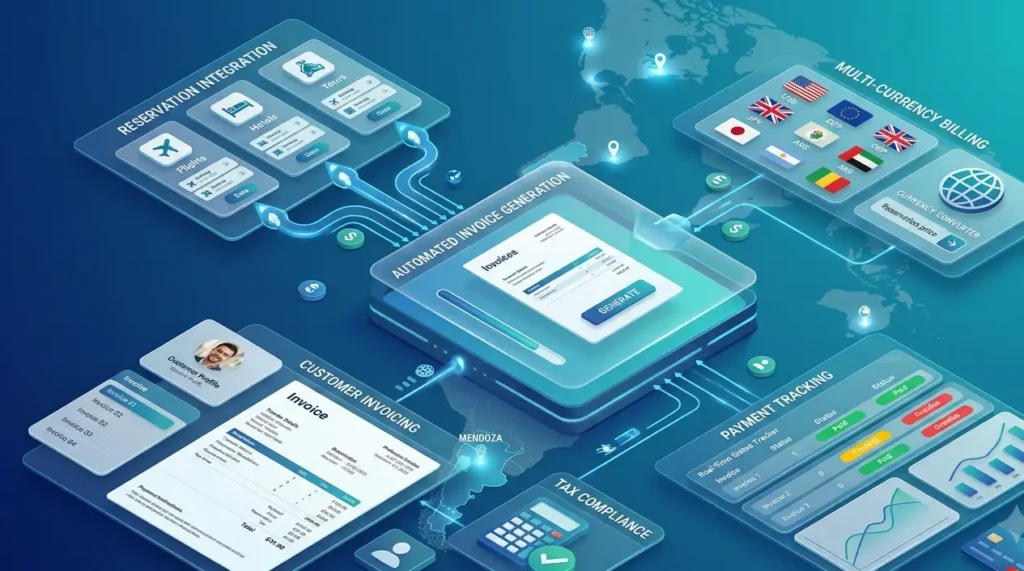
Connecting the booking, the payment, and the invoice from one place is, at its core, the goal of management platforms designed for tourism. Toursys, for example, integrates e-invoice issuance with the operation in markets where it is mandatory, and in those where it isn’t, it organizes and centralizes tax information so it’s ready when needed. The specific scope varies by country, so it’s best to confirm it specifically before assuming anything.
The starting point, however, doesn’t change regardless of the platform chosen: first understand how the agency’s operation is structured, booking by booking and country by country, so that technology supports that order instead of trying to replace it. When that foundation exists, e-invoicing stops feeling like an obligation imposed from the outside and starts functioning as a natural consequence of how the agency already works, with no surprises every time a market updates its rules.