
An agent who puts together ten travel proposals per week doesn’t dedicate ten times the same effort to each one. They spend more time on the first draft, adjust what’s necessary in the following ones, and, in theory, gain speed through repetition. In practice, many agencies don’t achieve those savings: every new proposal starts almost from scratch, even if the destination, structure, or type of service is similar to the previous client’s.
Therein lie some of the less-discussed benefits of an itinerary builder for agencies: it’s not just about the final document looking better, but about how much selling time gets trapped in tasks that have already been done before.
The itinerary builder and the invisible cost of repetitive work
Let’s consider a common scenario. An agent puts together an itinerary for Costa Rica with three nights in San José and four in the Arenal area. Two weeks later, another client asks for something practically identical: same regions, similar duration, different group of passengers. If the process depends on starting over every time, that recoverable time is lost once again.
This doesn’t show up in any error reports. It doesn’t generate complaints or claims. It simply consumes hours that could be used to handle more inquiries or close more sales, and no one notices because the itinerary, in the end, turns out fine. The problem isn’t the result. It’s what it cost to get there.
When an agency measures how long it takes on average to manage travel proposals, they are often surprised by how much of that time is spent rebuilding something similar to what they’ve already done, instead of adapting it.
Commercial capacity: the true benefit of optimizing itineraries
It’s tempting to think of this issue in terms of order or internal neatness. But the real effect is commercial: it defines how many proposals a team can produce in a week without adding staff.
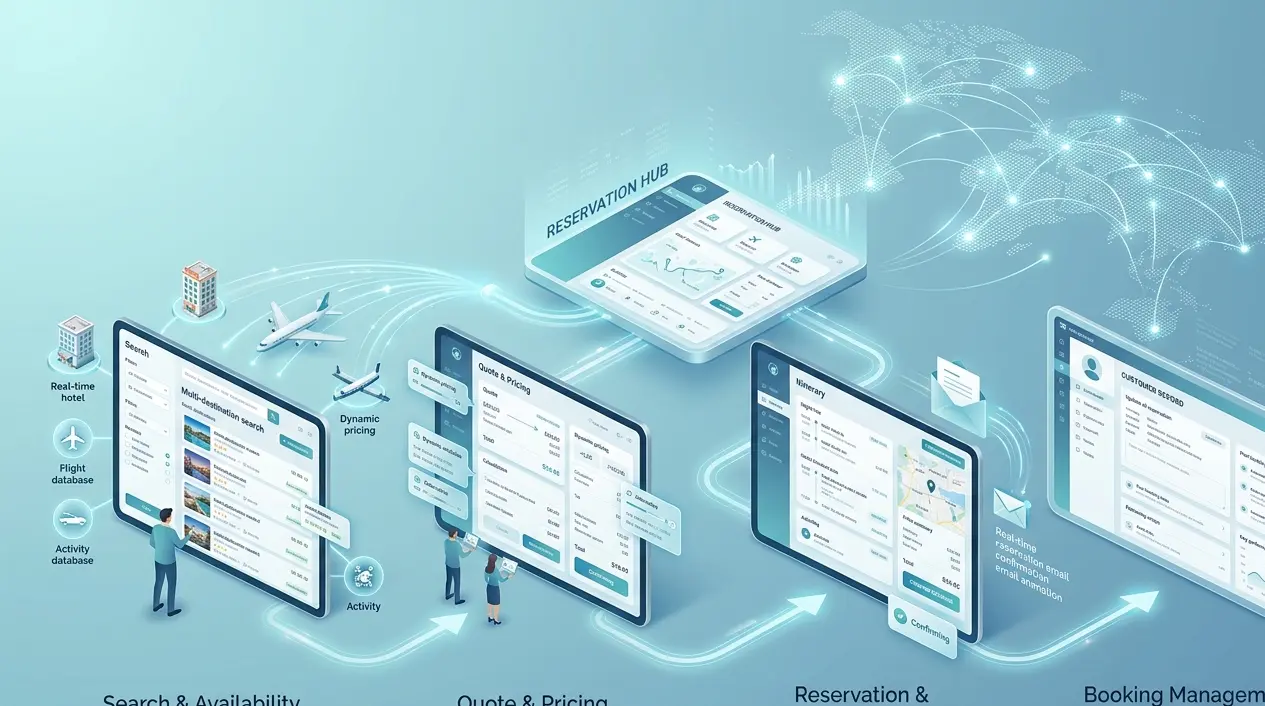
An agency that achieves real time savings in travel agencies of this type doesn’t just work faster. It expands its response capacity without having to hire more agents. It can take on more inquiries during peak season, respond in parallel to several clients who are comparing options, and maintain that pace without the quality of each proposal suffering under time pressure. This logic connects directly with how a well-integrated booking system operates from the inside, where every time saving at one point in the process translates into more capacity in the next.
One point should be clarified: this doesn’t mean producing generic, mass-produced proposals. It means that the repetitive part of the work—the base structure, the format, the blocks used over and over again—stops absorbing the time that should go toward what actually changes between one client and another: specific preferences, budget, and the details that make those personalized travel itineraries feel tailor-made.
What type of agency gains the most from an itinerary builder
Not all operations experience it the same way. An outbound agency that puts together packages for recurring destinations, with travel structures that repeat across different clients, is the one that recovers the most capacity when it stops rebuilding the same thing for every proposal.
A tour operator designing their own circuits faces a different version of the same problem: their itineraries serve as a base for other agencies to resell, so every time they adjust an existing circuit, that change should propagate without someone having to redo the entire document by hand.
Inbound agencies, on the other hand, usually deal with finer variations within the same general structure: the same destination, but with different durations, groups, or seasons. There, the challenge isn’t starting from scratch, but adjusting with precision without wasting time manually reviewing every detail.
The particularities of each business model influence which type of tool should be prioritized, because not all agencies accumulate the same type of repetitive work or at the same point in the process.
What changes when assembly time is recovered
Recovering the time spent on reconstruction isn’t just an abstract productivity improvement. It has a direct effect on how many opportunities an agency can handle without stretching its team beyond reasonable limits.
This matters especially during peak demand periods, when several inquiries arrive at the same time and response speed starts to weigh as much as the content of the proposal. An agency that takes two days to put together what another resolves in two hours doesn’t just work differently: it competes under different conditions for the same client.
It’s worth asking, then, how much of that delay comes from genuine decisions about the trip and how much comes simply from rebuilding a structure the team already knows by heart. Distinguishing between the two is part of what differentiates a tool designed specifically for the tourism sector from one that doesn’t account for this type of repetitive work.
Specialized tourism management platforms, such as Toursys, usually treat this point as a separate software category, precisely because they understand that assembly time isn’t a minor detail but a variable that directly affects how much an agency can sell.
Here are the two new sections to insert before the closing, plus the rewritten closing.
Signs that repetitive assembly is costing sales
There is a sign that many agencies overlook: when an agent avoids certain inquiries, not because they don’t know how to solve them, but because they know how much time they will consume. A request for a multi-destination circuit, a proposal with several hotel alternatives, an itinerary that needs to be adjusted three times before the client confirms. None of these cases are technically difficult. What weighs them down is the time.
Another symptom appears in response times. If an inquiry that arrives on a Tuesday morning doesn’t receive a proposal until Thursday, there isn’t necessarily a real workload problem: there might be a problem with how long it takes to build each proposal from scratch. The difference matters because the solution is not the same. Hiring more staff doesn’t fix a slow process; it only spreads the same problem across more people.
It’s also worth observing what happens when two similar inquiries arrive on the same day. If responding to the second takes almost as much time as the first, even though both share a structure, there is the clearest evidence that work is not being reused as it could be.
The cumulative effect in peak season
During months of highest demand, this problem doesn’t grow linearly: it multiplies. A team that loses fifteen minutes rebuilding each similar proposal can absorb that loss without major consequences when they receive five inquiries per week. The same loss, multiplied by thirty or forty inquiries in a peak season week, is no longer a minor detail: it’s the difference between responding to all clients in a reasonable time or starting to accumulate a backlog.
It is during these peaks where the cost of not reusing work becomes visible to the entire team, not just to the person putting the itineraries together. Inquiries pile up, response times stretch, and pressure falls on the same people who seemed to handle the volume without a problem during low season.
That’s why it’s worth thinking of this point not as a cosmetic adjustment but as a variable that defines how well an agency maintains its service level when demand rises. An operation that only works well with low volume has a growth limit much lower than its owners usually imagine.
Recovered time is gained capacity
Thinking about the benefits of an itinerary builder ultimately comes down to a question about limits. Not the limits of the destination or the client’s budget, but those of the agency itself: how many inquiries can it handle well before quality starts to suffer or response times become a problem in themselves.
That question is rarely asked during quiet months. It appears when demand rises and the team notices they are running behind the volume instead of managing it with a margin. By then, it’s no longer a decision that can be postponed without cost: every inquiry that is answered late is an inquiry that has likely already chosen another option.