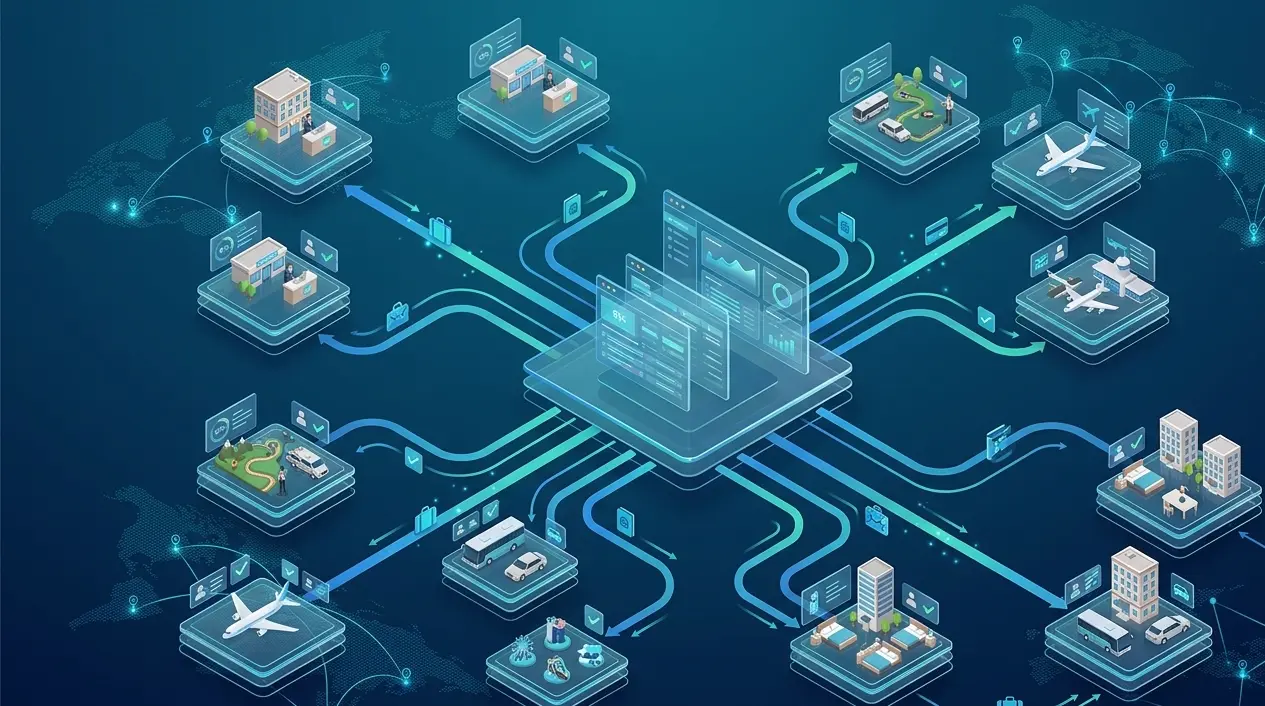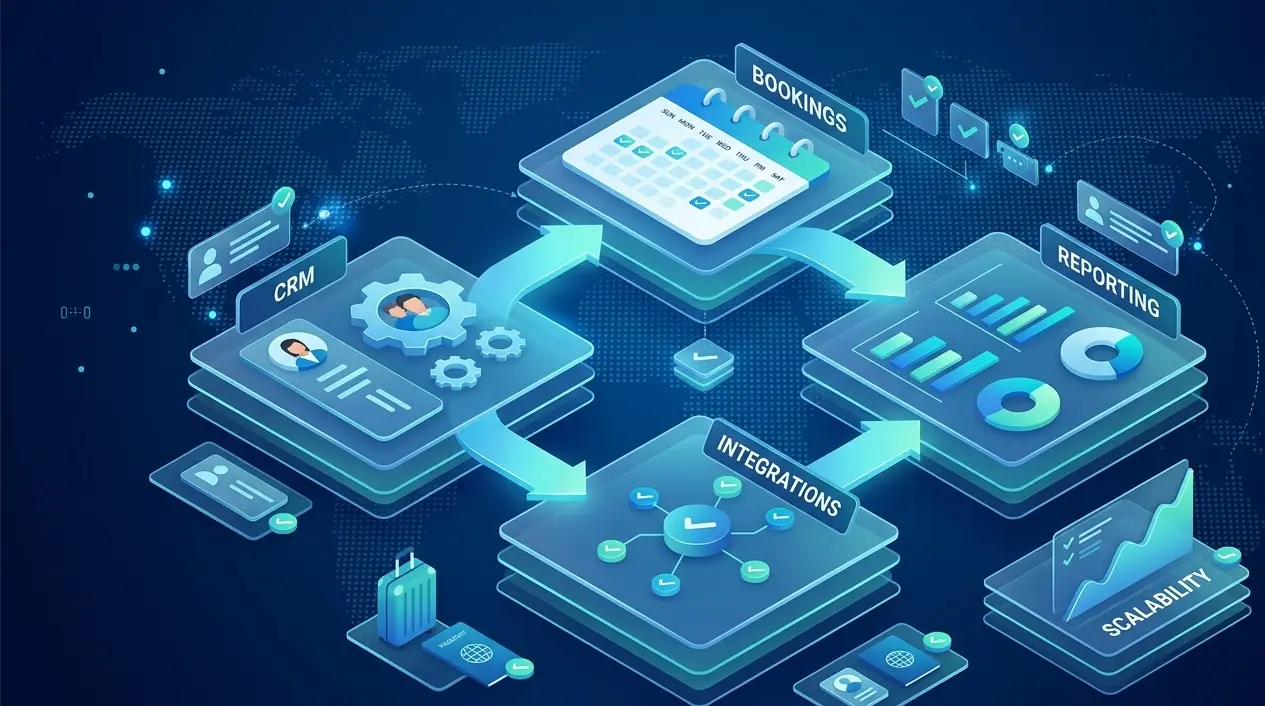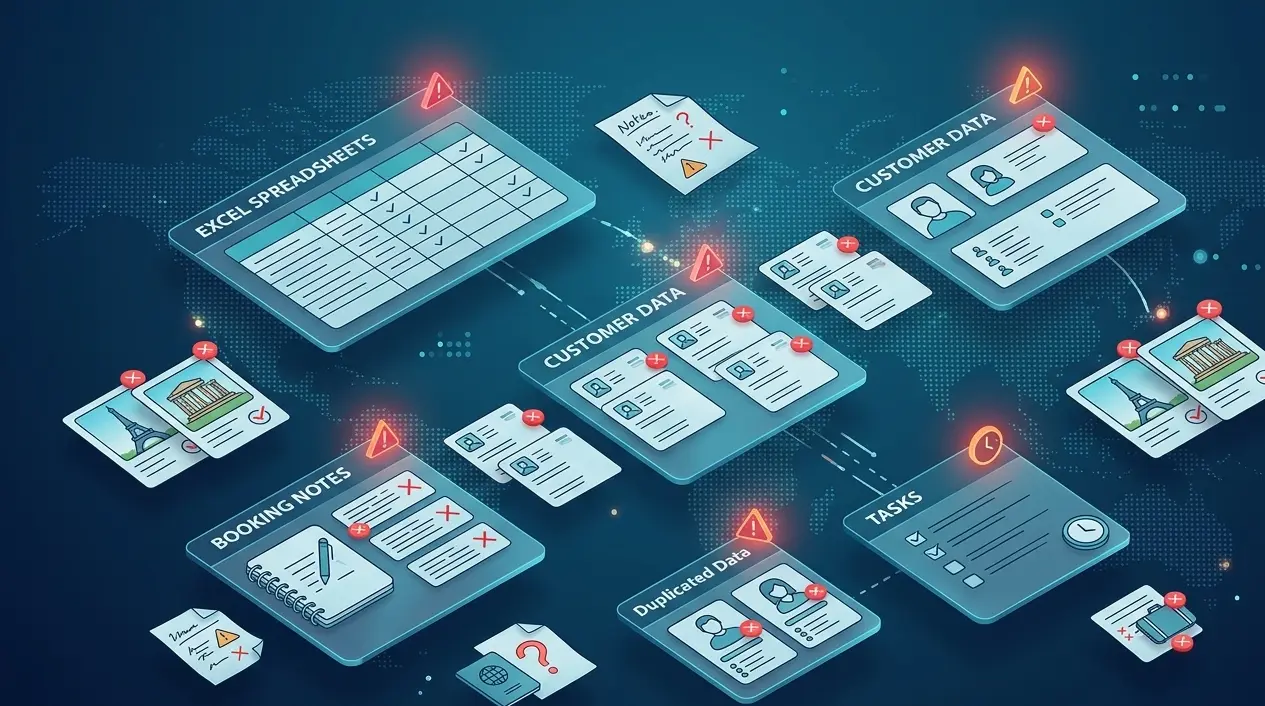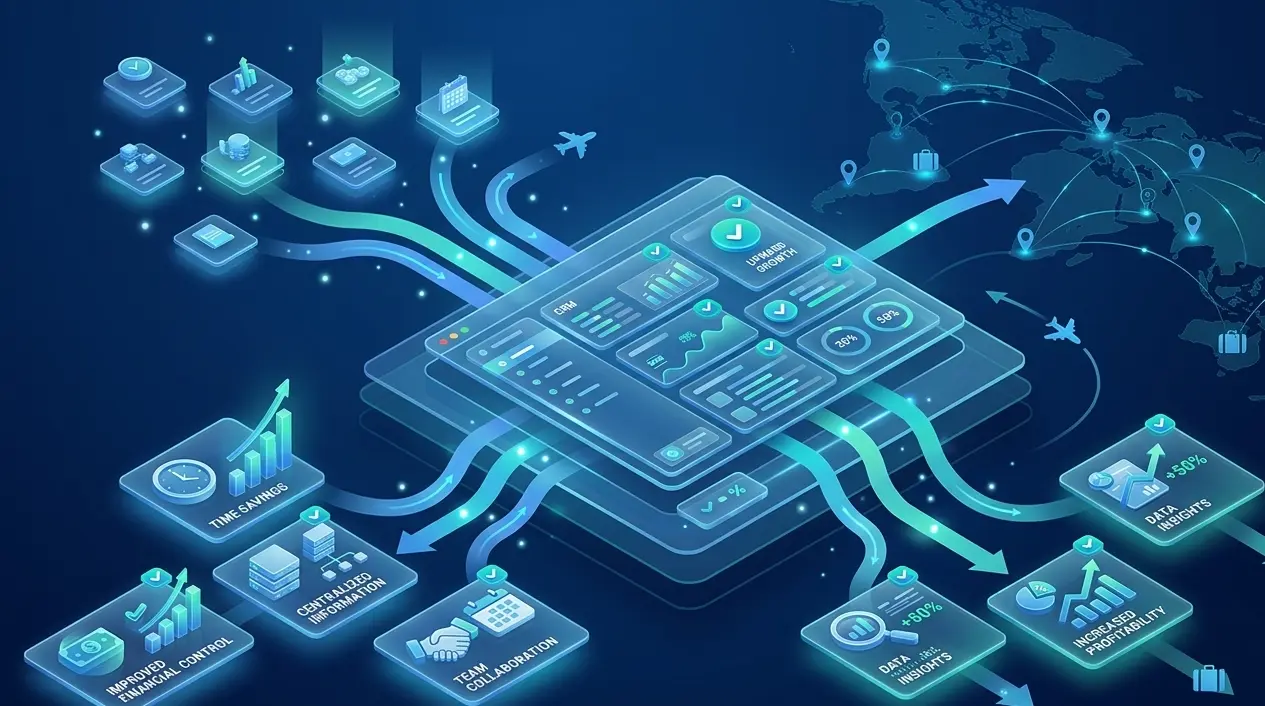
Choosing a management system without first understanding how your agency operates is like buying a vehicle without knowing if you need urban transport or an off-road vehicle. The result is often the same: a tool that technically works, but doesn’t fit the day-to-day reality.
The problem is not a lack of options. Many platforms are presented as management software for travel agencies — but almost none start with the right question. What distinguishes a truly useful system is not its interface or initial price: it’s how well it understands the logic of your business model.
Before discussing travel agency software, let’s talk about your business model
There’s a very common mistake when starting a digitalization process: defining which tool is needed before mapping out which processes need to be supported. An outbound agency, an inbound agency, and a wholesale tour operator share very little in operational terms, even though all three sell tourism.
Their workflows are different. Their clients are different. The points where operations break down are also different.
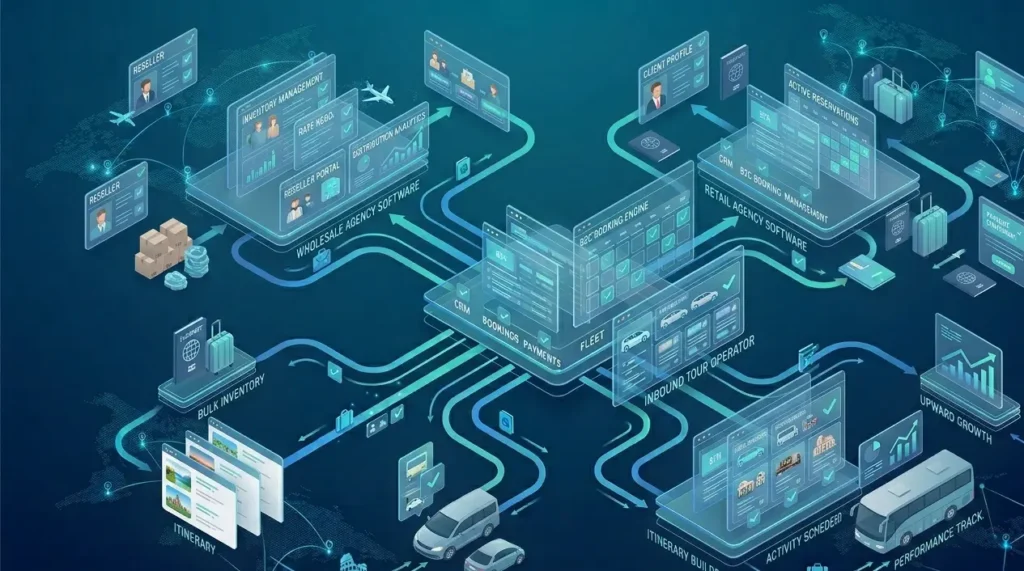
An outbound agency works with the end traveler, manages the commercial relationship, closes sales, and coordinates services with third parties. Its greatest pressure lies in response speed and controlling the margin per quote. An inbound agency, on the other hand, operates at the destination: it coordinates guides, transportation, local services, and suppliers, often in real-time and for travelers sent by another agency. And a wholesaler designs its own products — packages, circuits, tours — which it then distributes to other agencies.
Three business types. Three completely different logics.
When a system is not designed for your operational logic, it doesn’t simplify: it adds friction. And that friction has a real cost in time, errors, and scalability.
Software for Outbound Agencies: Speed and Relationship Control
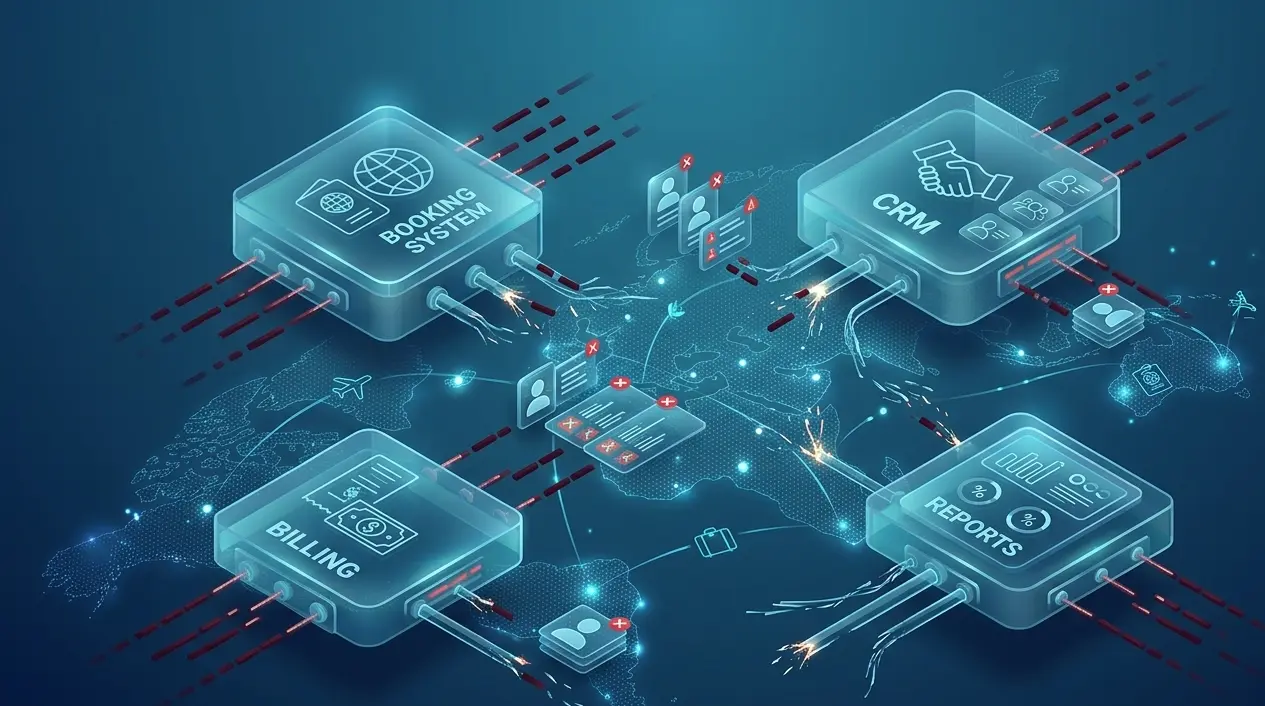
For an outbound agency, sales don’t start with the booking. They begin with the first contact with the prospect. From there, the chain includes inquiry, quotation, adjustments, confirmation, partial payment, operation, and settlement. These are six or seven stages, and each generates information that, without a connected system, resides in emails, spreadsheets, and WhatsApp conversations.
What is lost there? Control. When a client’s history is scattered across three different tools, the quality of service depends on the memory of the agent who assisted them. That doesn’t scale.
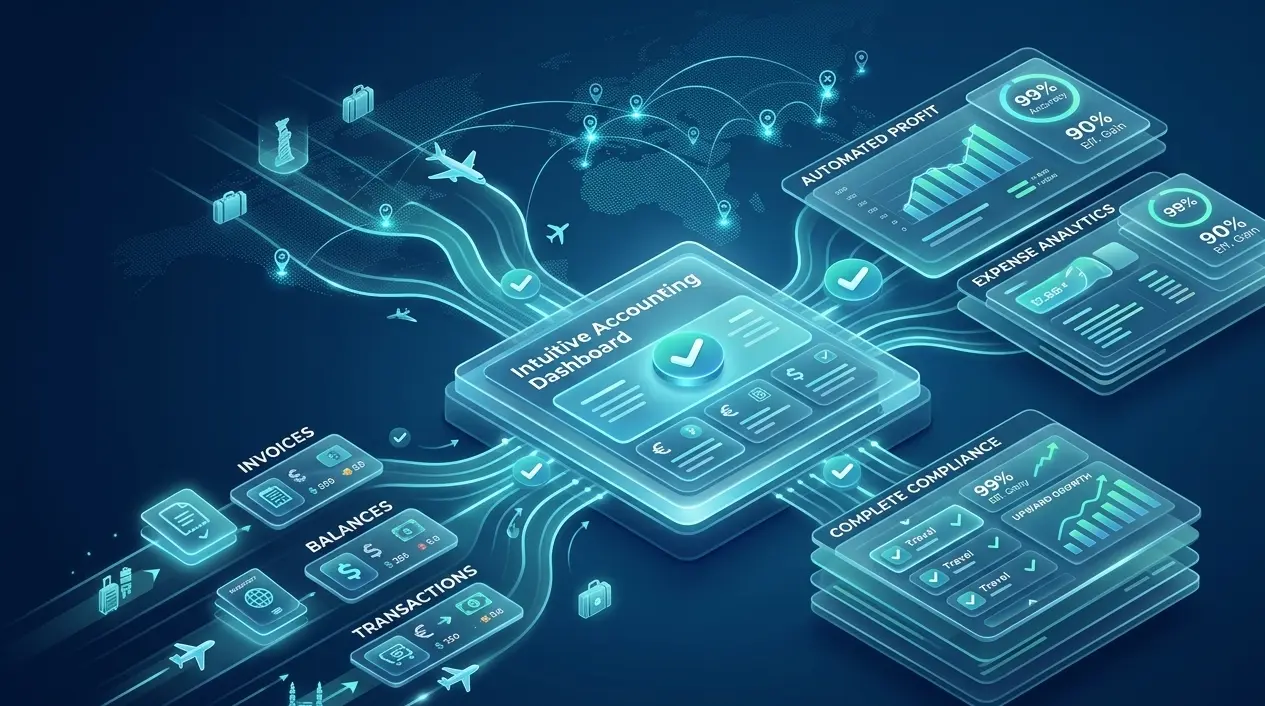
The system an outbound agency needs must, at a minimum, solve three things: create personalized quotes in minutes — with configurable markup and visual presentation —, centralize client information from the first contact to after-sales, and connect that information directly with bookings and payments. If you want to see how this integration also impacts the financial side, the article on accounting software for travel agencies explains it in detail.
A detail that many generic platforms overlook: the pricing logic in tourism is not the same as in e-commerce. Margins vary by season, by passenger type, by volume, and by each supplier’s policy. A system that doesn’t understand this complexity forces the agent to calculate outside the platform, which introduces errors and consumes time that could be used to close more sales.
Software for Inbound Agencies: On-Destination Coordination
The inbound model has a particularity that makes it especially demanding from an operational point of view: the end client generally does not interact directly with the DMC. The commercial relationship is with the outbound agency that sent the traveler, but the operational responsibility is total: transfers, guides, tours, activities, hotels.
When a group arrives during high season, that operation can involve dozens of services, multiple local suppliers, and confirmations that need to be resolved with hours — sometimes minutes — of lead time. If this coordination is managed by email or spreadsheets, any change triggers a chain of manual adjustments that consumes hours and opens windows for error.
What differentiates a good management tool for inbound agencies is not that it has many features: it’s that it has the right features for this workflow. The ability to assign guides and transportation from a central control tower, to control allotments in real-time with each supplier, to invoice in different currencies according to the traveler’s origin market, and to provide B2B access to outbound agencies so they can check availability without mediating every request. Without this operational traceability, the DMC operates reactively. And in high season, reactive costs dearly.
There’s something else worth noting: for an inbound agency working with agencies from several countries, language matters. Not just in customer service, but in the platform itself. A system that only operates in one language limits team autonomy and multiplies misunderstandings in coordination with foreign agencies.
Software for Wholesalers and Tour Operators: Scale and B2B Channels
Wholesalers and tour operators share a particularity that no other agency model has: they design and manage their own product. They are not pure intermediaries. They create packages, circuits, or tours, set rates, control availability, and distribute them through other agencies, their own channels, or both. This completely changes what is required of the management system.
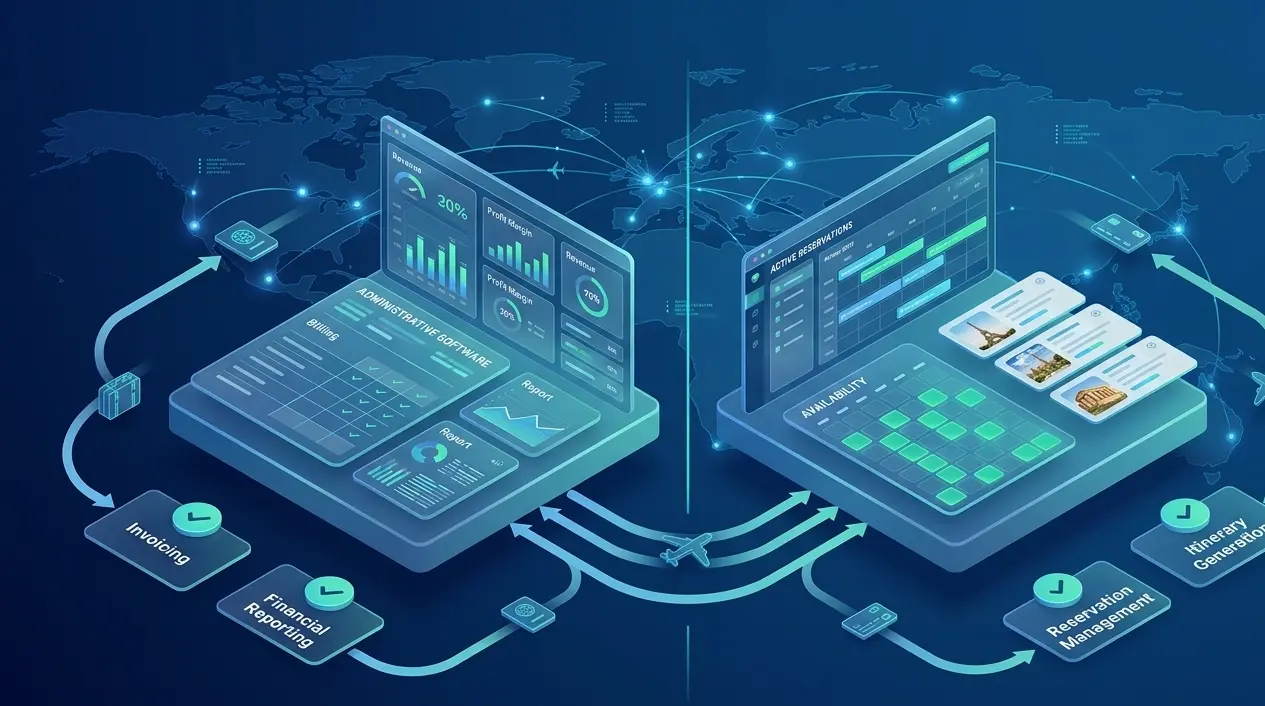
In this model, margin control is not a secondary module: it is the core of the operation. Knowing the true cost of each service included in a package, what margin remains after distributor agency commissions, how profitability behaves by destination or product type — all of this requires the system to integrate finance and operations from the same place, not as two modules that synchronize with a delay.
Allotment is another critical point. When a wholesaler negotiates quotas with suppliers, they need to know at all times what availability is committed, what can be sold, and what is at risk of being oversold. Managing this in a spreadsheet separate from the booking system is a recipe for error.
And the B2B channel completely changes the dynamic. The wholesaler does not serve the end traveler: they serve agencies that, in turn, serve travelers. This means the system must be able to show rates and availability to these agencies in real-time, without each inquiry requiring manual intervention from the team. An integrated marketplace — where distributing agencies can consult, quote, and book directly — transforms what was once a communication process into an automated workflow.
Travel Agency Software: Choose Based on Your Business Model
The table below summarizes the critical processes and most relevant system capabilities for each type of agency. It is not a tool comparison: it is a map to understand the operational logic from which digitalization should be approached in each case. If you want to explore how a platform designed for tourism organizes these processes in practice, you can learn about Toursys’ features before evaluating other options.
| Agency Type | Critical Processes | Key System Capabilities |
| Outbound Agency (sells to end traveler) | Quoting and sales closing · Lead tracking (CRM) · Personalized itineraries · Payment and collection control | Fast quoter with markup · CRM integrated with bookings · Visual itinerary builder · Accounts receivable |
| Inbound Agency — DMC (operates at destination) | Guide/transport coordination · Allotment control · Operational control tower · Multi-currency invoicing | Field operations module · Availability management · B2B access for agencies · Multi-language and multi-currency |
| Wholesaler / Tour Operator (own product, B2B channel) | Package and circuit management · Distribution to other agencies · Margin and rate control · Mass confirmations | Integrated B2B marketplace · ERP with cost centers · Allotment management · Financial reports per booking |
Each business model has a distinct operational logic. The system should follow it, not force you to adapt to it.
Size vs. Business Model: What Really Determines the System You Need
A small agency does not necessarily require a simple system. A large agency does not necessarily need the most complex system on the market. What defines which type of platform makes sense is not the team’s size or the available budget: it is the maturity of the processes and the business model you want to sustain.
An inbound agency with five people operating international groups has more complex operational needs than an outbound agency with twenty agents managing domestic travel. Volume does not determine system demands. Business logic does.
The most common story among agencies that switched platforms midway is always the same: they chose based on price or a specific feature, without evaluating whether the system understood their business model. Months later, when operations grew or changed, they discovered the tool couldn’t keep up.
That’s the question worth asking before evaluating any option: Was this system built with my type of agency’s operations in mind, or will I have to adapt my operations to the system?
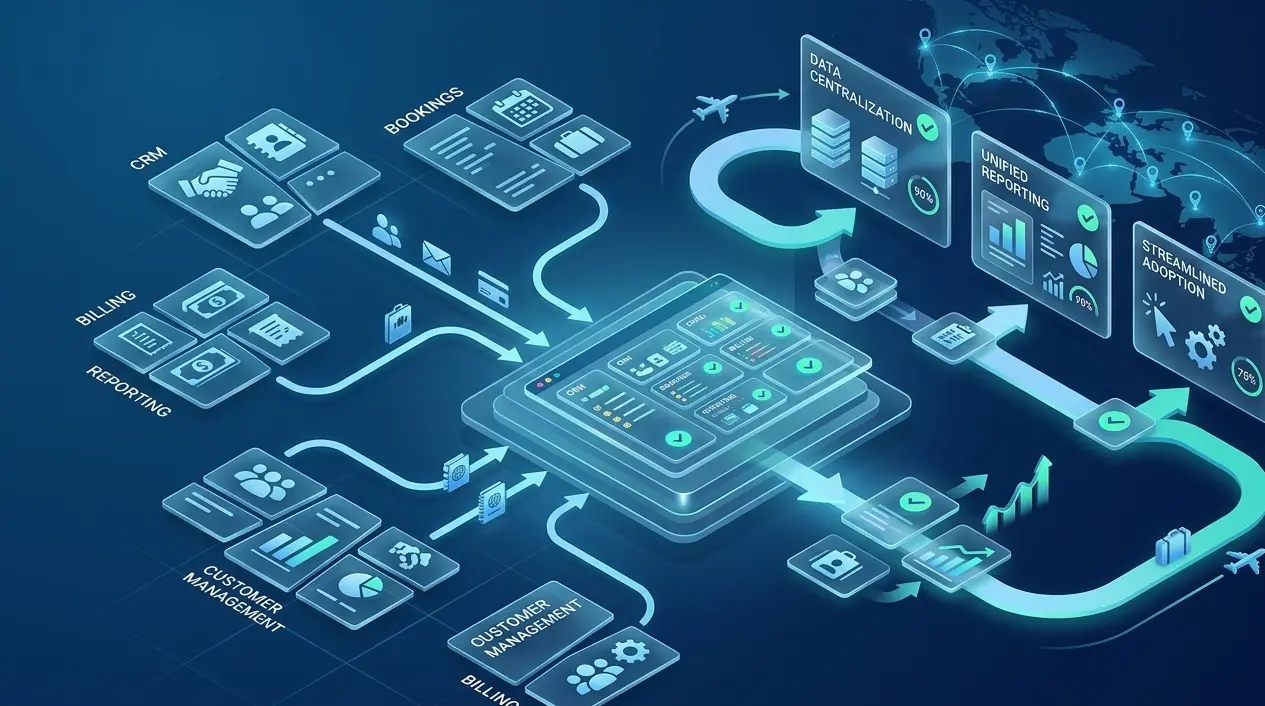
Platforms designed specifically for the tourism sector — like Toursys, which covers the operations of outbound agencies, inbound agencies, and wholesalers from a single platform — start from a different logic: the system adapts to the agency’s processes, not the other way around. This difference in approach becomes decisive when operations scale.
Start by Mapping Your Operations, Not by Comparing Prices
The decision to digitalize has a greater impact when it stems from an honest understanding of how the agency operates today and how it should operate as it grows. This involves identifying where time is lost, where errors occur, and what critical information exists outside the system.
With that clear map, the evaluation of tools changes. Instead of looking for the cheapest or most recognized, you look for the one that best supports the processes that truly matter in your business model. If you want to understand in more detail how an agency’s financial management is organized within an integrated platform, the article on accounting software for travel agencies can be a good starting point. And if you want to explore what specific functionalities Toursys offers for each type of operation, you can learn about the platform in detail before making any decision.