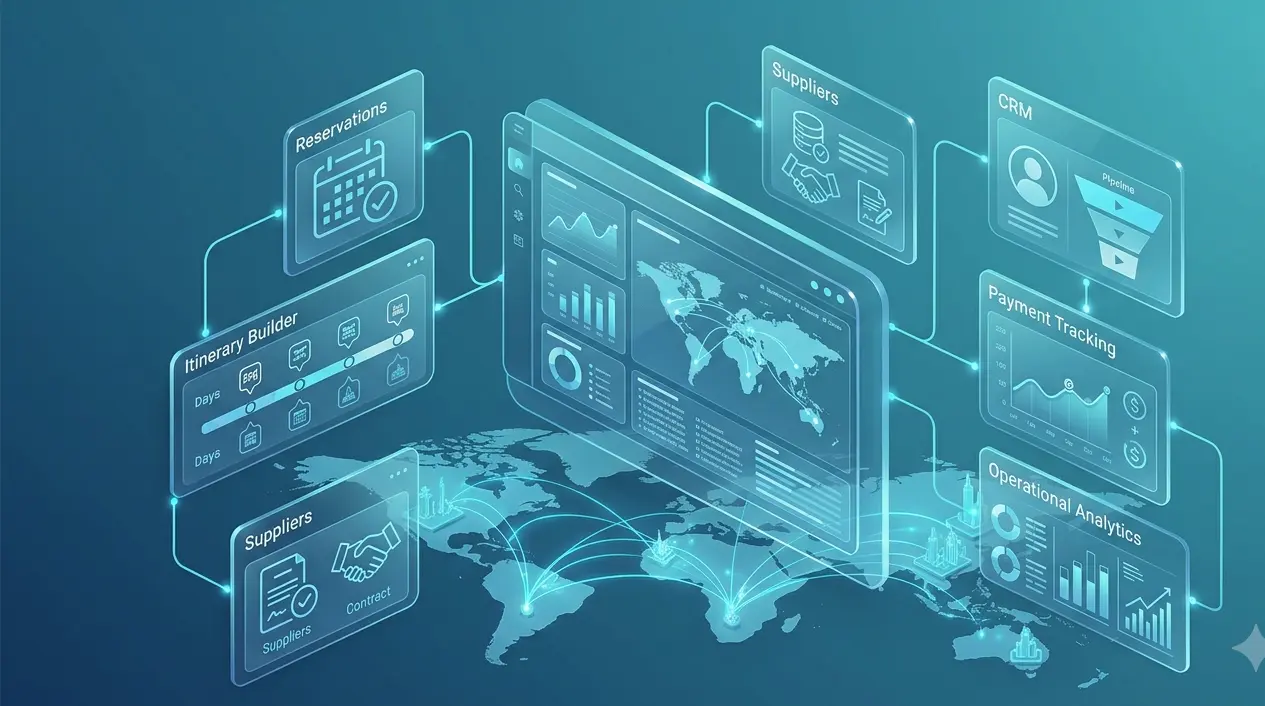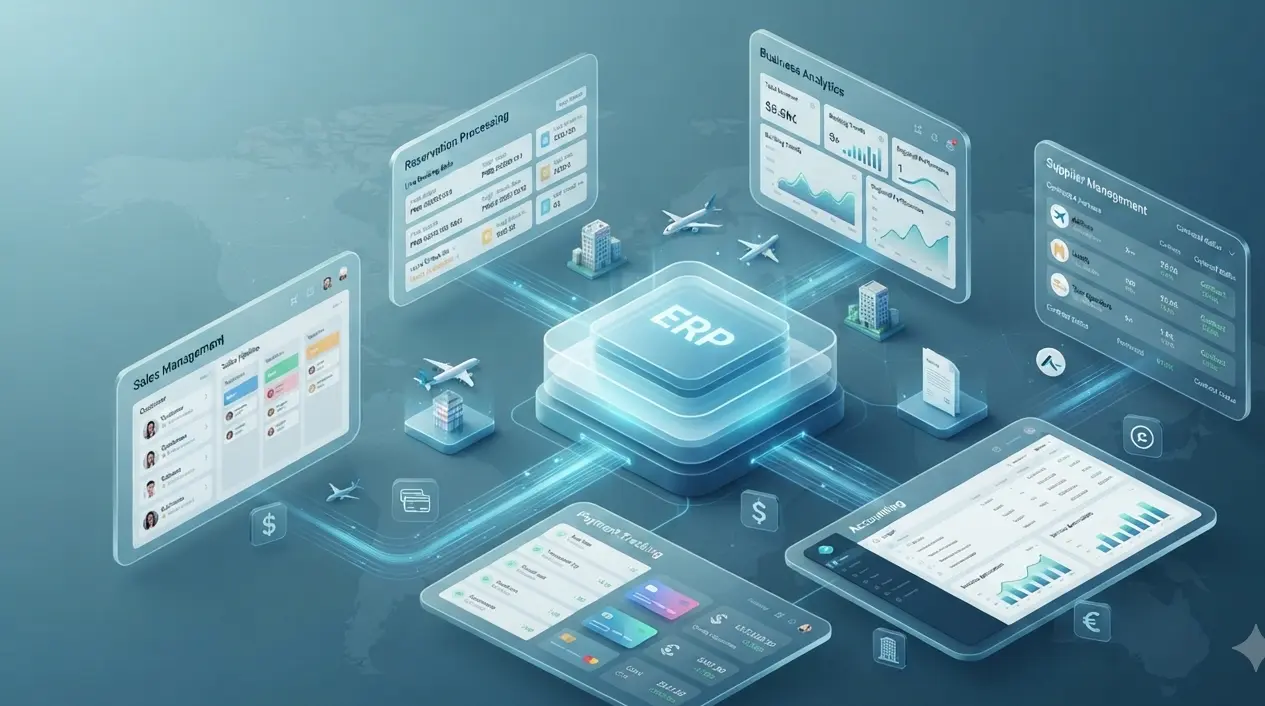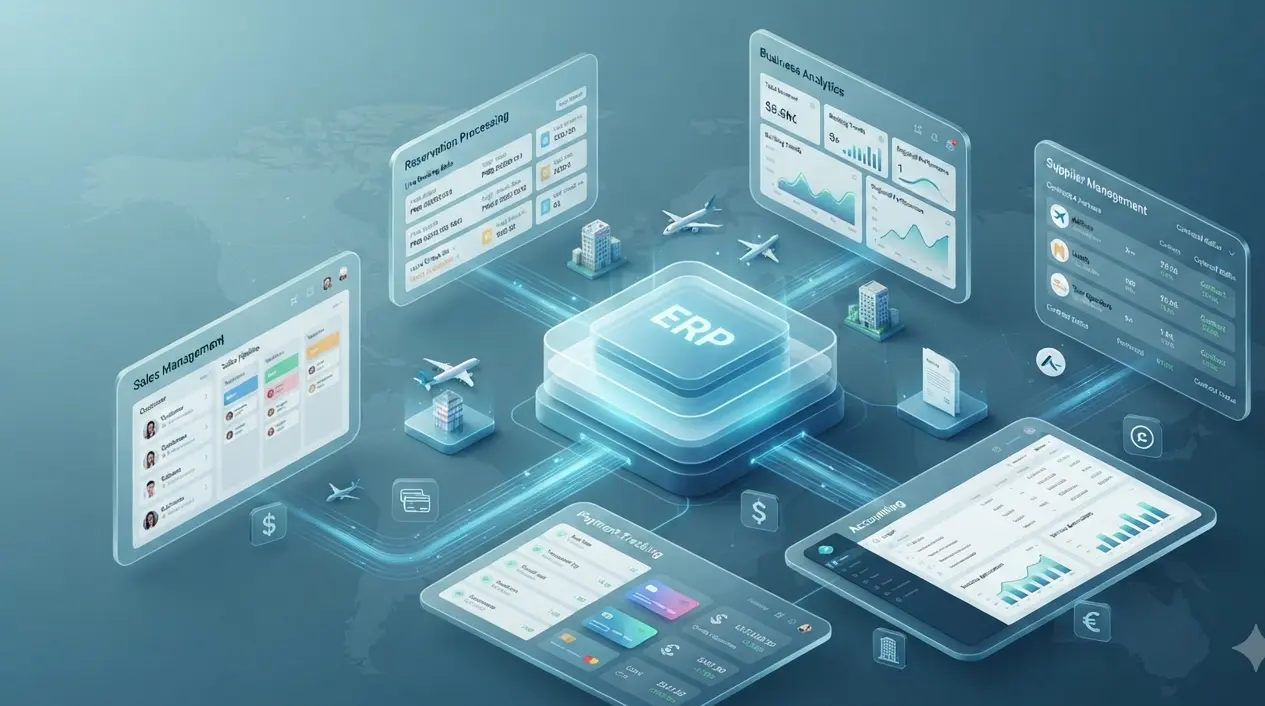
Tour operator software is the system that connects all processes of a tourism company within a single environment: from the moment a client request arrives until that operation is financially closed, including supplier coordination, documentation generation, and margin control.
The simple definition is easy to find. What is harder to understand is how it truly works in a specific operation — and why an inbound operator needs that system to function differently from an outbound operator.
The difference is not in the technology. It lies in the business logic that the software must support.
If you are still trying to understand the structural characteristics that distinguish a well-designed platform for operators, it may be useful to first review what a good platform for inbound operators should have.
What defines tour operator software beyond the list of features
Searching for a definition of tour operator software always yields the same answer: a tool that manages bookings, quotes, suppliers, and finances in one place.
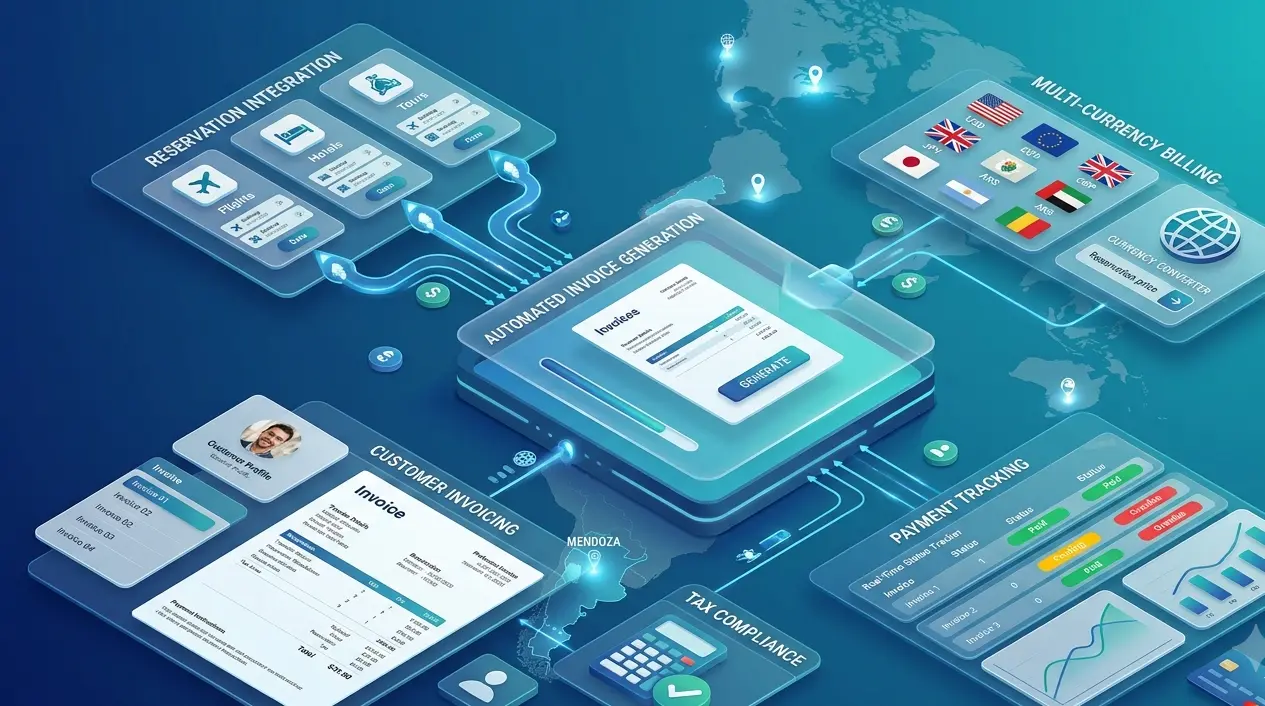
That is correct. But it is incomplete. What truly defines tour operator software is not the sum of its modules but how those modules communicate with each other. A system can have quotes, bookings, and accounting as separate compartments that do not update each other. Another can have the exact same three modules connected in such a way that every change in a booking automatically impacts the operation and the accounts, without manual intervention.
The operational outcome of these two systems is radically different. The first digitizes tasks. The second transforms how the business operates.
A tour operator does not work with isolated processes. They work with chains: a request becomes a quote, the quote becomes a booking, the booking becomes service coordination, the services become documentation for suppliers and guides, and all of this translates into financial movements that must be closed with precision. When this chain lives within the same system, the operation gains traceability, speed, and control. When it is fragmented across different tools, each link is a potential point of error.
How tour operator software works in practice
The operational flow of a tour operator has a logic that any specialized system must be able to support from beginning to end. Not as modules used separately, but as a continuous process where information flows seamlessly.
The entry point is always a request. An operator receives an order from an outbound agency, a corporate group, or a direct traveler. This request triggers a quoting process that, in a well-designed system, does not start from scratch: it starts from an already loaded database of services and rates, with each supplier’s conditions, seasonal pricing policies, and margins defined by client type.
The quote is generated, sent, and — when approved — converted into a booking without needing to reload information. What changed is the status of the record, not its content. This continuity seems like a technical detail. In practice, it eliminates a constant source of transcription errors and saves hours of weekly work.
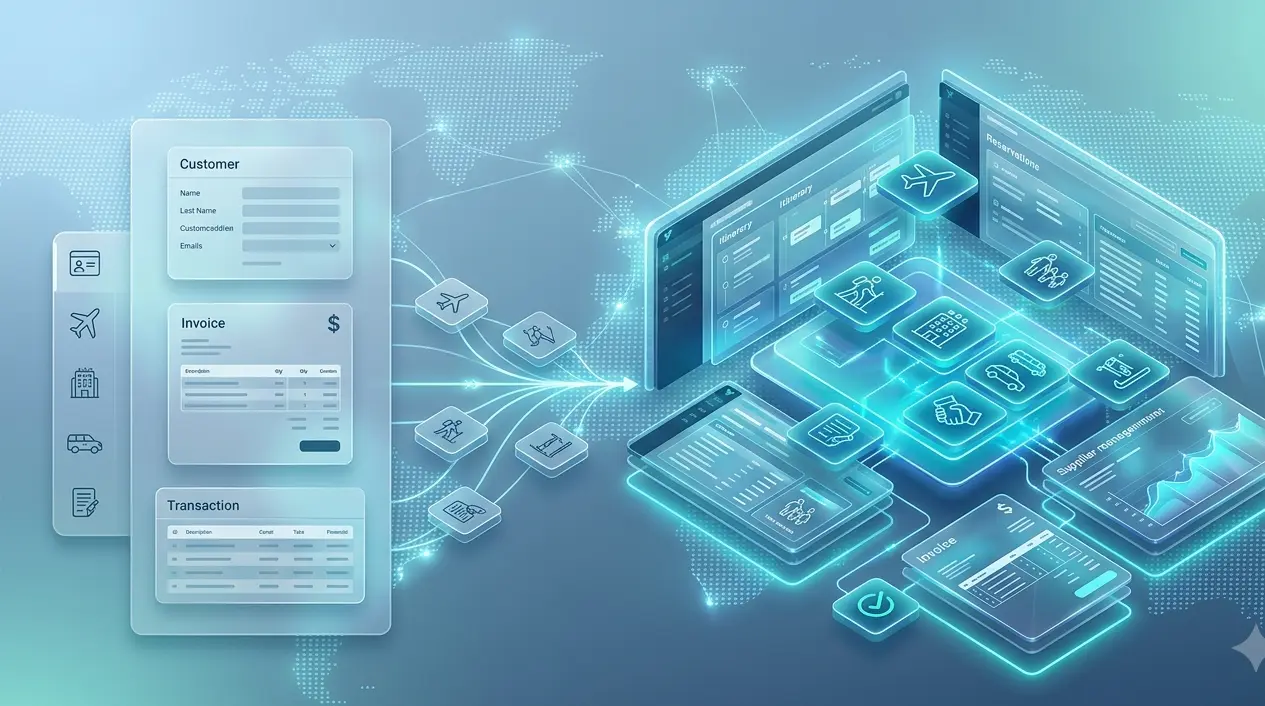
From the confirmed booking, the system distributes the information to the appropriate places: it generates service orders for suppliers, produces documentation for guides and transporters, updates the availability of assigned resources, and records the corresponding financial movements.
The following flowchart shows how this process is chained in an integrated system:
Client request
↓
Quoting from centralized database
(rates, margins, client-specific conditions)
↓
Approval → Confirmed booking
(no information reload, only status change)
↓
Automatic distribution to connected modules:
→ Service orders to suppliers
→ Documentation for guides and transporters
→ Availability and allotment updates
→ Movements in accounts receivable and payable
↓
Financial close
(real margin visible without manual reconciliation)
When this flow is integrated, the operator works within the system. When it is not, they work around it — and the difference in operational burden is significant.
Why tour operator software functions differently depending on the business model
The same core architecture can behave very differently depending on the operator’s business model. This difference is important for understanding what type of system each one needs.
An outbound operator designs and sells trips to destinations they do not manage directly. Their operation is focused on the commercial process: quick quoting, precise margin calculation, and coordination with external suppliers operating at the destination. The system needs to be especially agile in the sales layer — itinerary generation, proposals, and quotes — and robust in financial control per operation.
An inbound operator works in reverse. They receive travelers sold by another company. Their challenge is not sales but execution: coordinating guides and transporters, managing personalized services at the destination, generating precise operational documentation, and responding in real-time to last-minute changes. The system needs to be solid in the operational layer — resource allocation, allotment control, communication with local suppliers — and multilingual by necessity, as their clients are international agencies and operators.
| Dimension | Outbound Operator | Inbound Operator |
| Main Focus | Commercial process and sales | Operational execution at destination |
| Direct Client | End traveler or retail agency | Outbound agency or international operator |
| System Priority | Quoting speed and margin control | Service coordination and operational documentation |
| Multilingual | Useful but not critical | Structural requirement |
| Supplier Management | Remote coordination | Local network with allotments and B2B portal |
This difference is why a system designed from the logic of each operator type directly impacts team efficiency — and why the same generic tool rarely works well for both models simultaneously.
The capabilities that structure tour operator software
Beyond the business model, there is a set of capabilities that any tour operator software needs to support as a foundation. Not as modules to check off a list, but as a response to concrete operational problems that arise in daily operations.
Commercial response speed is one of them. An operator who takes hours to put together a proposal because they have to search for rates in separate files, calculate margins in a spreadsheet, and create the document in another program is absorbing with human effort what a well-designed system resolves in minutes. This speed difference has a direct impact on the conversion rate.
Tracking each operation from quoting to closing is another. When the status of a booking — supplier confirmations, intermediate changes, pending payments — lives in emails and parallel spreadsheets, information becomes fragmented and errors increase. When it lives in the system, any team member can know exactly where that operation stands without relying on the person who usually manages it.
Real financial control per operation is the third structural capability. An operator can close many sales and still have little clarity on their actual profitability if the financial movements of each booking are not automatically connected to accounting. When this connection exists, the margin of each operation is visible in real-time — without manual reconciliations at the end of the period.
And finally, the ability to generate useful reports from actual operations. Decisions about which destinations to prioritize, which suppliers to renegotiate, or how to distribute the team’s workload require reliable data. A system that automatically produces these reports turns existing operational information into a strategic tool.
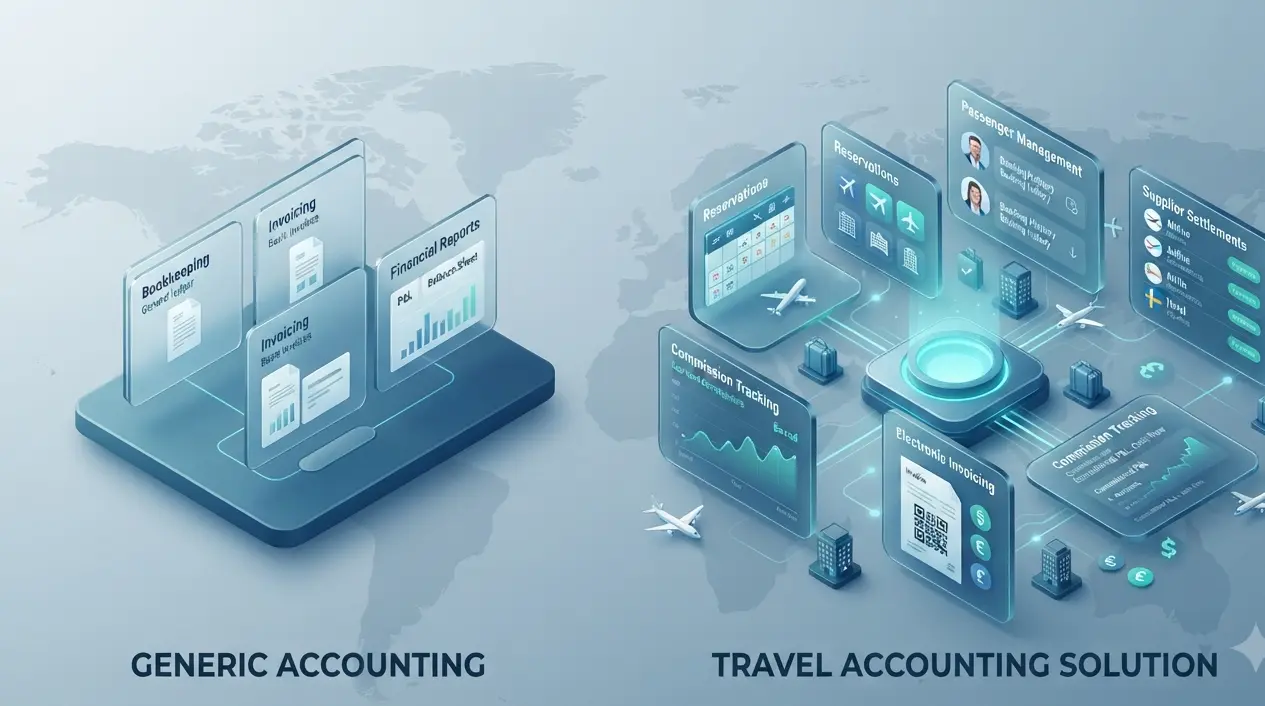
The differences between a generic system and a specialized platform become most visible precisely in these capabilities: a generic system may have all of them as modules, but without the integrated tourism logic from the architecture, the team ends up solving outside the system what the system does not cover.
What operations reveal when tour operator software is well-designed
When the system is misaligned with the operator’s logic, workarounds appear — the parallel solutions that the team builds to compensate for what the system does not cover. Additional spreadsheets, emails that function as records, informal conventions on how to name files so everyone can find information. These workarounds are symptoms, not habits. They indicate that the system was not designed for the operation it needs to support.
When the software is well-designed for the type of operator using it, these workarounds disappear — not because the team is more disciplined, but because the system already accounts for what previously had to be solved externally.
Platforms like Toursys — specifically designed for inbound and outbound tour operators, with an architecture that connects quotes, bookings, operations, and finances in a single environment — start from this logic in their design. Toursys’ tour operator software covers both models with multilingual support included and the ability to scale without changing platforms.
The most important definition of tour operator software
The technical definition is well-known. What is less often said is that well-implemented tour operator software not only organizes what already exists: it changes how the operator can grow.
When operations do not depend on people’s memory but on processes recorded in the system, incorporating new destinations, new markets, or new suppliers becomes a controlled expansion. This ability to grow without losing control is, ultimately, what distinguishes an operator that scales from one that stagnates at its current volume.