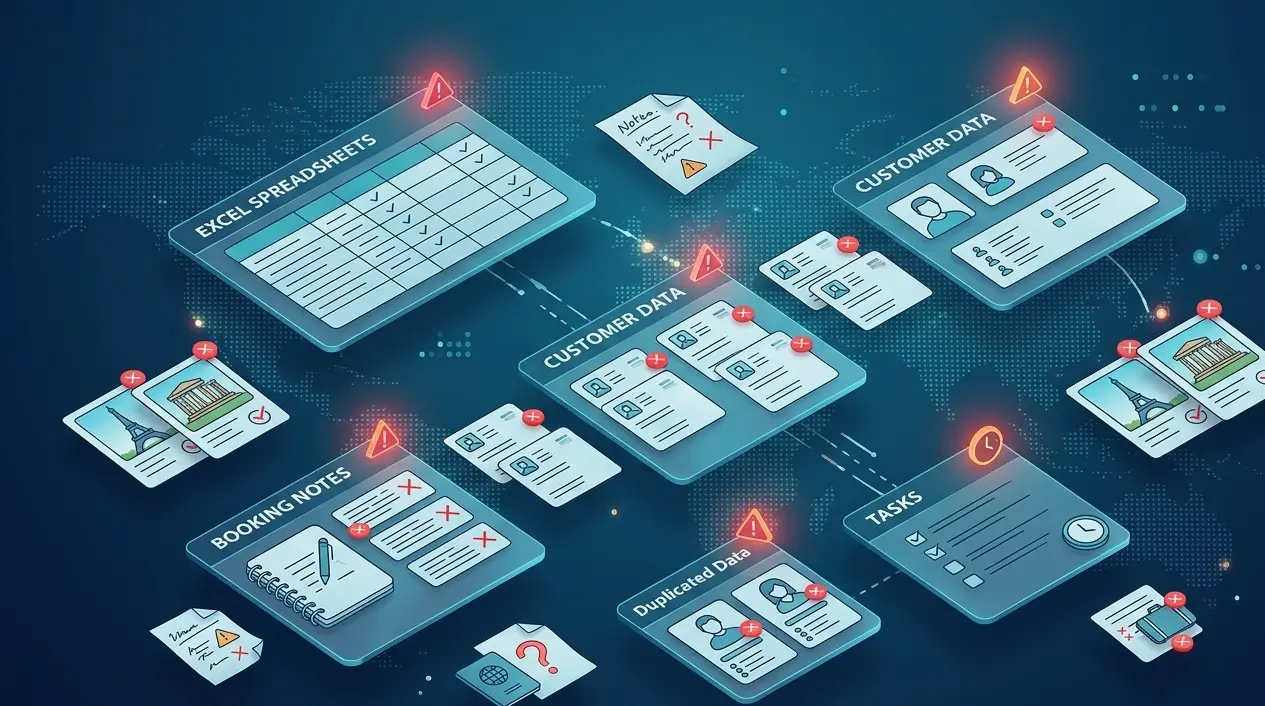
In an increasingly dynamic tourism market, having a good booking software is no longer a luxury, but a strategic necessity. Agencies, operators and DMCs that still manage their processes in isolated systems or spreadsheets end up facing delays, errors and cost overruns that reduce their competitiveness.
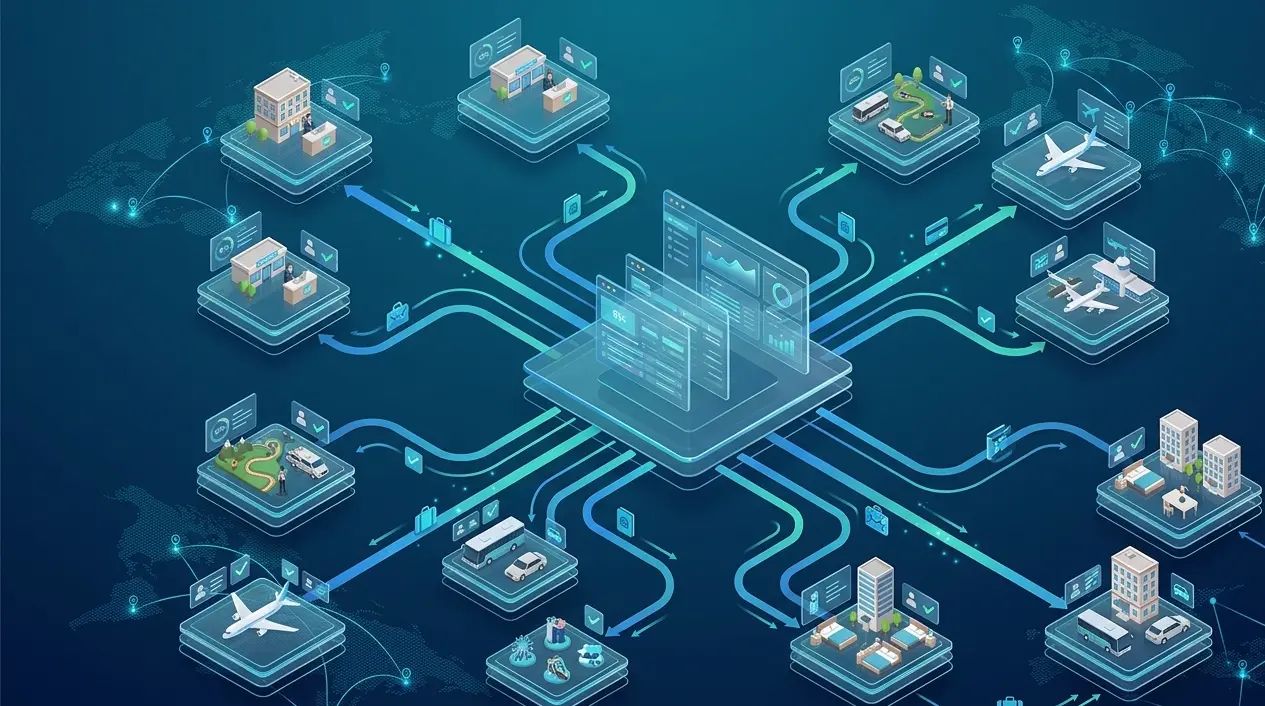
A modern booking software must be horizontally integrated, covering the entire business cycle. This starts with the quote prepared by the company or the direct sale generated by a B2B or B2C. Then, that quotation becomes a confirmed booking, which triggers key processes such as customer payment control, supplier prepayment management, and automatic generation of a projected cash flow based on confirmed sales.
But the most critical piece of this cycle is the operation, the heart of any tourism enterprise. A properly managed operation allows:
- Ensure that all services (hotels, tours, transfers, experiences) are confirmed in a timely manner.
- Reduce human errors such as wrong dates, duplications, omitted services or misassigned suppliers.
- Coordinate efficiently with suppliers, either through automatic digital confirmations or manual processes structured in the system.
- Have visibility of each booking in real time: what is confirmed, what is pending, what is at risk.
- Optimize the use of resources (vehicles, guides, quotas, allotments), reducing operating costs.
- Create a clear history for auditing, internal control and customer service.
A robust operation not only streamlines internal work, it directly impacts the end customer experience. When everything is recorded in a single system, operational staff can act fast, anticipate problems, coordinate frictionless changes and provide clear answers to the customer in seconds.
In addition, a well automated operation helps to reduce hidden costs, such as:
- Staff hours spent manually checking emails and reconfirming.
- Errors that generate reprocessing or compensation.
- Duplicate or misapplied payments.
- Cancellations due to lack of follow-up.
- Miscalculations in transportation logistics or activities.
In short, an efficient booking platform not only centralizes business information: it builds a seamless bridge between sales, payments, operations and suppliers, allowing the company to work with greater accuracy, speed and profitability.
A well-designed hotel reservation manager keeps pace with the real pace of a modern agency: fast, connected, integrated and totally focused on customer service quality.
Centralizing management: the basis for a simpler operation
The starting point for any robust solution is centralization. When bookings, quotations, suppliers and financials coexist in different systems, every change means duplicating work and multiplying errors.
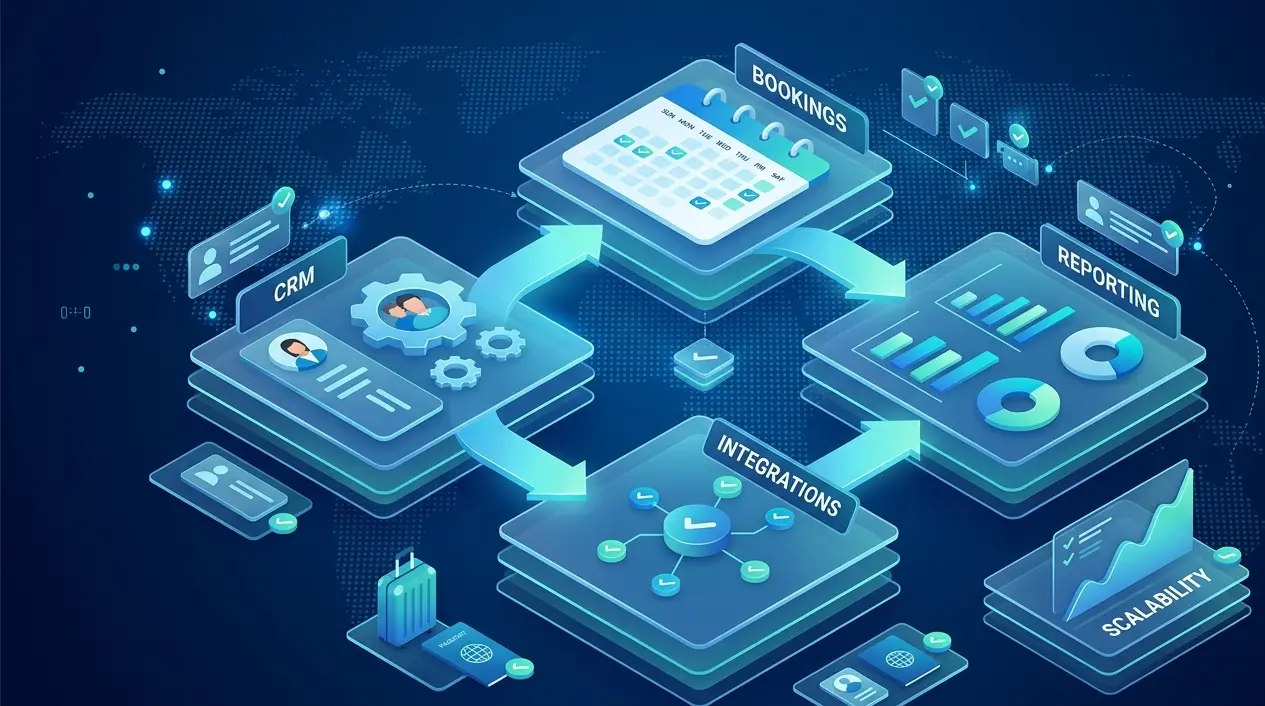
A comprehensive software allows you to manage the entire operation from a single platform: quotes, reservations, itineraries, invoicing, customers and suppliers. This unified vision reduces response times and allows each area to work on updated information.
A concrete example: an agency that manages groups and ground services often receives schedule changes or rate adjustments. In an integrated software, this change is instantly reflected in all linked modules – without intermediate emails or outdated files – ensuring operational consistency and smooth communication with the customer.
Integration with suppliers and real-time dynamic pricing
Good reservation software is not limited to organizing internal information: it must connect with the global tourism ecosystem.
Integration with bed banks, activities, transports and payment gateways allows the agency to work with always up-to-date availability and prices. This eliminates the risk of overbooking and improves margin control. Agencies can query dynamic rates and update their inventory in seconds. If a supplier changes a rate or sells out, the system automatically reflects this.
This type of integration not only avoids economic losses: it also provides confidence to the traveler, who receives accurate answers and real quotes in record time.
Quote, edit and confirm in minutes
In today’s travel industry, speed of response is key to closing sales. Generating a manual quote, checking with each supplier and sending a PDF document can take hours or even days. With an intelligent itinerary generator, agencies can create customized proposals in minutes, with up-to-date pricing and the ability to adjust services or dates in real time.
Let’s imagine a case: a passenger changes his travel dates or requests an alternative hotel. Instead of redoing the quote from scratch, the agent can recalculate with a click and resend the updated itinerary instantly. Each modification is automatically saved, ensuring traceability and consistency across teams. Productivity is multiplied and the customer experience is improved.
Self-management for customers and total flexibility for the team
Modern software must allow collaboration and self-management, both for partner agencies (B2B) and end customers (B2C).
Today, a good reservation system must offer personalized portals where each customer or partner can check availability, make reservations or check the status of their operations without depending on the commercial area. This frees up time for the internal team and improves the user experience, who can access updated information from any device.
For example, an inbound operator can give access to its network of international agencies to book their services directly. The system automatically manages rates, quotas and confirmation, while the operator maintains control of the entire operation in a single panel.
Support, security and technology that grows with you
Beyond the functionalities, a good booking software must offer reliable support and scalability, as well as accompany each client from implementation to daily operation, with live training, tutorials and multilingual technical assistance.
In addition, its modular structure must provide for scalability according to business growth: from small agencies to large international operators and guarantee security, remote access and constant updates, keeping the platform always aligned with the technological trends of the sector.
Checklist: the 10 must-haves of a good booking software
| Key element | Why it is important |
| Operational centralization | It unifies quotations, reservations, finances and suppliers in a single platform, reducing errors and management times. |
| Real-time integration | Connects with bed, transport and activity banks, showing automatically updated rates and availability. |
| Remote and multichannel management | It allows access and operation from any device, at any time and place, with total security. |
| 4. B2B and B2C self-management | Offers customized portals for partner agencies and end customers, enhancing the user experience. |
| 5. Intelligent itinerary generator | Create and edit customized digital itineraries in minutes, with automatic adjustments for any change. |
| 6. Process automation | Updates prices, confirms reservations and sends notifications without manual intervention, streamlining the operation. |
| 7. Reporting and integrated analytics | Measure sales, margins and operating performance with dynamic, real-time reporting. |
| 8. White label design | Allows you to customize brand, colors and domain, strengthening your visual identity to your customers. |
| 9. Multilanguage and multicurrency | Facilitates global operations with machine translations and AI-driven currency conversions. |
| 10. Continuous support and scalability | It provides multilingual technical support and constant updates that evolve with the business. |
Why does Toursys make a difference?
After reviewing the essential elements of a good booking software, a key question arises: which tool brings them all together and adapts to the real growth of an agency? Toursys is that alternative. A comprehensive platform designed for tourism companies seeking to modernize their management without slowing down their operations.
It integrates quotes, reservations, itineraries, finances and CRM in the same digital environment, allowing to work with updated data and reduce response times. Its differential is not only in the technology, but in the way it is implemented: flexible, progressive and without interruptions.
Progressive implementation: technology that grows with you
The implementation process allows the company to continue operating normally. The company can start with the essential modules -such as itineraries or booking engine- and add others over time, such as supplier integrations or payment automation.
This phased approach reduces the learning curve, facilitates equipment adoption and ensures fast results without stopping daily business.
Schedule a demo and discover how Toursys simplifies your reservations, connects all your processes and allows you to offer a more agile and professional experience to your customers.