Transforming an agency with a cloud program doesn’t start with the technology. It starts with the customer. Today, digitization impacts the traveler’s perception before it impacts the internal operation. Speed of response, clarity of propositions and consistency of service directly influence the purchase decision, even when the product is similar.
Understanding how an agency is transformed when it digitalizes its management allows us to think about the operation with more perspective. It is not a matter of adding tools, but of reviewing how the tourism service is provided in a context where expectations have changed structurally.
The tourist service is evaluated prior to sale.
Today’s traveler does not wait to travel to form an opinion. He evaluates from the first exchange. A confusing email, a late reply or an unclear proposal weighs as much as the price or the itinerary.
This higher bar does not arise from direct competition between agencies, but from the digital environment in which decisions are made today. Comparators, platforms, networks and multiple channels have accustomed travelers to having immediate options. Faced with this scenario, an agency can have excellent knowledge of the destination and still be at a disadvantage if its internal structure does not keep up with the pace.
Digital transformation then appears as a concrete response to this external pressure. Not as an optional internal improvement, but as a minimum condition to sustain credibility and professionalism.
Operational order: what the traveler does not see, but perceives
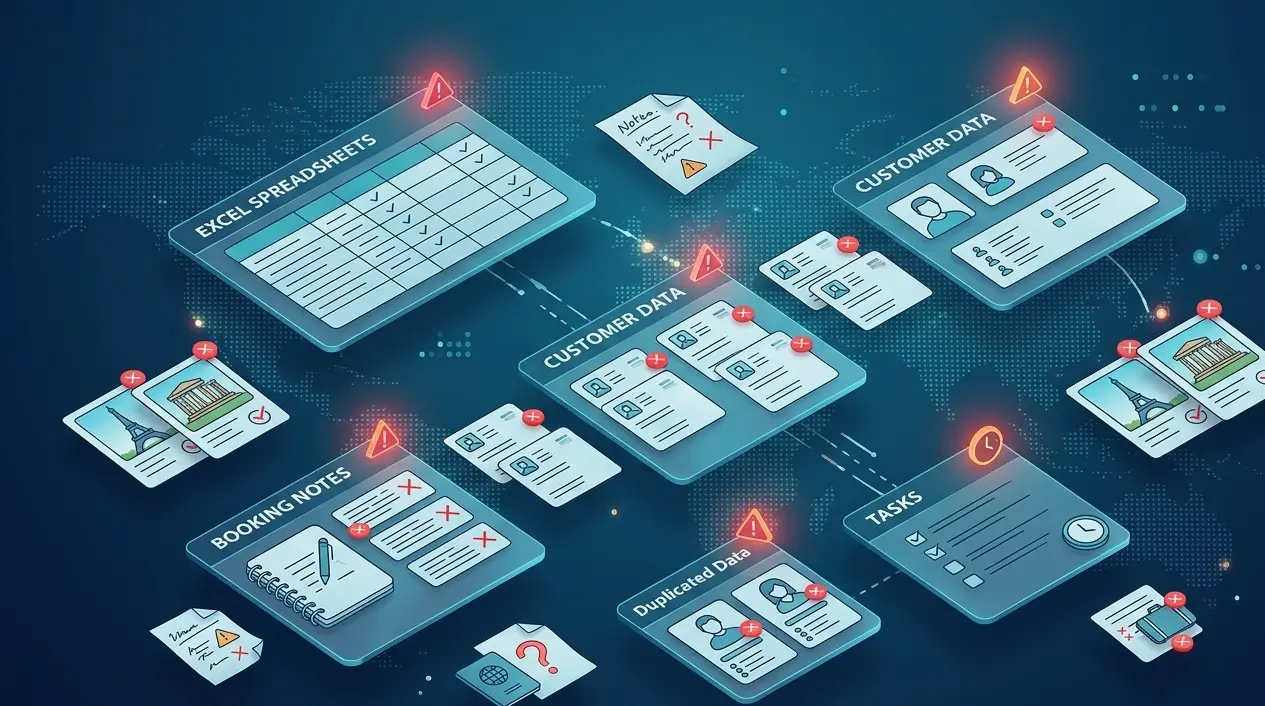
When information is dispersed, the impact rarely remains behind closed doors. It manifests itself in small frictions: delays, contradictions between versions, incomplete follow-ups. From the traveler’s point of view, these details make for an unreliable experience.
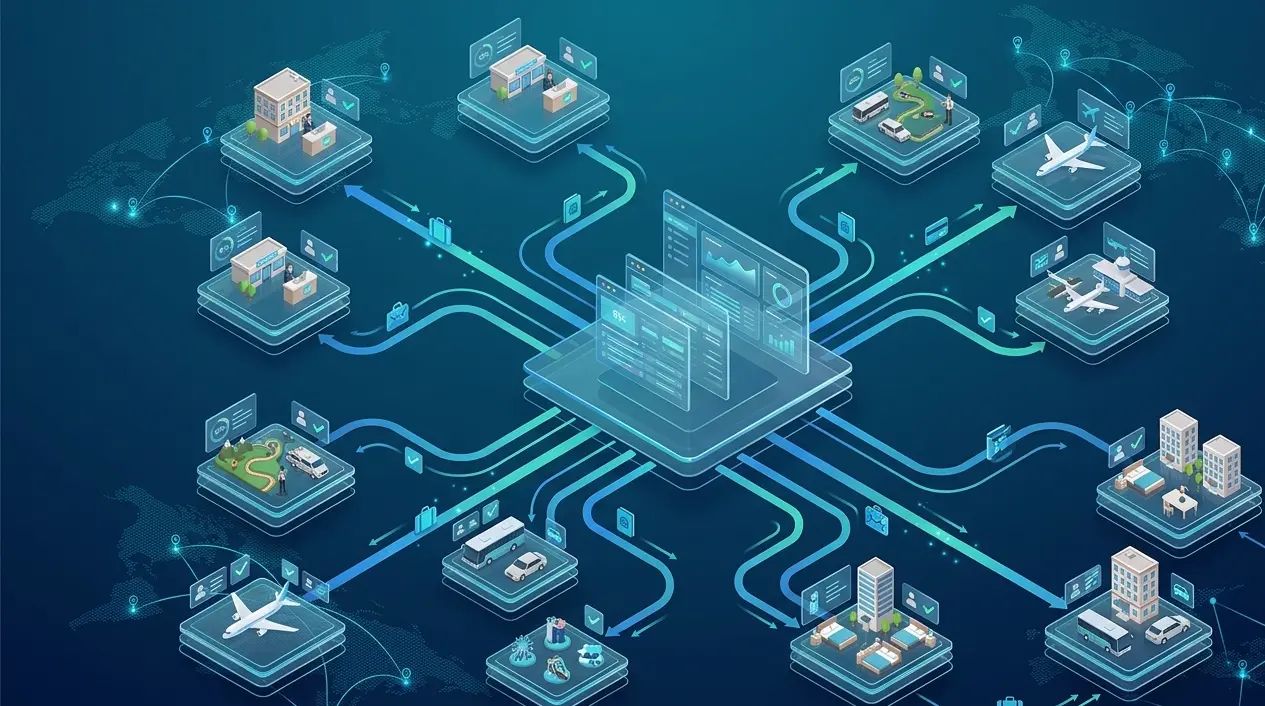
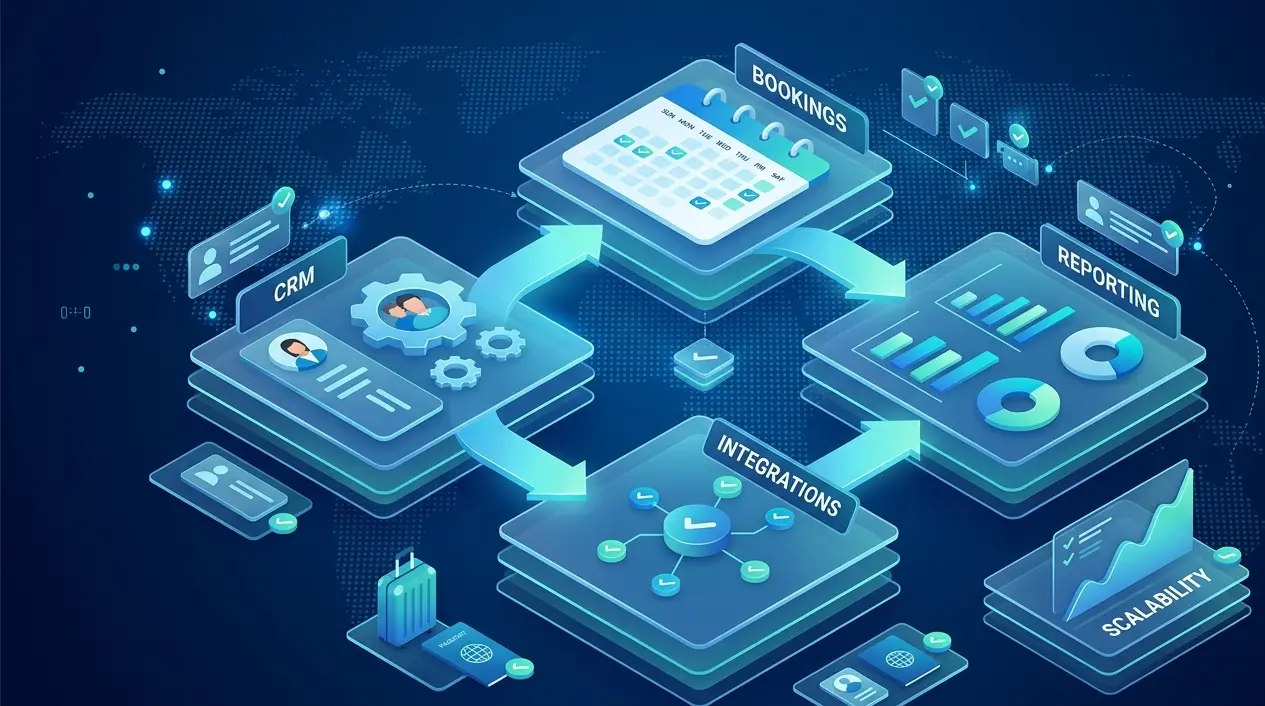
Centralizing management with a cloud-based program changes this dynamic. Sales, operations and administration work on the same information base. There are no parallel versions or excessive dependencies on key people. Coherence is no longer dependent on individual effort, but is supported by the structure.
This internal order is not communicated explicitly, but it is perceived. In the clarity of the answers. In the security of the proposals. In the continuity of the service.
Digitizing does not mean automating everything
It should be stated bluntly: digitizing does not mean replacing people with systems. It means ordering what should not consume human time. Repetitive tasks, manual calculations, cross-validations and fragmented follow-ups generate operational wear and tear and increase the risk of error.
When those processes are supported by cloud management, the team stops working to sustain the operation and can focus on improving service. There is no magic and no shortcuts. There is less friction, less rework and more focus on professional judgment.
Automation and management in the cloud as a basis for real efficiency
Many operating costs do not appear on the balance sheets. They accumulate in hours spent correcting errors, redoing proposals or verifying information that should have been available from the start.
Process automation, applied judiciously, makes it possible to reduce this invisible burden. Not to speed everything up indiscriminately, but to eliminate unnecessary steps and give continuity to the operation. When flows are connected, adjustments cost less and the quality of service is sustained even when volume increases.
Operational efficiency is no longer an abstract promise. It becomes a natural outcome of a clearer and more predictable structure.
Technology, new expectations and human judgment
Technology is already part of the tourism experience, even when the traveler does not mention it. They expect immediacy, clear information, well-presented proposals and a certain degree of personalization.
Artificial intelligence and automation systems raise market standards, but they do not replace human judgment. They order and enhance it. By freeing up operational time, the agency can devote more energy to interpreting needs, adjusting proposals and accompanying increasingly complex purchasing decisions.
This balance between technology and professional judgment is where much of the differential value lies.
H2: When an agency is ready to transform itself
Not all agencies reach this point at the same time. The need for transformation usually appears when certain signals start to repeat themselves: the volume of queries exceeds the manual response capacity, the team spends more time sorting information than selling, errors generate constant rework and the customer experience depends too much on specific people. When this happens, digitizing management is no longer an incremental improvement but a structural decision.
At that point, another key question also arises: not only when to transform, but how to do it. Not all cloud programs generate the same impact. Generic tools tend to force to adapt the operation to the system, instead of following the logic of tourism, where processes, times and the management of multiple variables are critical. For this reason, there are platforms such as Toursys, designed specifically for travel agencies, operators and DMCs, which incorporate human support during implementation, a decisive factor when digitization impacts on real processes, equipment and decision making, and not only in the way of uploading information.
Transforming the agency means redefining where the value lies.
A cloud program does not remove the human stamp of an agency. It protects it.
By optimizing time, centralizing information and reducing errors, the operation ceases to be a limit and becomes a solid foundation to compete, adapt and grow. Transformation does not occur when a tool is adopted, but when the agency manages to sustain a consistent and professional experience from the first contact.