For years, many travel agencies built their operation by adding tools according to the need of the moment. An Excel for sales, another for payments, a reservation system, e-mails for coordination and some separate administrative software. At first it works. In fact, it seems flexible.
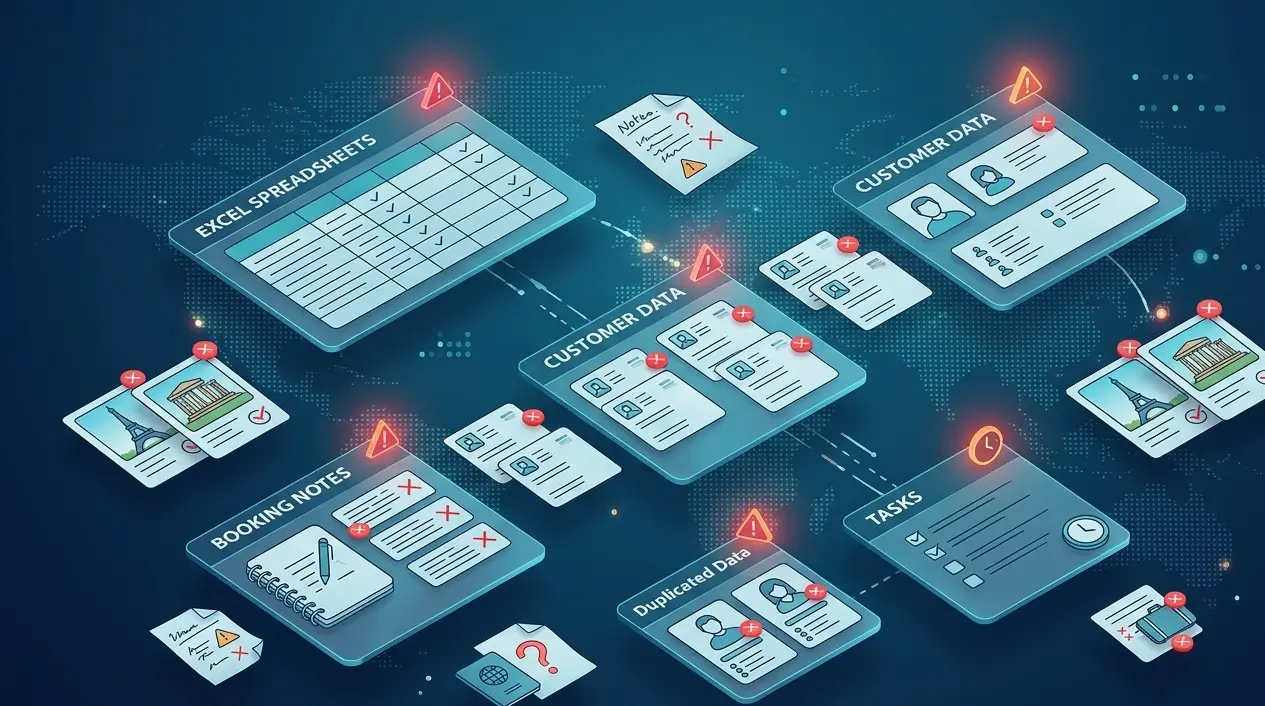
The problem appears when the volume grows and this logic begins to show cracks. What was once “orderly” becomes a fragmented structure, where each area works with its own version of reality.
That’s where the real risks of isolated systems in a travel agency arise: not as one-off failures, but as a root problem that affects the operation, decision making and customer perception.
What happens when you work with isolated systems in your travel agency?
In a tourism operation, each sale triggers multiple processes that should be connected: quotation, confirmation, transaction, invoicing, follow-up and analysis.
When these processes live in separate systems, it’s not just efficiency that breaks down. Continuity of information is lost.
The same reservation may exist in different versions depending on the area that consults it. Sales handles one piece of information, operations another, and administration a slightly different one. Not because there are obvious human errors, but because the system forces you to replicate data over and over again.
That break in the flow of information is the starting point for almost all subsequent problems.
The real risk of siloed systems: inconsistent information
Duplication of tasks is often mentioned as the main problem. But that is only looking at the surface. The structural risk is that information becomes unreliable.
Any time data is copied manually between systems instead of being managed from a
integrated system for travel agenciesIn this case, there is a possibility of error. It may be minimal, even imperceptible at the beginning, but cumulative. Over time, differences in rates, conditions, dates or services included appear. The result is not just rework. It is uncertainty.
And when an agency loses certainty about its own data, it begins to operate with a margin of error that is not always visible, but constant.
How stand-alone systems impact every area of the agency
To better understand this problem, it is useful to see it as a complete flow, not as isolated tasks.
| Area | Expected performance | What happens with isolated systems |
| Sales | Clear, fast and consistent quotations | Different versions depending on the channel or consultant |
| Operations | Execution aligned with what was sold | Differences between quoted and traded prices |
| Administration | Accurate financial control | Duplicate or incomplete reconciliations |
| Address | Reliable reports to decide | Fragmented or late information |
This misalignment does not always generate an immediate error that can be pointed out. In fact, many agencies operate this way for years.
The problem is quieter: the operation starts to rely on constant validations, manual reviews and informal controls that consume time and energy.
The hidden cost of working with non-integrated systems
One of the biggest risks of isolated systems in travel agencies is not what you see, but what you don’t measure.
When information is fragmented, reports cease to be a strategic tool and become an approximation. Decisions are made with incomplete or outdated data, which directly impacts profitability.
It is not always obvious, but it occurs in situations such as:
- products that seem profitable but are not
- miscalculated margins due to lack of cost integration
- difficulty in identifying which lines of business work best
Added to this is the time invested in reconstructing information before it can be used, something that is rarely accounted for but affects the capacity for growth.
Impact on the customer experience and brand image.
The customer does not know your systems, but he does perceive their consequences. When the operation is fragmented, signals appear that erode trust. Responses that take longer than expected, small inconsistencies in information or changes that require unnecessary explanations.
None of this is usually serious on its own. However, together they build a feeling that is difficult to reverse: lack of control.
In tourism, where service is intangible until it is experienced, that perception is critical. Trust is not only built with good products, but with consistency in every interaction.
Differences according to the type of agency: same problem, different effects
Although the origin is the same, the effects of isolated systems vary according to the business model. In outbound agencies, fragmentation directly impacts the speed and consistency of quotes. Each business interaction requires validating information in different locations, which slows down the process and increases the margin for error.
In inbound agencies, the problem is transferred to the operation at destination. Differences between what is sold and what is executed can affect the traveler’s experience, generating frictions that are difficult to correct in real time.
In tour operators, the challenge lies in coordination. When working with multiple suppliers and services, any misalignment is quickly amplified, generating a chain of adjustments that affects the entire operation.
In all cases, the pattern is the same: information does not flow continuously, and that conditions everything else.
Beyond technology: an operational design problem
It is tempting to think that this problem is solved by incorporating new tools. However, adding systems on top of a fragmented structure tends to deepen the problem rather than solve it.
The key point is not how many tools you use, but how the information flows between them.
When each area works independently, traceability is lost and dependence on manual controls increases. This limits the ability to scale without increasing complexity.
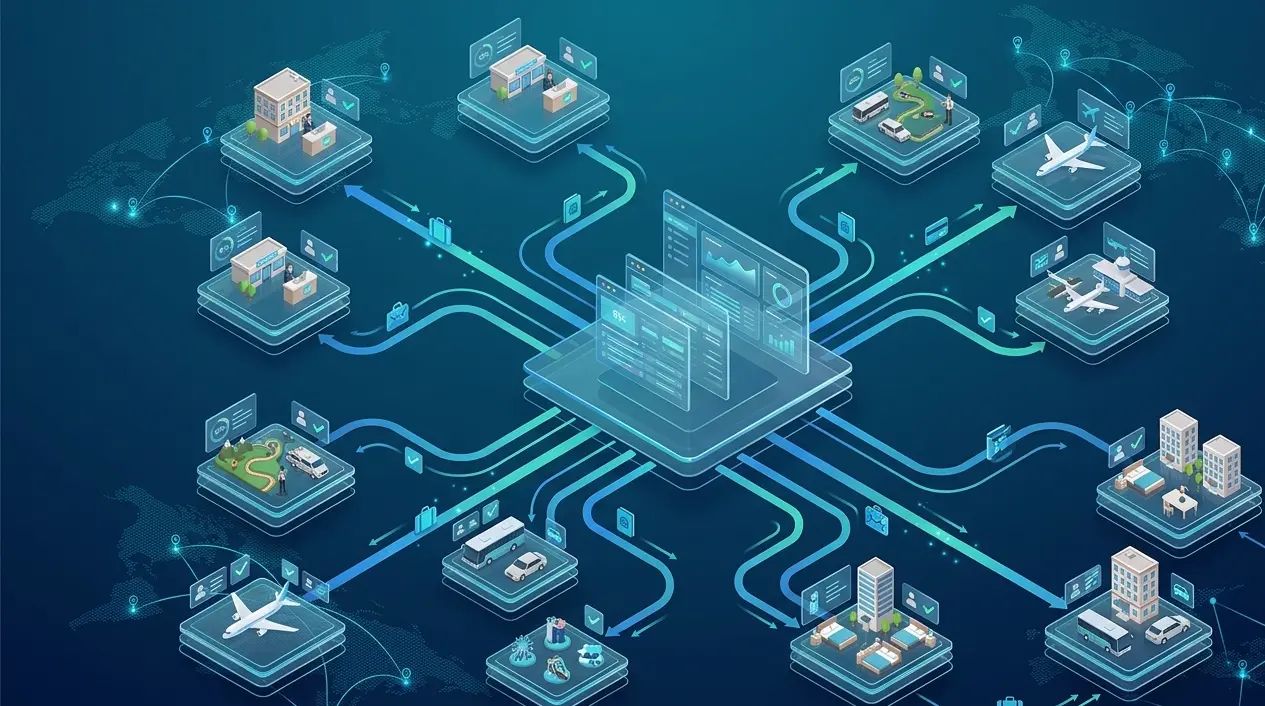
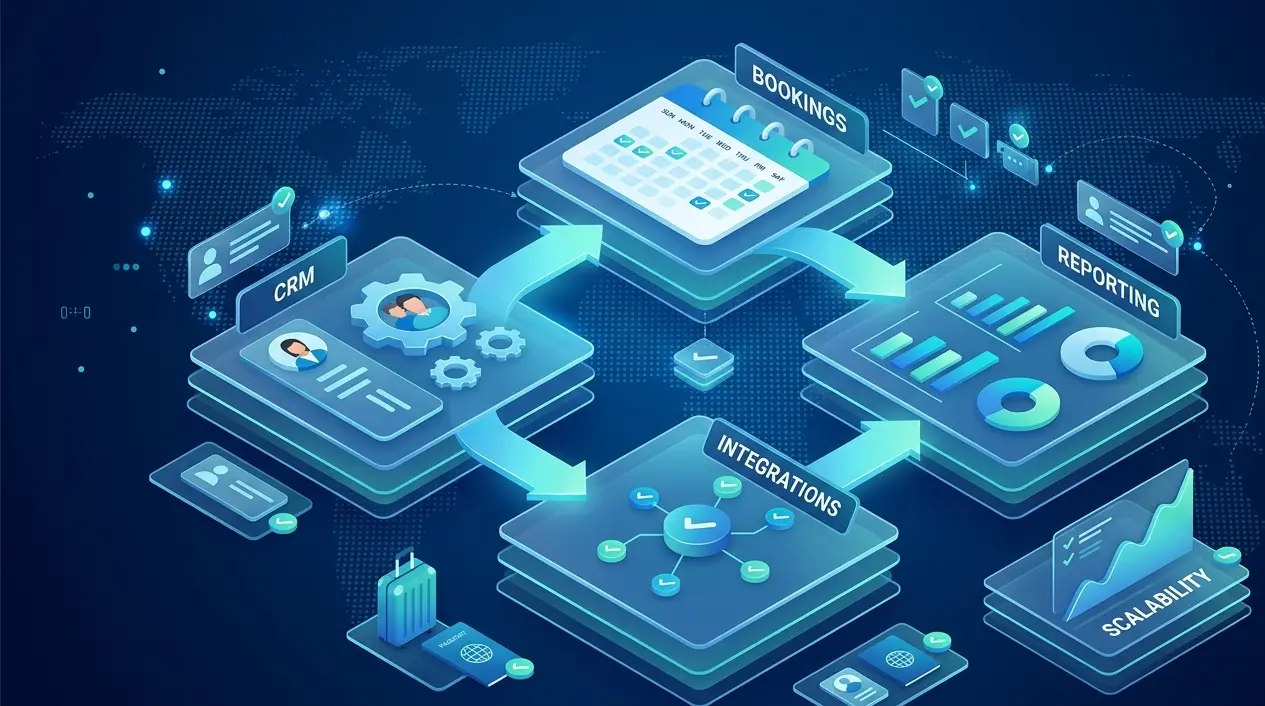
In contrast, when information is managed in an integrated way, the logic changes. Data is no longer replicated but shared, which reduces friction and improves operational consistency.
What changes when you leave behind isolated systems
Moving from isolated systems to an integrated model is not just a technological improvement. It is a change in the way the agency organizes its operation. The difference is felt at several levels:
- information is recorded only once and used throughout the operation
- the areas work on the same basis, without reinterpretation.
- processes become more predictable and less dependent on validations
But, above all, you regain something fundamental: confidence in the data. When you know that the information is consistent, you can make decisions with greater clarity and project growth without relying on constant adjustments.
A final thought on how to address this problem
At this point, many agencies begin to question whether the problem lies in the tools they use or in the way they are organized. The answer is often both.
Tourism has a particularity: sales, operations and administration are not independent areas, but parts of the same flow. When this flow is fragmented, the operation loses coherence. Therefore, rather than looking for isolated solutions, the challenge is to rethink the system as a whole.
On that path, there are platforms designed specifically for travel agencies, such as Toursyswhich are based on this integrated logic and accompany the implementation with close human support. It is not just about technology, but about understanding how the tourism operation really works.
And therein lies the difference.