For years, Excel has been the natural tool for organizing clients, quotes and bookings in many travel agencies. It’s flexible, accessible and almost any team knows how to use it. That’s why issuers, inbound and tour operators often start there when the operation is still manageable.
The problem arises when the volume and complexity of information grows. More simultaneous queries, more passengers, multiple versions of quotes, date changes, different suppliers and conversations spread between mail, WhatsApp and internal files. At that point Excel ceases to be an organizational solution and begins to generate friction.
Migrating to a CRM usually appears as a possibility. But before evaluating tools, it is important to understand what this change really involves and how to do it without losing critical information in the process.
What happens in an agency before migrating from Excel to CRM?
Excel does not fail for lack of functions. It can calculate, filter and organize large volumes of data. The problem appears when the operation ceases to be individual and becomes dependent on several people working at the same time.
In a travel agency, information is not static. A quotation may change several times before it becomes a booking. A client may consult different destinations for weeks. Conversations add context that is then key to closing the sale or operating the trip.
When that flow of information lives in separate spreadsheets, duplicate files or personal notes, maintaining a clear view of the process becomes increasingly difficult. Teams start spending time reconstructing information that should be immediately available.
At that point the question is no longer whether Excel is enough. The real question is how to organize the information so that the entire company can work in the same context.
Signs your agency has outgrown what Excel can solve
There are certain symptoms that often appear when an operation begins to rely too heavily on spreadsheets.
Customer information is distributed in different files
Each agent usually keeps his or her own track. When someone is absent or changes roles, it can take hours to reconstruct a customer’s history. Some of the information remains in the main file, some in internal notes and some in emails.
Active quotes are difficult to trace
It is not always clear which proposal is current, which was sent to the customer or what modifications were made in each version. This creates confusion for both sales and operations.
Conversations with the customer are left out of the system
Much of the context of the journey lives in emails or messages. If that information is not associated with the customer or the quote, retrieving it later becomes complex.
Coordination between areas depends on reminders
When information is not centralized, the operation depends on messages, informal notices or manual file reviews.
These symptoms do not mean that the agency is malfunctioning. Rather, they indicate that the company has reached a level of activity that requires another way of organizing information.
The speed of response also defines whether the customer trusts
In tourism, response time has a direct impact on the customer’s decision. A person making an important travel inquiry – often a significant financial investment – expects to receive a clear and timely response.
When information is scattered, responding may take longer than expected. The agent needs to review files, confirm data, search for previous conversations or reconstruct the quote.
This delay is not always visible internally, but it is perceived by the customer. And in many cases the reaction is simple: if the response takes too long or arrives incomplete, the traveler continues to look for alternatives.
No one would entrust the planning of a trip or a significant investment to a company that does not demonstrate organization and clarity in its communication.
A CRM allows you to keep customer history, quotes and interactions in one place. This makes it easier to respond faster and with more continuity, something that in tourism directly influences the perception of professionalism.
Migrating to a CRM is not just a change of tool
One of the most common mistakes is to think of migration as a simple transfer of data. In reality, the change involves redefining how information flows within the company.
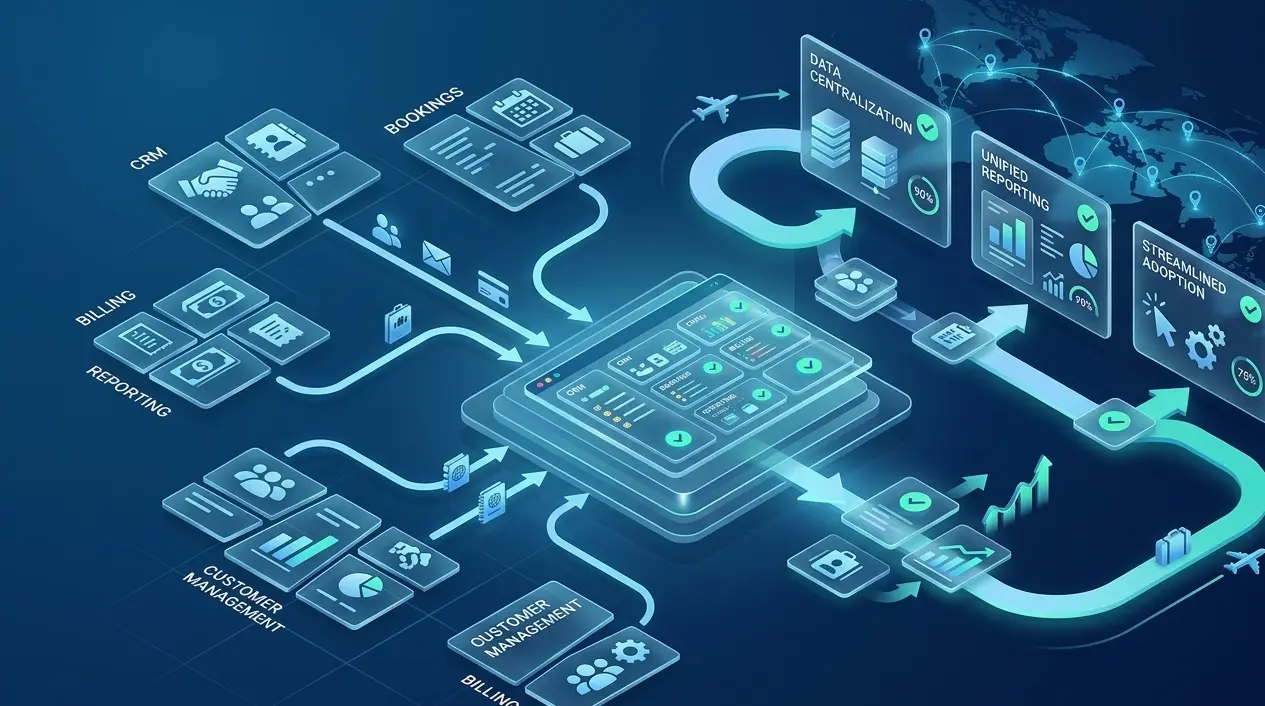
Migrating from Excel to CRM means moving from individual files to shared records. The information no longer depends on who created the file and becomes part of a system where all teams can consult the complete history.
This allows every interaction with the customer to have context: past inquiries, quote versions, preferences or special conditions. The company starts working with live information, not isolated files.
Biggest mistake when migrating from Excel to CRM: moving data out of order
Many companies are afraid to migrate because they believe they may lose important information. In practice, the problem is often different: moving a messy database to the new system.
If the files contain duplicate contacts, inconsistent fields or notes without context, that same disorganization can be replicated within the CRM. This is why prior preparation is one of the most important steps in the migration. Before importing information, three things should be reviewed:
- What data is really necessary for the operation. Not everything in a spreadsheet has operational value.
- Eliminate duplicates or records that are no longer relevant. Clean bases facilitate any further processing.
- Define how future interactions will be recorded. Without clear rules, even the best system can end up reproducing the initial dispersion.
What changes after migrating from Excel to CRM
When data is organized in a shared system, the impact is quickly felt in the work dynamics. Each customer has a clear history of interactions. Quotes are recorded along with their modifications. Teams can understand what stage each inquiry is at without relying on personal files.
This reduces the time spent searching for information and improves continuity in communication with the customer.
In addition, the company gains visibility into its commercial activity. It can understand how many inquiries are open, which proposals are active and which require follow-up.
In tourism, where decisions are often made with partial information and under time pressure, having that visibility changes the way the operation is managed.
A realistic roadmap for migrating from Excel to CRM
Implementing a CRM for travel agencies does not necessarily imply a long process. In platforms designed for tourism, the implementation can be done in a few weeks if the base information is prepared correctly.
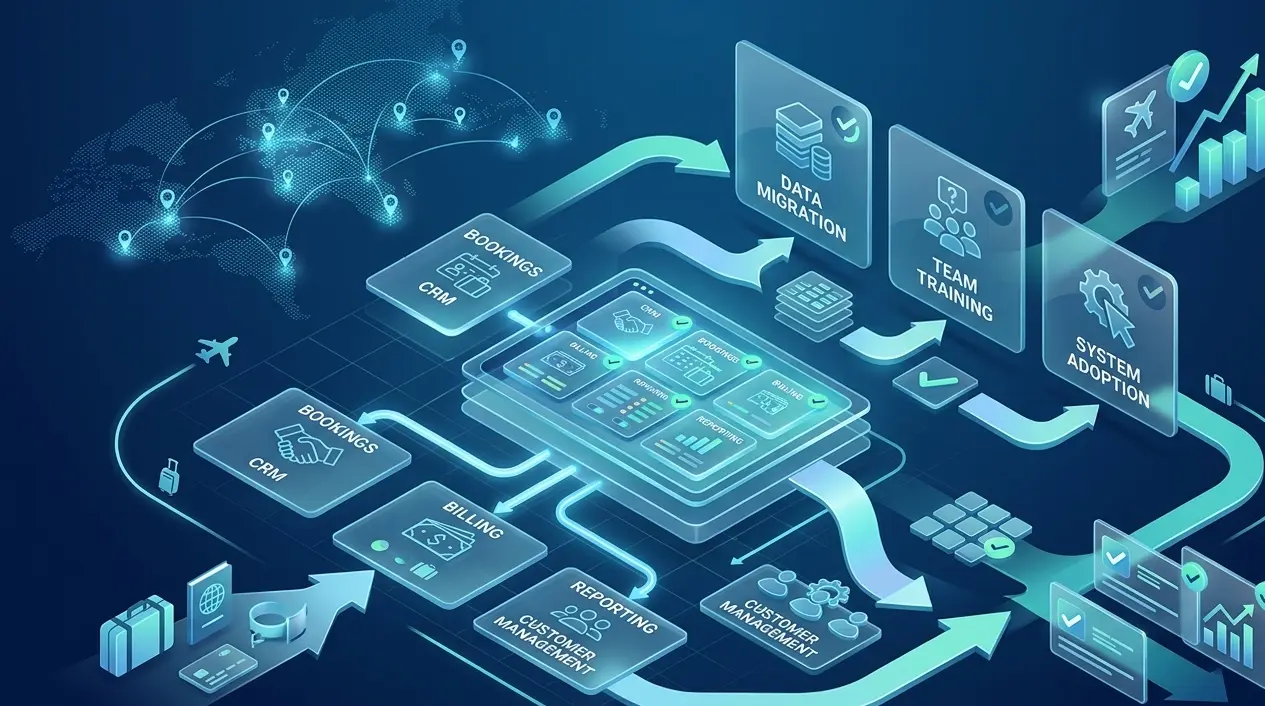
A typical Excel to CRM migration process is usually organized in the following steps:
- Review and cleanup of Excel files: identify duplicates, eliminate obsolete records and define what information will actually be useful within the CRM.
- Data structure definition: establish how records will be organized within the system: customers, contacts, suppliers, services or relevant notes.
- Initial data load from Excel: import the base information using templates or structured files to move customers, suppliers and other records without rebuilding the base manually.
- Start of CRM operational use: register new queries, quotations and interactions directly within the system to start centralizing information.
- Training and process adjustment: accompany the team in the adoption of the system and adapt the use of CRM to the real dynamics of the company.
In platforms specifically designed for travel agencies, this process is usually accompanied during the initial configuration, allowing them to start operating quickly with the information already centralized.
Migrating from Excel to CRM often marks a change of phase in the company.
The transition is not simply a matter of abandoning a familiar tool. Rather, it reflects that the company has reached a level of complexity that requires another structure for managing information.
Agencies that go through this process often discover that the value of CRM is not just in storing data, but in organizing the way information flows within the company. And when information stops living in isolated files and becomes part of a shared system, the organization gains clarity, responsiveness and a stronger foundation for growth.