Implementing tourism software without stopping the operation is a step that many agencies and operators know they will have to take sooner or later. The question is how to do it in a way that strengthens the operation, rather than disrupting it or generating internal friction.
Before evaluating tools or suppliers, it is important to understand what is at stake: how the way you operate communicates to the outside world, what consumer trends are transforming the industry and what steps are involved in an implementation that really works. This article helps to reflect on these aspects with data, examples and a clear implementation model.
What your operation communicates outwardly (and why it matters)
The way of operating not only affects internal efficiency: it is a constant message to customers, suppliers and alliances. Even when today everything is solved “in a timely manner” with manual methods, this flow communicates structural signals that impact trust and the perception of professionalism.
Imagine two scenarios when receiving a quotation:
- An agency that responds with multiple versions, scattered attachments and manual corrections.
- Another that delivers consistent, up-to-date and traceable proposals, with a clear change history.
The former conveys uncertainty, risk of error and dependence on key people; the latter, security, predictability and control. In increasingly competitive travel markets and with complex B2B decisions, these perceptions directly influence who you work with again, what commissions you accept and how you negotiate terms or conditions.
In addition, operational inconsistency often translates into greater friction in negotiations with suppliers: unsynchronized changes, availability errors or misaligned versions of tariffs. This attrition has a real relational and commercial cost, although it does not appear on any balance sheet. When information begins to be organized and centralized, one of the first effects is usually a smoother interaction and fewer unnecessary clarifications on a day-to-day basis.
Consumer trends and digitization: facts you can’t ignore
Digital transformation is no longer an idea of the future: it is a structural reality in global tourism.
Some clear trends confirm this:
- The global market for travel technologies – platforms, booking engines and automation – is growing steadily, at annual rates of more than 8% in key segments.
- The digital travel market, which ranges from search and booking to integrated management tools, exceeds $600 billion and continues to expand at a rapid pace.
- The online travel agency sector, one of the drivers of this transformation, is already worth more than $250 billion and is growing at a rate of close to 8% per year.
- More than 60% of large travel and hospitality companies in markets such as the U.S. and U.K. already use automation or artificial intelligence tools for reservations, customer service and marketing.
- The use of digital solutions by travelers, especially in younger generations, is changing expectations for speed, personalization and consistency of service.
These data do not reflect a technological fad, but a profound change in how tourism is consumed and managed. As the ecosystem goes digital, agencies need to design more orderly and coherent internal operations, capable of adapting frictionlessly to these new standards.
How to implement tourism software without stopping the operation: a phased model
Successful implementation is not a one-time event, but a process that combines diagnosis, adaptation and operational continuity. The following is a pragmatic model with clear steps.
1) Diagnosis of the operation
Before any tool, it is essential to understand how to work today.
- What are the recurring bottlenecks?
- Which tasks consume the most time without providing strategic value?
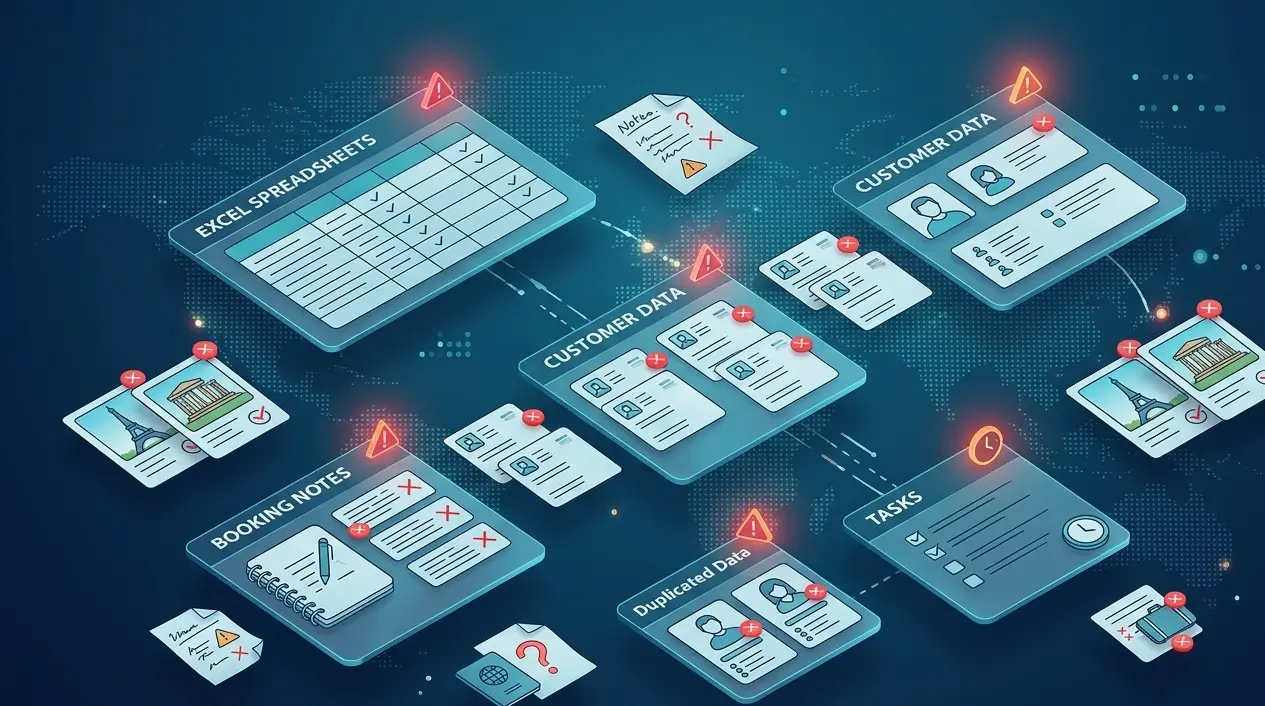
- What information lives in silos (spreadsheets, emails, notes)?
- What processes depend on memory or a specific person?
This diagnosis does not seek perfection, but a realistic reading of the operation. From there, it is possible to prioritize which processes need order before automating, and begin to perceive early improvements without altering the pace of work.
2) Definition of value criteria
Tourism software is not just technology: it is a means to align processes with desired results.
It is important to define what value is expected from digitization:
- Traceability of versions and quotations
- Synchronization of availability and rates
- Reduced friction in communication with suppliers
- Improved response times to customers and partners
It is not a matter of enumerating functionalities, but ofidentifying what specific change is sought in the operation and how to measure it against the current situation.
3) Progressive configuration (phased implementation)
To implement tourism software without stopping the operation, it is key to avoid massive changes from one day to the next. Digitalization works best when it is incorporated gradually, accompanying the actual pace of work.
Phase 1: Order the essentials of the operation
In the first stage, the system is used to solve the most basic day-to-day issues: working with a single version of each quotation, centralizing changes and ensuring that the entire team has access to the same information. It does not change the way we work, but it reduces errors, confusion and rework.
Phase 2: Connecting currently separate processes
Once the essentials are in order, progress is made in avoiding duplicated tasks. Processes such as suppliers, rates or reservations are connected to reduce manual controls and improve the fluidity of the operation, without adding complexity to the team.
Phase 3: Improving and consolidating the way of working
When the system is already part of the daily work, adjustments and training are carried out to standardize tasks and improve internal coordination. At this point, digitization ceases to feel like a project and is integrated naturally, without slowing down the activity.
4) Measurement and feedback
A seamless implementation keeps the operation active, but it also requires observing what changes in practice. Measuring does not mean evaluating the software, butcomparing how the operation works before and after digitization. At this stage, indicators such as the time it takes to generate a quote, the number of corrections needed, the frequency of conflicting versions or the internal perception of repetitive tasks allow to detect real improvements and adjust processes. Measurement functions as a continuous learning tool that helps to consolidate more orderly and sustainable habits.
The importance of human support and sectoral specificity
Not all software is the same. A tool designed for tourism incorporates logics, terms and flows specific to the sector that are not present in generic solutions. This facilitates frictionless implementation and shortens the adaptation curve.
Human support is also key. Having support, training and follow-up during each stage reduces the risk of digitalization depending on trial and error. In this sense, platforms such as Toursys exemplify how tourism software, with a sectorial approach and support during implementation, can help to organize the operation and move forward without significant interruptions.
Think before you automate
Implementing tourism software without stopping the operation is not an empty promise or a single recipe. It is the result of thinking strategically about the operation, diagnosing what changes matter, adapting processes and accompanying the team in the transition.
Approaching this challenge from an understanding of the business – and not from a sense of urgency – makes it possible to move forward in a sustainable way, with less friction and with results that begin to be perceived even in the early stages of the process.