Implementing a new management system, especially when it impacts billing, is usually one of the most sensitive moments in the evolution of a travel agency. It is not just a matter of adding technology, but of changing the way in which collections, payments and financial information are organized, without jeopardizing daily operations or the relationship with clients and suppliers.
For outbound, inbound and DMC agencies, implementing a billing system without slowing down your agency’s operation involves finding a balance: moving towards a more orderly and professional environment without stopping the business while the change takes place. The real challenge is not technical, but operational and human.
This guide addresses that critical point and proposes a realistic approach: how to prepare the new system in advance and execute an orderly change at a defined cut-off point, keeping the operation active without losing control and visibility.
Implementing a billing system without slowing down the operation: the principle that orders everything
Implementing without slowing down does not mean doing it automatically. It means not interrupting the operation, not losing financial traceability and not forcing the team to work blind during the transition.
One of the most frequent mistakes is to think of the implementation as an improvised change, when in fact it requires careful prior preparation that respects the real time of the business. Agencies that manage to implement a billing system without slowing down the operation prioritize continuity: they maintain their daily activity while the new system is prepared and validated in advance and define a cut-off point at which billing stops being issued in one environment and switches to the other, without overlapping.
The real starting point before implementing a billing system
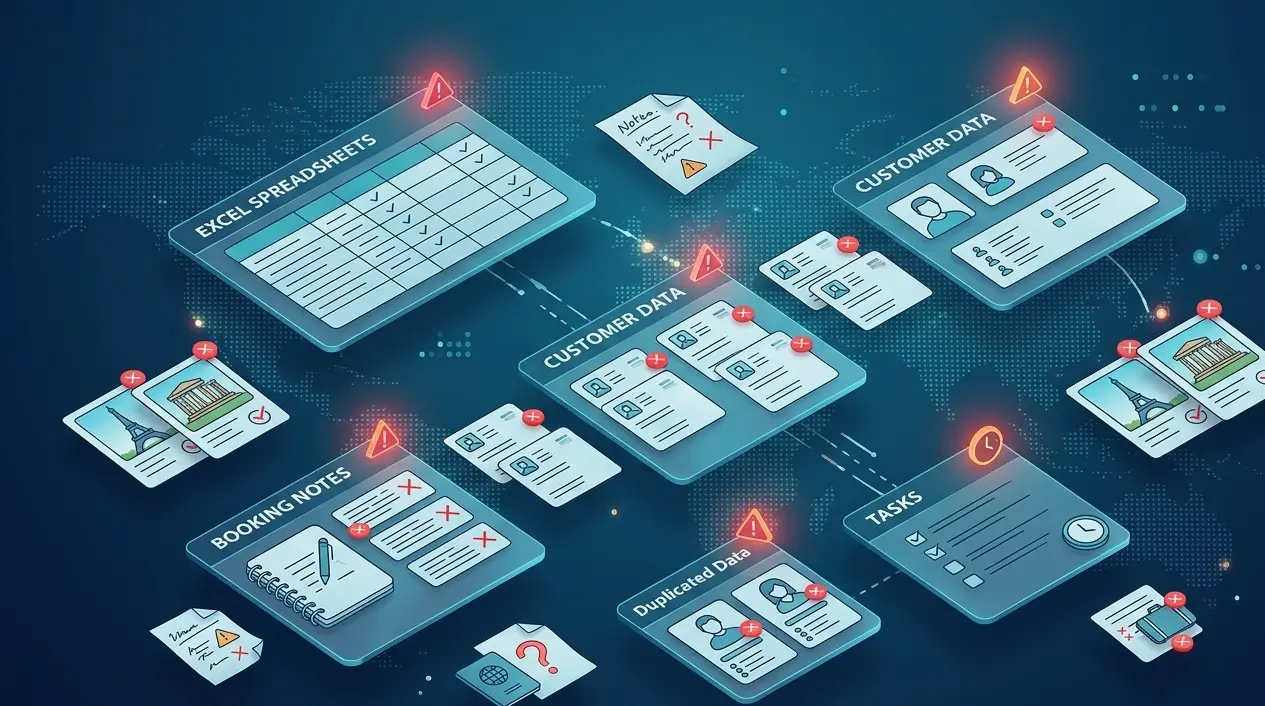
Most agencies come to this process from two common scenarios. Some operate with Excel, a flexible and well-known tool, but fragile when volume grows. Others use generic billing or accounting systems that solve the basics, but do not take into account the logic of tourism.
The problem is not the starting point, but how to manage the moment of change. In invoicing, it is not possible to operate in parallel with two active tax systems: cryptographic keys make it necessary to define a clear cut-off point.
Implementing an invoicing system without slowing down your agency’s operation involves preparing the new environment in advance, validating processes and data, and defining a specific moment when invoicing stops being issued in one system and switches to the other, without overlapping or improvising.
Best practices for implementing a billing system without slowing down the operation
Not all agencies implement a billing system in the same way, but those that do so without slowing down the operation usually follow a clear logic: prepare everything before the changeover and execute the handover at a defined time.
During the preliminary stage, the new system is configured without intervening in active billing. Structural business data – customers, suppliers, services and operational rules – are loaded and flows are validated to ensure that they work correctly. This preparation allows the system to be ready before going into production.
Then, the change occurs at a defined point in time: you stop billing in the old system and start billing in the new one. From that moment on, invoicing continues in a single environment, without duplication or operational risks. In this way, the operation is not slowed down, but billing maintains the legal and technical consistency it requires.
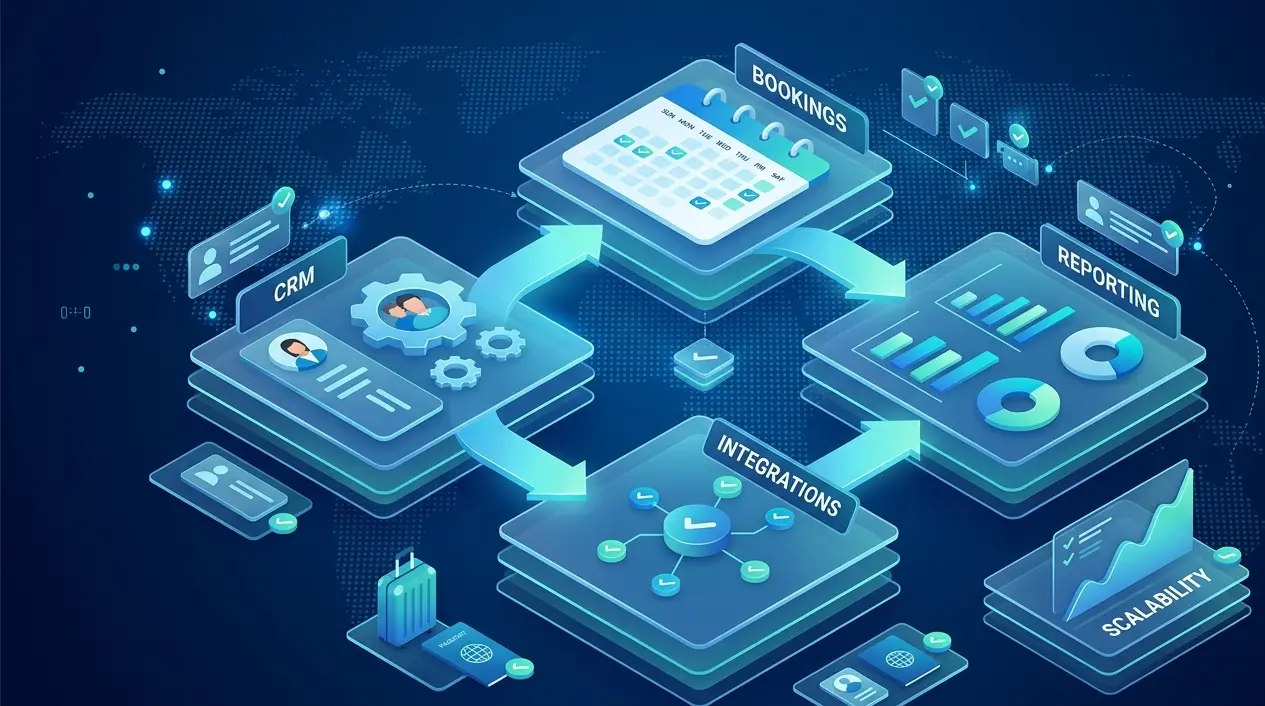
Regarding the scalability of the modules, many agencies start using the system only for new quotes and bookings. In this way, the team becomes familiar with the operational flow without affecting ongoing operations or migrating complex historical information.
Invoicing is incorporated later, when the operational circuit is already mastered. Thus, financial transactions reflect real operations and the margin of error due to lack of context is reduced.
Finally, training by role and at specific times facilitates adoption. Sales, operations and management learn what they need when they need it, avoiding overloading the team from the start.
This phased approach reduces risk and makes implementation a natural transition, not a disruption.
Why not all systems can be implemented without slowing down the operation
Not just any system will do to implement an invoicing system without slowing down your agency’s operation. Many programs are designed for industries with immediate sales and linear processes, which is rare in tourism.
It is common to find systems that require invoicing at the time of sale, when in tourism there are future services and payments at different times. Others do not distinguish between collections from clients and payments or prepayments to suppliers, mixing revenues with costs and distorting cash flow. There are also tools that do not contemplate service commissions or that operate in a single currency, forcing manual controls.
When the system does not adapt to the business reality, the agency ends up adapting to the system: it adds parallel spreadsheets, external validations and duplicated processes. Instead of facilitating the transition, the implementation becomes an obstacle.
What changes when the turnover accompanies the tourism operation
When billing is supported by the actual operation, order appears almost immediately. Bookings generate consistent financial movements, receipts and payments are associated with specific services, and reports reflect what is happening, not an after-the-fact reconstruction.
This change not only saves time. It allows you to answer key questions with real data: what’s been collected, what’s outstanding, what’s due and what margin is left on each transaction. For a growing agency, that visibility is a silent but decisive advantage.
The role of support in implementing a billing system without slowing down the operation
Beyond the software chosen, there is a determining factor: support. Implementing without slowing down requires someone who understands the tourist operation and knows in which order to activate each part of the system.
At Toursys, the implementation is designed as a guided process. The platform has a basic accounting module that organizes internal information, an accounts receivable and payable module adapted to the logic of tourism and an invoicing module that works on reservation information.
In countries where electronic invoicing exists, this module allows to integrate and resolve the issuance of electronic invoices natively. In other contexts, the strength lies in ordering and centralizing operational and financial information, maintaining consistency between sales, collections and management, without slowing down the operation.
Implementing today with the growing agency in mind
Implementing a billing system without slowing down your agency’s operation is not a marketing promise, but the result of choosing technology designed for tourism and a realistic implementation method.
At this stage of consideration, the key question is not which system has more features, but which one best understands your business, your operational rhythm and your context. Taking the time to inform yourself today is what allows you to implement with confidence tomorrow.