When people talk about digitizing the administration in a travel agency, they almost always mention the obvious: saving time or reducing errors. However, these are only the most visible effects. In practice, the real changes appear when the operation grows and less obvious tensions begin to emerge: data that do not match, decisions made with incomplete information and teams that work more than necessary to sustain the same level of activity.
It is at that point that the hidden benefits of digitizing administration cease to be a theoretical promise and begin to transform the way the agency operates.
Hidden benefits of digitizing the administration in the face of digital fragmentation
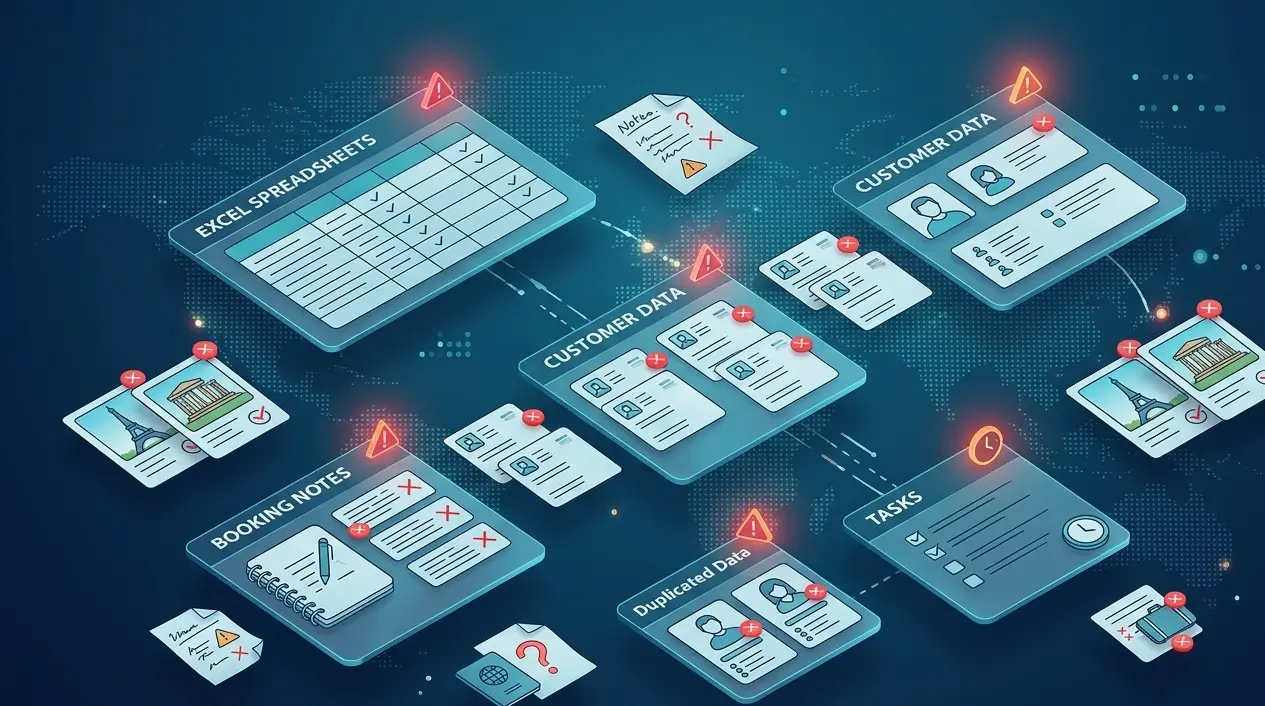
Many agencies already use digital tools, but not in an integrated way. They are digitized in parts, which in practice creates more problems than it solves. You quote in one system, calculate costs in spreadsheets, invoice in another tool and follow up by mail or courier. Everything seems orderly, but the information does not flow consistently.
This phenomenon, known as digital fragmentation, has a direct impact on operational efficiency. According to the McKinsey Global Institute, workers can spend nearly 20% of their time searching for and reorganizing information. Several analyses published by Harvard Business Review in recent years also warn that the dispersion of data and systems increases operational errors, especially in organizations where multiple areas are involved in the same process.
In a travel agency, where every booking goes through sales, operations and administration, this disconnect is not a technical detail. It is a structural limitation that affects control and decision making.
Hidden benefits of digitizing administration that really change the operation
Real-time profitability control
Without integrated management, profitability analysis is often late. Results are reviewed at the end of the month, forcing the company to explain deviations instead of preventing them.
When you move into travel agency back-office digitization, that logic changes. You can detect variations in costs or margins as sales occur, quickly identify which products are underperforming, and adjust decisions accordingly.
The impact is cumulative. It’s not just about better reporting, but about intervening at the right time.
Less rework, more focus on valuable tasks
Much of the administrative work is unseen. It’s in correcting errors, searching for data, copying information between systems or validating numbers that don’t match. It’s a constant drain that is rarely measured, but directly impacts productivity.
When you decide to digitize your agency’s administration, this effort starts to be reduced because the information is no longer duplicated. Data is loaded once and used throughout the entire flow, without the need to reconstruct it at each stage. According to Deloitte, integrated processes can reduce up to 30% of the time spent on repetitive tasks. In an environment like tourism, that means not only efficiency, but real capacity for growth without increasing equipment.
Full traceability without human dependency
In many agencies, understanding what happened to an operation involves piecing together the story across systems and conversations. This creates dependency on key people and makes any analysis difficult.
With a digitized administration, every action is recorded within the flow. You can follow a booking from quotation to invoicing without relying on the memory of the person who managed it. This change, while seemingly technical, has a direct impact on the quality of service and the ability to resolve problems quickly.
Centralized information that improves decision making
When data are scattered, analyzing them requires time and effort. This limits the frequency with which decisions are made and reduces the depth of analysis.
On the other hand, when information is centralized, you can observe patterns, compare margins between products or anticipate financial problems with greater clarity. Management ceases to be a reactive area and becomes a basis for understanding the business in real time.
How digitizing an agency’s administration impacts its business model
The impact of digitizing the management of a travel agency is not uniform. It changes according to the type of operation and, above all, according to where the main frictions are concentrated.
Emissive agencies: volume without losing control
In outbound agencies, growth is often accompanied by a progressive loss of visibility on margins. Sales volume increases, but so do the deviations that go unnoticed: outdated rates, misapplied commissions or differences between what was quoted and what was executed.
When management is digitized, these mismatches are no longer hidden in the volume. For example, you can identify that a specific destination is being sold less profitably due to recent changes in suppliers, or detect that certain commercial channels generate less margin than others. This allows you to adjust quickly without slowing down your operation.
Incoming agencies: coordination between operation and costs
In inbound agencies, the challenge lies in coordination. Each itinerary involves multiple services that must be executed with precision, and any change impacts the cost structure.
When management is not integrated, this information is easily misaligned. An adjustment in a supplier may not be reflected in the final calculation, or an operational change may not be updated in the administration.
By digitizing the administration, this gap is reduced. Changes are reflected throughout the flow and make it possible to understand, for example, how a one-off change in a move affects the total margin of an entire program. This provides a much more accurate view of the business.
Tour operators: climbing with control
For a tour operator, the main risk is not the punctual error, but its repetition. When you work with structured products, any deviation in costs or conditions is replicated in multiple sales.
Without digitization, this control depends on manual reviews that become unworkable as volume grows. With integrated management, on the other hand, you can adjust a base cost and ensure that change automatically impacts all associated operations. This allows you to scale without errors multiplying.
When the hidden benefits of digitizing administration become apparent
Many agencies postpone this process because the operation continues to function. However, there are clear signs that the model is starting to fall short: the team spends more time sorting information than analyzing it, the numbers do not match between areas, or certain people become indispensable to sustain the operation.
When these situations become frequent, digitization ceases to be an optional improvement and becomes a structural necessity.
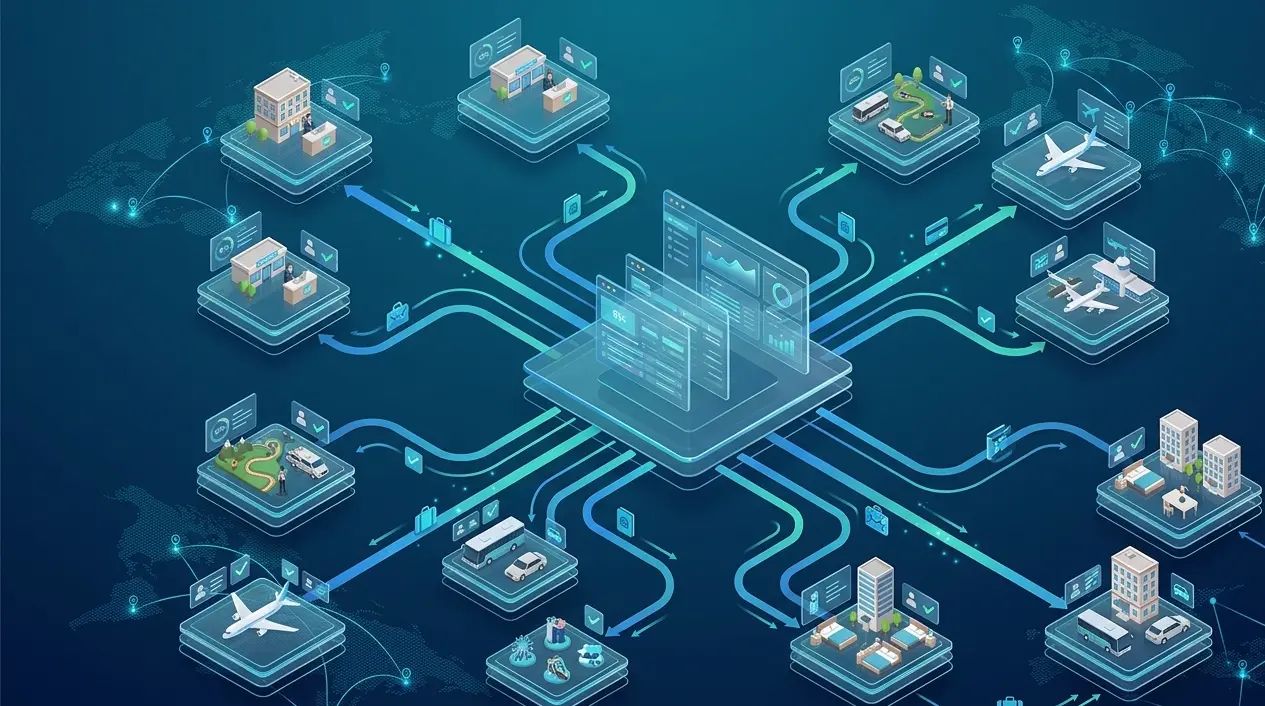
Digitizing administration means integrating, not adding tools.
One of the most common mistakes is to incorporate new tools without resolving the integration between them. This does not simplify the operation, but makes it more complex.
The real change occurs when management connects with sales and operations within the same flow. At that point, information is no longer fragmented, and technology becomes an enabler rather than a complicator.
The role of specialized tourism software
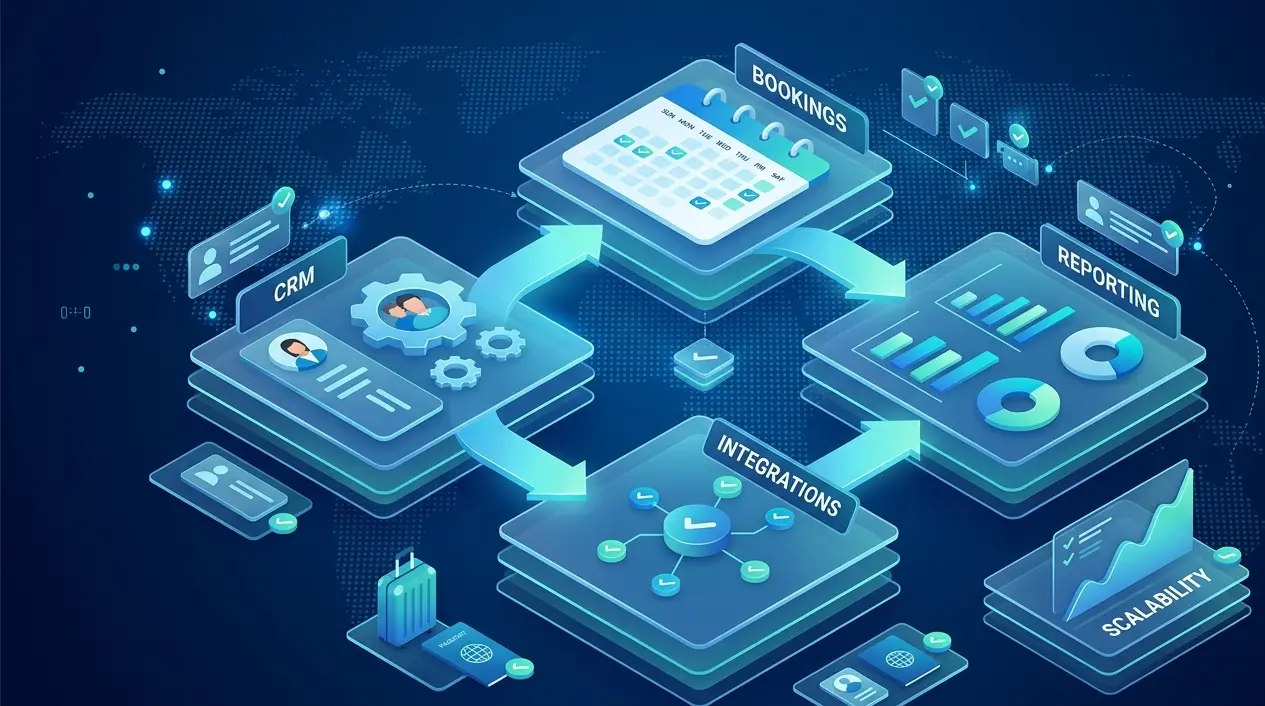
Travel agencies operate in a dynamic environment, with multiple suppliers, variable itineraries and constant changes. This complexity means that generic systems are often unable to adapt without friction. For this reason, administrative digitalization in travel agencies is often supported by solutions designed specifically for the sector, where administration is not an isolated module, but part of an integrated system.
In this context, platforms such as Toursys accompany this process not only through technology, but also through human support, which is key when it comes to transforming the way an agency manages its operation.
A transformation that redefines business
The hidden benefits of using administrative software in your travel agency are not always immediately apparent, but over time they impact the most important: greater control, better understanding of the business and the ability to grow without losing order.
Digitizing an agency’s administration is not just about better organizing what already exists. It is to start managing with a level of clarity that was simply not possible before.