Implementing a reservation system for travel agencies is not simply incorporating a digital tool. It is to intervene in the operational heart of the business: where customers, suppliers, rates, payments and critical times converge.
If you are investigating how to implement a travel agency reservation system, you have probably already detected clear signs: quotes that take too much time, scattered information, excessive dependencies on key people or repeated errors. This guide is designed to help you evaluate the implementation from a strategic perspective, understanding operational implications before analyzing suppliers.
What really changes when you implement a reservation system
A reservation system transforms the agency’s operational structure. By automating repetitive tasks and centralizing information, it reduces the need for manual intervention at every step of the process. This translates into time savings, greater efficiency and optimization of human resources, as the team can handle more volume with the same structure or redistribute functions to higher-value tasks.
In an agency that works manually or with generic tools, the flow usually looks like this:
- An agent receives the query.
- Other validates availability with suppliers.
- Finance confirms payment terms.
- Multiple emails are sent to adjust details.
- The information is replicated in different spreadsheets.
Each step involves human intervention and risk of inconsistencies. When there is a reservation system designed for tourism, much of that flow is articulated within the same environment. The reservation is not an isolated file: it is the trigger for interconnected operational and financial movements. The impact is not just speed. It is traceability, control and consistency.
Processes with and without reservation system for travel agencies
The following is a conceptual comparison focused on reserves, which allows us to visualize real operational differences:
| Appearance | No specialized system | With tourist reservation system |
| Persons involved in a standard reservation | 3 to 5 areas involved (sales, operations, finance, management) | 1 to 2 people manage within the same environment |
| Average quotation time | 1-3 hours (according to complexity and manual validations) | 15-30 minutes with templates and parameterized rates |
| Risk of errors in tariffs | High (copy/paste, multiple versions) | Low (centralized tariffs and business rules) |
| Tracking of changes | Scattered mailings and conflicting versions | History integrated in the reserve |
| Margin control per operation | Subsequent manual calculation | Automatic display by reservation |
| Scalability | Limited by human capacity | Scalable according to volume without duplicating structure |
This difference doesn’t just translate into time savings. It changes the way the agency can grow without losing control.
Stage 1: Assess operational maturity prior to implementation
Not all agencies are ready at the same time to implement a travel agency reservation system. The decision depends not only on size, but also on the level of internal organization and operational pressure faced by the team.
Before moving on, it is worth analyzing three signs that indicate whether digitization is becoming a structural necessity.
Operational volume and complexity
The first indicator is the volume of bookings and the variety of services you manage. Operating tailor-made programs with multiple suppliers, seasons and rate bases requires more control than selling standard products.
As complexity increases, so does the risk of errors and rework. If the team spends more time validating information than generating new sales, the model begins to show limits.
Fragmentation of information
How does information circulate within the agency? Separate spreadsheets, long email chains or different versions of the same quote are often red flags.
Fragmentation is not always evident until an error occurs. Evaluating this point makes it possible to identify how much the operation depends on the individual memory and how much it is actually structured.
3. Reliance on critical manual processes
Rate validation, margin calculations, payment updates or repetitive confirmations often absorb time without providing strategic value.
When these processes depend entirely on human intervention, growth becomes proportional to the increased workload. Detecting these dependencies helps determine whether a reserve system can provide operational stability and efficiency.
Step 2: How to select a booking system for travel agencies
At this stage, the question is not “what functionality does it have”, but “what problems does it solve and how does it impact my operation”.
Some key criteria:
- Real integration between reserves and administration.
- Parameterization of business rules (payment methods, categories, commissions).
- Multi-currency and multi-language if you operate internationally.
- Ability to manage suppliers, services and availability in a single environment.
- Cloud access with real-time information.
A frequent mistake is to choose generic software that forces to adapt the operation to the system. In tourism, the opposite is true: the system must understand the logic of deferred services, prepayments, consolidations and constant changes.
Stage 3: The importance of the demo in the decision
At this informational stage, you’re not hiring yet. You are understanding.
A demo should not focus on impressing with screens, but on answering concrete operational questions:
- How to create a real reserve step by step?
- How is it recalculated in the event of a change of dates?
- What happens automatically when it is confirmed?
- How does it impact accounts receivable and payable?
Observing the complete flow allows you to evaluate whether the system follows your agency’s logic or fragments it.
In the case of platforms such as Toursys, the demo usually shows how a booking automatically triggers movements in connected modules (customers, suppliers, rates, operation and accounting), evidencing structural integration. Beyond the brand, what is relevant is to understand this systemic approach.
Stage 4: Planning implementation without slowing down the operation
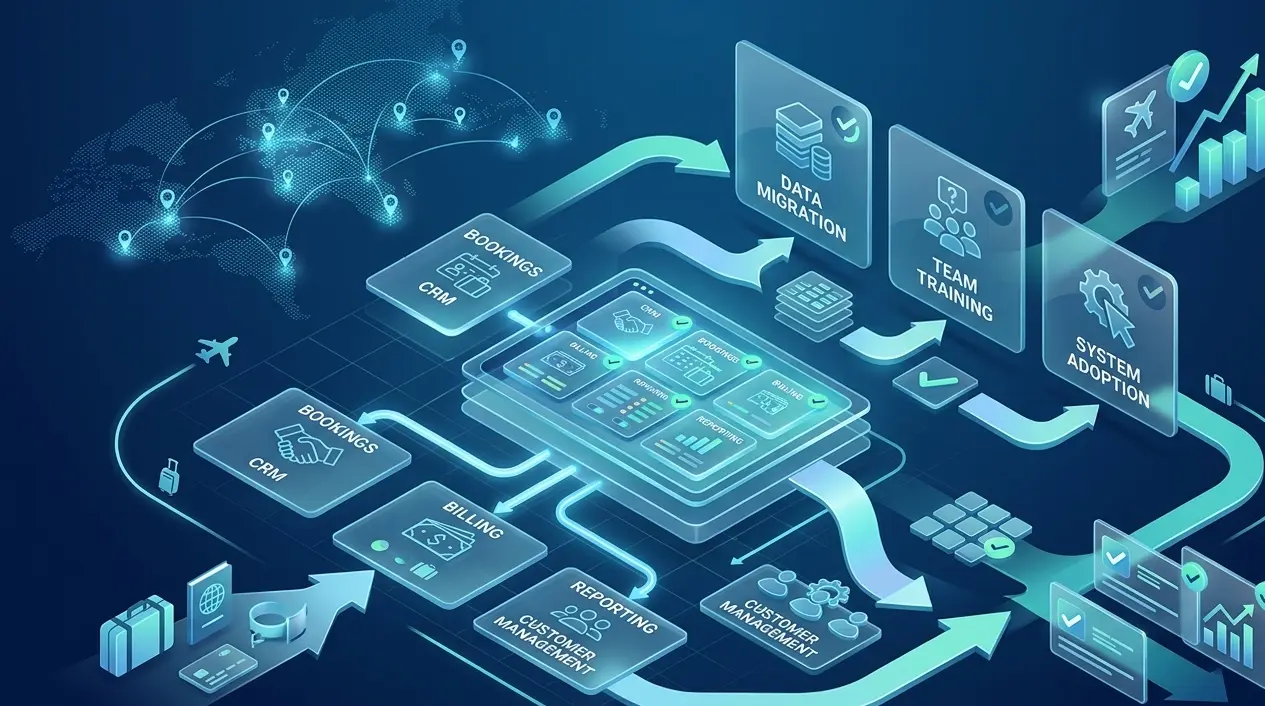
Going digital does not mean stopping the business. A responsible implementation of a travel agency reservation system is usually organized in phases:
- Initial parameterization of customers, suppliers and services.
At this stage, the basis of the system is configured: client structure, supplier data and types of services, ensuring that they reflect the operational reality of the agency. - Loading of base rates and business rules.
Seasons, commissions, payment policies and special conditions are defined here, establishing clear criteria that will then be automatically applied to each reservation. - Start with new quotations while maintaining active reserves outside the system.
It begins to operate progressively within the new environment, avoiding interruption of ongoing services and reducing operational risk. - Progressive migration.
As the team gains confidence and fluency, more processes are moved to the system until the entire operation is consolidated on the new platform.
During the first weeks, the goal is not perfection. It is adaptation and learning. Here, human support makes the difference. Implementing a reservation system implies accompanying teams with different technological levels, resolving operational doubts and adjusting configurations according to the reality of the business.
Common implementation errors
Many projects fail not because of the software, but because of mismanaged expectations. Attempting to digitize all processes at the same time often generates unnecessary friction, just as excluding those who manage reserves on a daily basis from the process can cause internal resistance. It is also common for the evaluation to be carried out solely by management, without validating the actual operational flow, or for the cultural impact of the change to be underestimated. A reservation system does not only transform screens; it modifies work dynamics and requires time for the team to incorporate it naturally.
Understand before deciding
If you are in the research stage, the priority is not to choose a supplier. It is to understand your own operation.
A reservation system alone does not solve organizational problems. But it can turn fuzzy processes into clear structures, reduce recurring errors and enable growth not to depend exclusively on human effort.
Digitizing with software designed for tourism is not a technical change. It is a decision that impacts the way of operating, projecting and sustaining the business over time. And that reflection is the real starting point.