There is an idea that often completely distorts the way in which an online software for travel agencies is evaluated: thinking that it is all about functionalities. As if the value were in the amount of things it “allows you to do”, when in fact what defines its quality is how the operation behaves when everything starts to move at the same time.
Because it is one thing to quote, book or invoice. And what happens between these actions, when the information changes hands, is transformed, reused or – in many cases – reloaded from scratch as if it were new, is quite another.
That’s where you start to see the difference between a tool and a system within a travel agency.
How online software should work in an agency operation
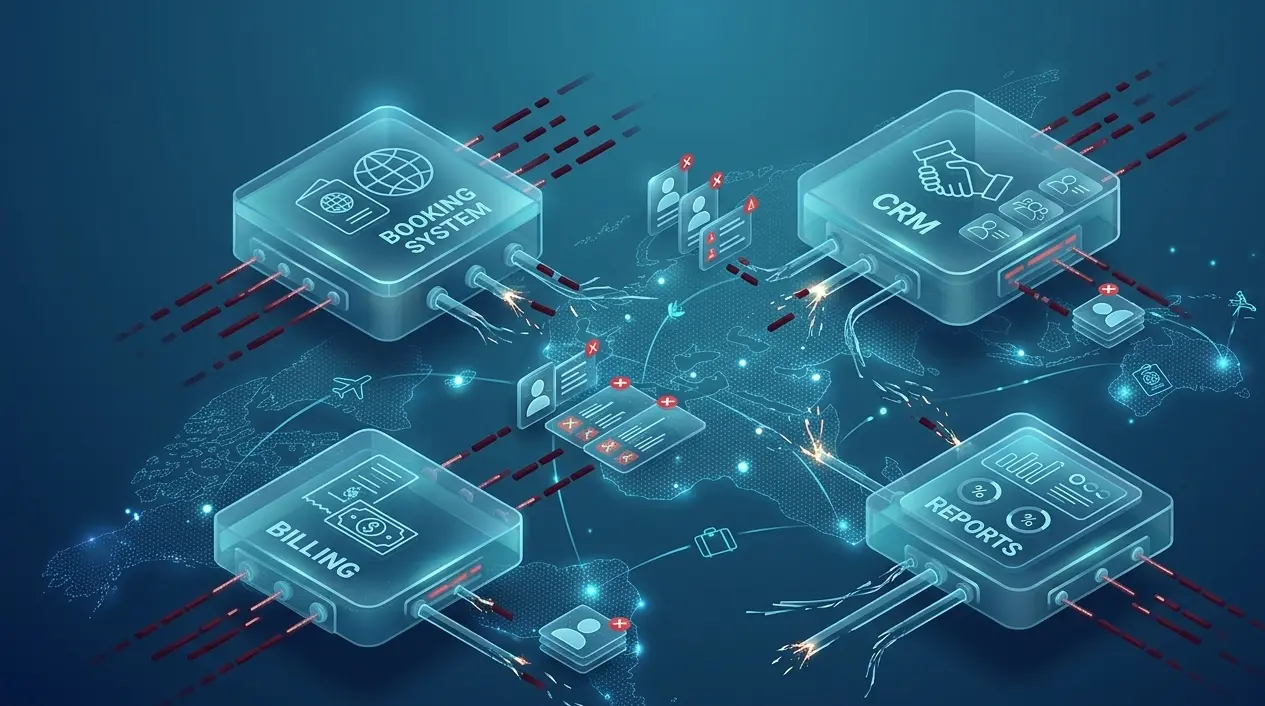
In many agencies, the operation grows in layers. First sales is solved, then booking management, then administration, and so on. Each need finds its own solution, but rarely is thought about how they connect with each other within a single travel agency software.
The result is not immediate, but appears over time. The same information begins to live in different places, teams work with different versions of the same operation, and control depends more on memory or internal exchanges than on what is actually recorded.
An outbound agency feels it when it needs to reconstruct a quotation that has already been sent, because the final details are scattered among e-mails and files. A receptive agency experiences it when the operation at destination does not reflect exactly what was sold. An operator drags it when the numbers don’t quite add up and you have to go back over each component to understand what happened.
In all cases, the problem is not a lack of digital tools. It is that the information does not flow as it should within the system.
Key features of an online software for travel agencies
When talking about the features of online agency software, the conversation often stays on the surface. But what really defines whether a system works well is not what it shows, but what it prevents you from having to figure out on the outside.
For example, when a quote is transformed into a booking without the need to redo it, what is happening is not just automation. It is continuity of information within the travel agency management software. When that reservation directly impacts the operation and, at the same time, feeds the administrative part, what we have is an integrated logic that eliminates invisible but critical steps.
The same goes for traceability. Being able to follow a sale from the first contact to its financial result is not an “extra”, it is what allows you to really understand how the business is working. Without that, any analysis ends up being partial.
And then there is real time, which is often interpreted as a question of remote access, when in fact it has to do with something else: that everyone involved in an operation works on the same information, without relying on manual updates or cross-confirmations.
When these conditions are not present, the system can continue to function. But it does so at the cost of more time, more validations and more margin for error.
Online vs. installable software for travel agencies
The comparison between online travel agency software and installable systems is often resolved too quickly, as if it were just a question of where the system is hosted. But the real impact comes in the way the operation is organized.
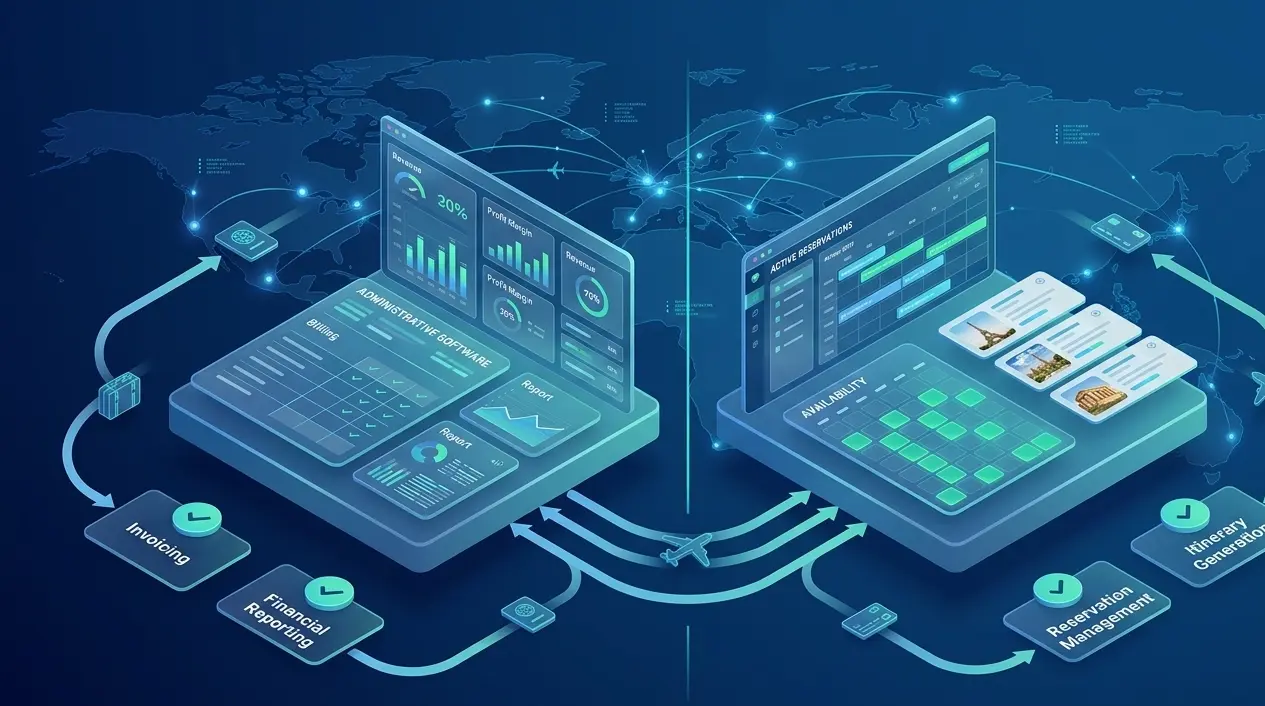
An installed system tends to generate small islands of information. Not necessarily because it is poorly designed, but because it depends on local environments, files that are exported, versions that are updated unevenly. The consequence is not always obvious, but it accumulates in the form of inconsistencies, delays and constant validations.
On the other hand, when the operation lives entirely in a well-structured online environment, the logic changes. Not because it can be accessed from anywhere, but because everything happens within the same flow. Information does not move: it remains available, up-to-date and consistent for everyone who needs it.
This is especially noticeable when several people are involved in the same operation. Where previously it was necessary to confirm, resend or verify, there is now direct visibility. And that difference, which may seem minor, is what ends up defining whether the operation is scaled up or becomes increasingly difficult to control.
What to consider when choosing software for travel agencies
Many agencies manage to operate for years with fragmented systems. They adapt, generate internal processes, develop certain gymnastics to compensate for what is missing. The problem is that this adaptation has a limit.
There comes a point where each new sales volume not only adds work, but also complexity. Errors appear at more advanced stages, financial closings take longer than expected, and responsiveness starts to depend on who has the information, not on the structure of the company.
That is when it becomes clear that the problem was not operational per se, but structural.
How to improve your operation with integrated online software
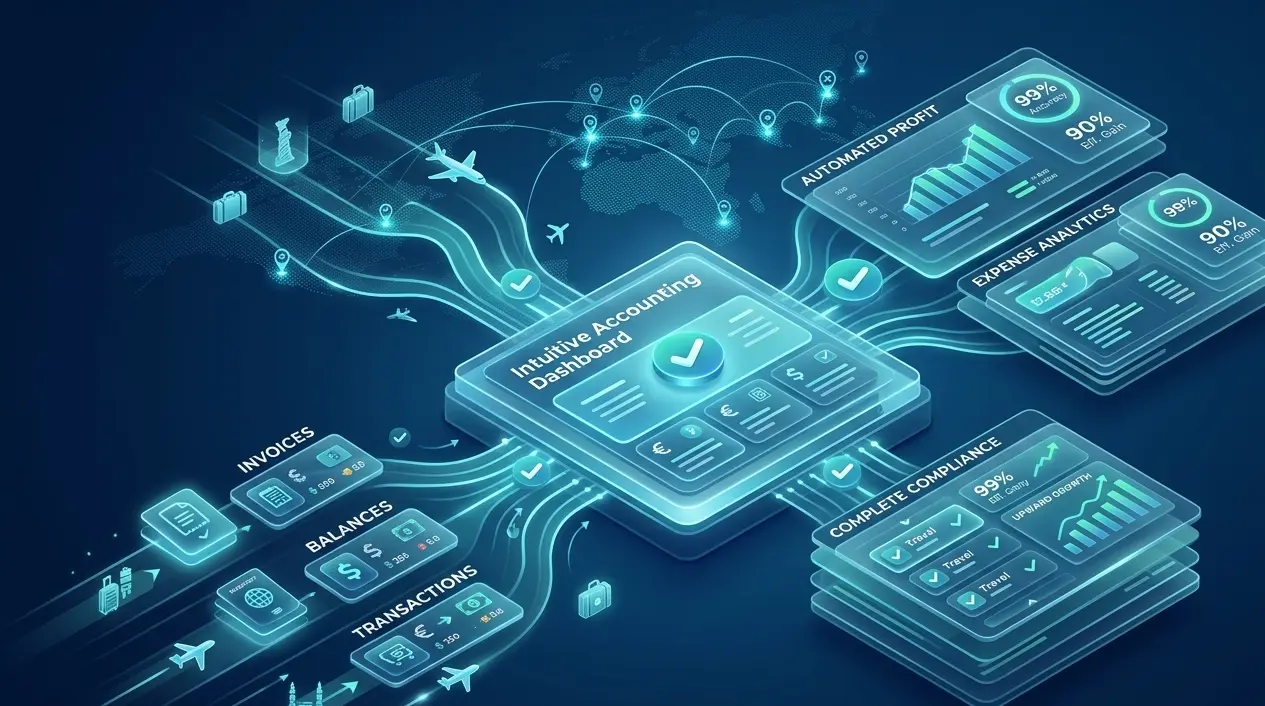
When an online agency software is well thought out, the feeling is not that it “does more things”, but that it no longer requires constant intervention. What used to involve reviewing, copying or confirming, is now resolved within the same flow without the need to go back to each step.
Information is no longer duplicated, processes become clearer and control appears without having to be built manually. Not because there is less work, but because the work begins to be ordered within a centralized management system.
In this context, growth ceases to be a risk factor and becomes a natural consequence of a successful operation.
Understanding the online software before the tool
At this stage, the key is not to compare options or evaluate feature lists. It is in understanding how your operation should behave in order to make sense in the long term.
Specialized software approaches, such as those that work on integrated models – where sales, operations and administration do not function as isolated areas but as parts of the same system – aim to solve this basic disconnect, rather than adding new layers of technology.
Because, in the end, the difference is not in the online travel agency software you choose, but in the way that software organizes everything else.