Digitizing corporate travel without slowing down the operation involves intervening in sensitive dynamics: active business relationships, demanding internal policies and service expectations where the margin for error is minimal. You’re not just managing bookings; you’re operating on the reputation of the company that hires you in the eyes of its own customers, partners and internal teams.
Every corporate trip represents a professional instance: a strategic meeting, a key negotiation, an institutional event. If something goes wrong, it is not only your operation that is affected. Your client’s image can be compromised.
In this segment, excellence is not an optional differential. It is the basis. And when processes grow without an integrated structure, improvisation begins to show.
Digitizing corporate travel without slowing down the operation: why it is more complex than for vacation trips
In vacation travel, the main objective is usually the passenger experience. In corporate travel, the critical variable is compliance with compliance: internal policies, budgets, timing and contractual agreements.
A mistake on a leisure trip can be a nuisance. A mistake on a corporate trip can compromise a strategic meeting, affect a company’s image or break a business deal.
Also, the weather operates differently. In vacation travel, you can work with greater flexibility. In corporate travel, decisions are immediate, modifications are frequent and approvals must flow without friction. Every step requires traceability.
Digitizing corporate travel without slowing down the operation means understanding this structural difference and adapting the transformation process to this requirement.
Before the software: internal audit focused on corporate travel
Before evaluating any tool, it is useful to analyze how you are operating today.
How do you manage the travel policies of each company?
Where are the authorizations registered?
How do you consolidate expenses and reports by cost center?
Who controls that the negotiated agreements are respected?
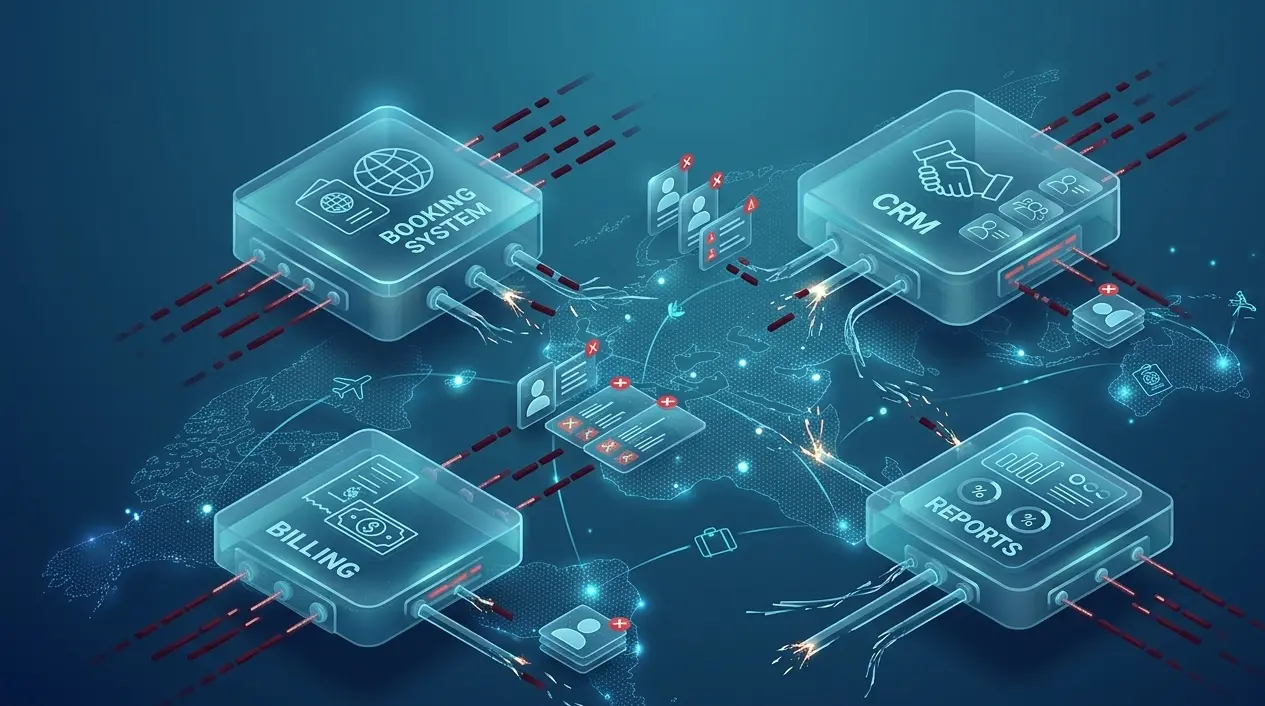
In many agencies, some of this information lives in emails, some in spreadsheets and some in the expertise of certain employees. As long as the volume is low, it works. When the number of corporate accounts increases, the system begins to strain.
A well-done internal audit does not seek to find culprits. It seeks to identify critical points: where tasks are duplicated, where errors are generated, where control depends exclusively on human memory. Digitizing corporate travel without slowing down the operation starts by clarifying these flows before automating them.
Excellence, reputation and control: what’s really at stake
In corporate travel – and also in MICE projects when you manage events, congresses or incentive trips – the agency becomes an operational extension of the client.
If a reserve does not comply with internal policy, if an expense is not correctly allocated or if a report is late, it not only affects the operation. It affects the perception of professionalism.
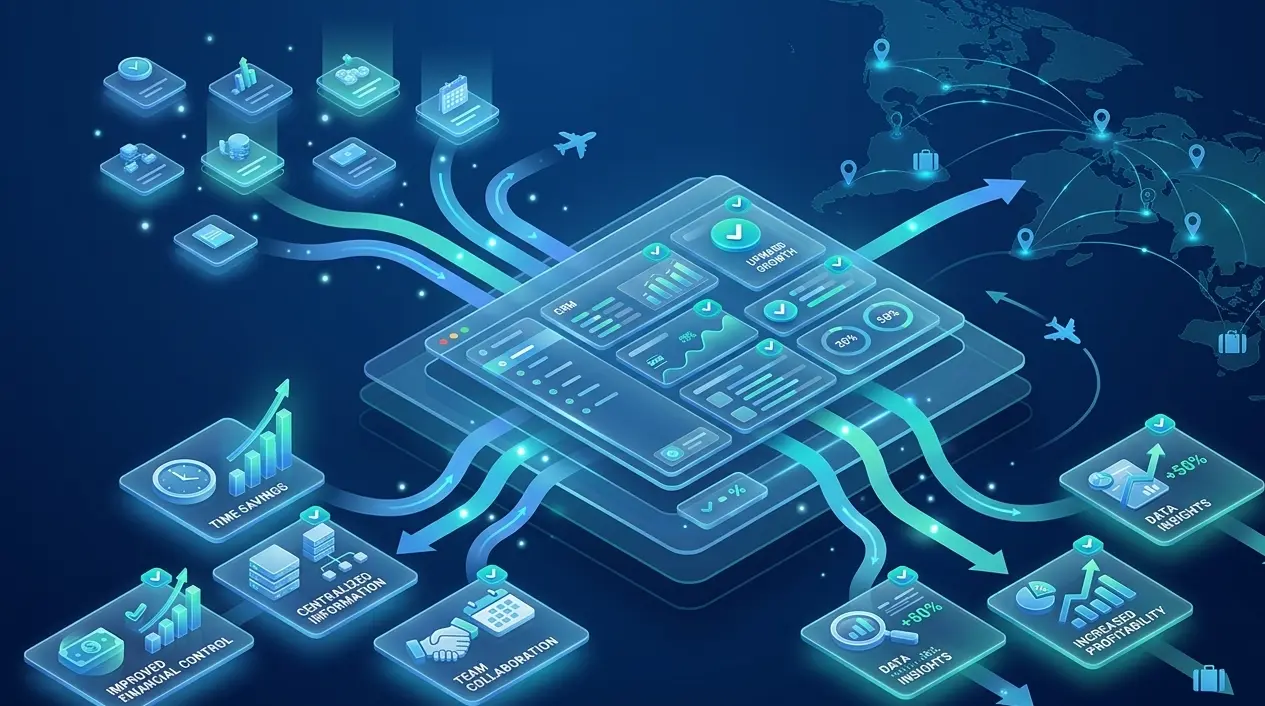
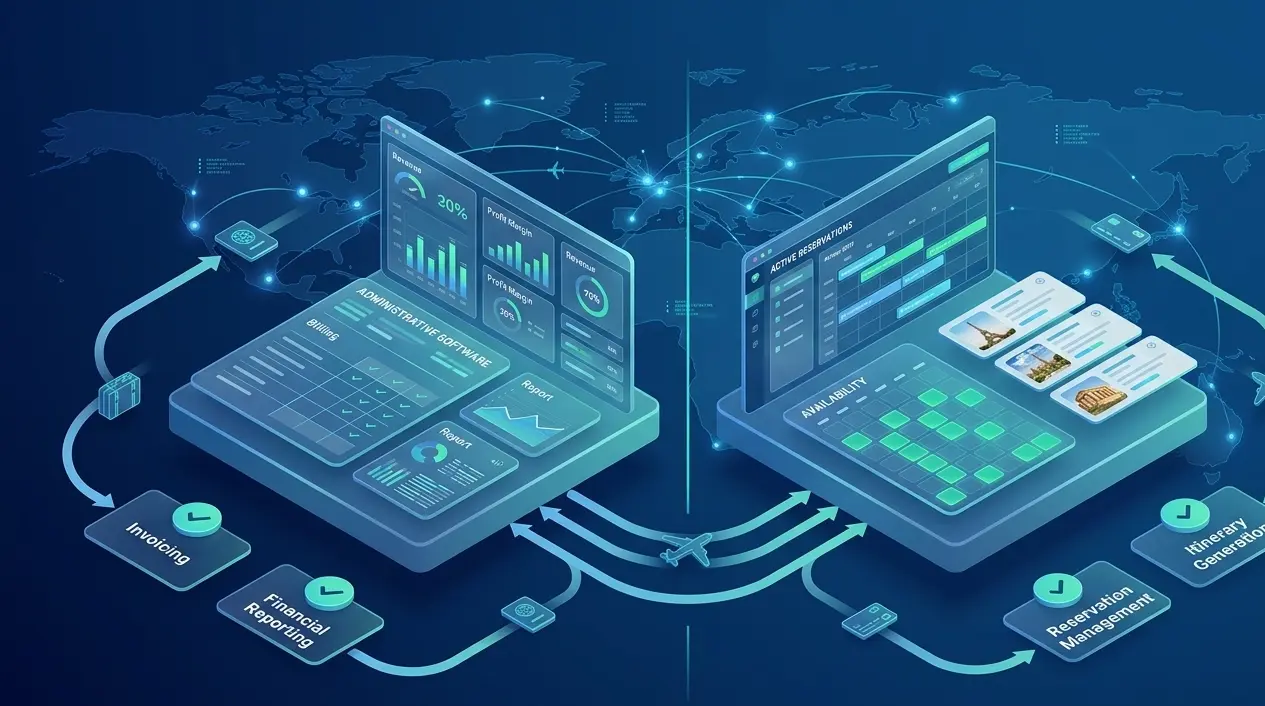
Integrated software reduces the margin of error because it connects reservations, costs, billing and reporting in a single environment. That eliminates manual handoffs, duplicate versions and endless reconciliations. But more importantly, it conveys consistency.
Professionalization does not just come from “having technology”. It comes from having structured processes that support every decision.
Progressive implementation: how to digitize corporate travel without slowing down the operation step by step
Trying to migrate everything at the same time is one of the most common mistakes. In corporate travel, an abrupt implementation can create internal uncertainty and affect the customer experience. A gradual approach is often more robust.
Stage 1 – Order and standardization
First, criteria are reviewed: how services are charged, how cost centers are named, how corporate policies are managed, what data should be visible in each reservation.
Here, a massive integration with the system has not yet occurred. A conceptual cleaning occurs. The operation is prepared to be digitized.
Stage 2 – Controlled operational integration
In this phase the real integration with the system begins. Not all corporate accounts are migrated at the same time. Some are selected, their policies are parameterized and new reservations are managed directly within the platform.
The previous operation continues for the rest of the customers while the team gains confidence with the new environment.
iThis is where digitizing corporate travel without slowing down the operation becomes tangible: the transition coexists with day-to-day business.
Stage 3 – Financial linkage and automated reporting
Once the management of corporate reservations has been stabilized within the system, the integration with financial modules is activated: accounts receivable, payments to suppliers, reports by client.
At this point, data duplication is eliminated. Information stops traveling manually between systems and begins to be consolidated in real time.
Stage 4 – Advanced Automation and Optimization
With the operation already integrated, you can incorporate more sophisticated automations: automatic policy validation, budget deviation alerts, periodic generation of executive reports for corporate clients.
Each stage consolidates the previous one. It is not about speed, but about stability.
Generic tools vs. structured digitization in corporate travel
Many teams try to solve management by combining generic tools: a traditional ERP, spreadsheets for policy control and external systems for reservations. The problem is not that these tools don’t work. It’s that they are not designed for the specific logic of corporate travel.
When reservations, billing, commissions and reports are not integrated from the source, islands of information appear. And each island requires manual intervention. Each manual intervention increases the probability of error. In contrast, a well-designed digitization connects operations and finance from the start. It allows you to visualize profitability by customer, policy compliance and cash flow without subsequent reconstruction.
Digitizing corporate travel without slowing down the operation does not mean partially digitizing. It means building coherence between areas.
The role of accompaniment in the digitalization of corporate travel and MICE
In corporate travel projects and also in MICE operations, implementation requires close monitoring. It is not enough to activate a system and wait for the team to adapt. It is necessary to parameterize specific policies, configure business rules per client, define approval flows and train the team in real scenarios.
Specialized tourism software, such as Toursys, contemplates this integrated logic between reservations, operation and accounting. But the real differential in this type of process is in the human support during implementation.
When the supplier understands the complexity of corporate travel and MICE, the transition ceases to be a risk and becomes an organized evolution.
Thinking digitalization as a strategic decision
Digitizing corporate travel without slowing down your operation is not a race to modernize. It’s a decision that redefines how you manage excellence, how you protect your agency’s reputation and how you build a solid foundation for growth.
Before analyzing functionalities or vendors, it is important to understand your own processes, vulnerabilities and strategic objectives. The right technology does not replace judgment. It enhances it.
And in corporate travel, where every detail impacts your client’s image, that structured approach is the real competitive asset.