Choosing accounting software for travel agencies is neither a technical decision nor a simple administrative procedure. In a travel agency, it involves defining how financial information is organized, managed and interpreted in relation to the daily operation of the business. Some companies reach this point after several years of experience; others incorporate it from the initial stages because they are looking for order, predictability and a solid base for growth.
In both cases, the criterion is not the size of the agency, but the level of clarity and control needed to manage the tourism operation, without losing flexibility or adding unnecessary complexity.
This guide is designed for travel agencies seeking to move towards a clearer financial management, connected to their operation and adaptable to different business and regulatory contexts.
Accounting as a reflection of the company’s momentum
An agency’s accounting needs change as the business evolves. In the early stages, the focus is usually on selling, operating and responding to day-to-day demands. Over time, new questions begin to emerge: which services are most profitable, how collections and payments are distributed over time, what impact operating expenses or commissions have, and how cash flow behaves in different scenarios.
Some agencies go through this process gradually and others decide to structure from the beginning. Neither option is wrong. What makes the difference is the point at which financial information moves from being a record to becoming a management tool.
When accounting ceases to be the accountant’s alone
In many agencies, regardless of their size, accounting is no longer an isolated task and is beginning to play a central role for decision-makers: owners, partners, operational managers or small management teams who need clear and reliable information.
In tourism, the collection and payment logic tends to be variable. There may be advance, partial or post-transaction collections, payments to suppliers with different terms, prepayments, outstanding balances, deferred commissions and subsequent adjustments. This flexibility is part of the usual dynamics of the industry. In this context, accounting software for travel agencies allows a better understanding of how collections and payments are organized in relation to the actual tourism operation.
For this reason, the accounts receivable and accounts payable modules acquire value when they are designed for this reality. It is not a matter of controlling more, but of better understanding how money flows in the tourism operation.
Excel is not the problem, the challenge comes when the model changes.
For a long time, spreadsheets and generic systems have been able to successfully solve the financial management of a travel agency. They work well as long as the volume is manageable and the operational complexity is low. The problem arises not because the tool is wrong, but because the business model evolves and begins to demand more coordination between the operation and the financial information.
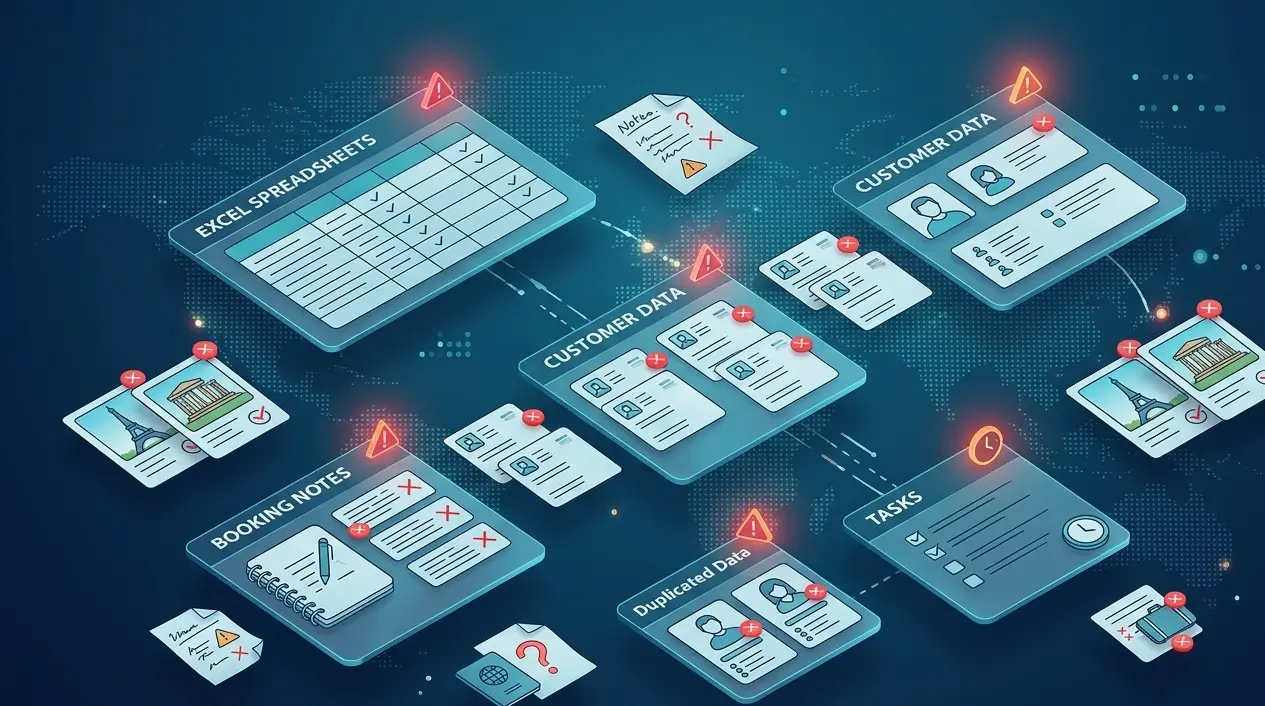
When active reserves increase, collection and payment methods diversify, transactions in different currencies appear and it becomes necessary to analyze information by service, customer or supplier, manual processes begin to lose efficiency. In this context, reconstructing data, reconciling transactions or relying on parallel spreadsheets consumes time and reduces visibility.
It is at this point where accounting software for travel agencies makes sense, not as an immediate replacement of all existing tools, but as a way to accompany the growth of the business with greater order, coherence and financial control, aligning the accounting information with the real dynamics of the tourism operation.
What should an accounting software for travel agencies allow?
Accounting software for a travel agency should adapt to the reality of the company at any given moment, without requiring a complex structure from the beginning or limiting future growth. Both a small agency and a larger company need order, visibility and consistency between daily operations and financial information.
In practice, this means facilitating the follow-up of collections and payments, organizing financial information in a clear way and accompanying the actual tourism operation, without forcing processes designed for other types of business.
As the agency grows or its operation becomes more complex, the software should allow it to deepen the analysis and adapt to different regulatory contexts. The key is for the system to accompany growth, not condition it.
What Toursys accounting module offers
The Toursys accounting module is designed to support the financial management of tourism companies from an operational logic, not as a generic fiscal software.
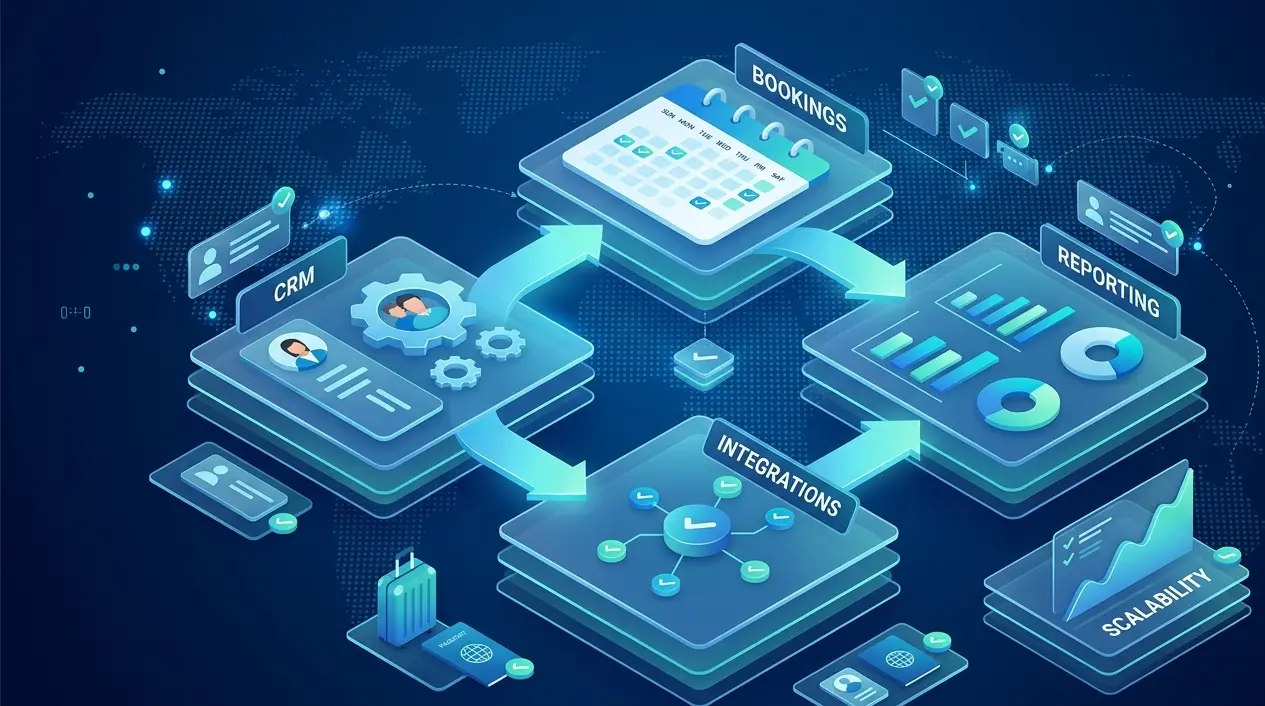
The platform includes a basic accounting module to organize internal financial information and centralize movements, and an accounts receivable and accounts payable module designed specifically for the dynamics of tourism. This allows the management of customer collections, payments and prepayments to suppliers, commissions, operating expenses and bank transactions, while respecting the flexibility inherent to the sector.
In addition, Toursys has an invoicing module that generates the reservation and integrates natively with the invoicing processes. In countries where electronic invoicing is applied, the system directly resolves the issuance of the invoice, keeping the tourism operation aligned with accounting and fiscal management. This makes it possible to work with consistent information, reduce administrative reprocesses and ensure that operation data, collections and invoicing are managed from a single environment.
Choosing with a long-term view
Choosing accounting software for travel agencies does not define the size of an agency, but it does reflect how it envisions its growth and how it manages its business. Some companies make this decision out of necessity, others out of planning and foresight.
In both cases, the value lies in having a platform that can evolve progressively, adapt to different contexts and maintain order and consistency between operations and finances over time. More than a technological decision, it is a management decision.