Choosing a CRM for travel agencies according to the size of your company and sales volume is not a minor decision. It directly impacts the way you organize your business process, distribute opportunities and project the growth of your operation.
When you start researching CRM software for agencies, the most important thing is not to compare prices or isolated functionalities, but to understand what level of complexity your structure has today and what demands it will have in the coming years. The right CRM does not depend on the tool itself, but on the operational moment your agency is going through.
A poorly sized CRM can quickly fall short, while an oversized one can generate internal friction and low adoption. The key is consistency between the tool and the operational stage.
Why the size of your agency defines the type of CRM you need
Not all travel agencies need the same CRM system. A small outbound agency managing customized travel faces different challenges than a wholesale tour operator or a DMC with multiple simultaneous services at the destination.
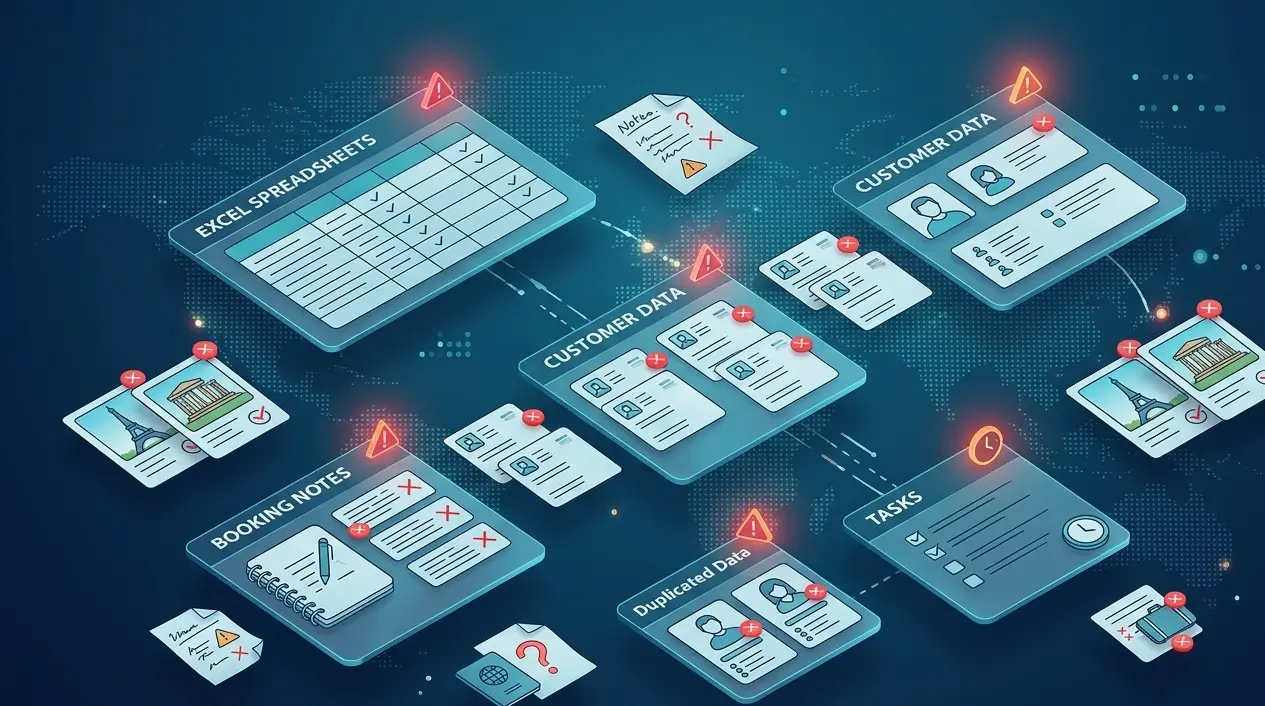
In many small agencies, business management still relies on spreadsheets, e-mails and non-integrated databases. The problem is not only organizational. When information is fragmented, quotes are lost traceability, tasks are duplicated and follow-up depends too much on the team’s individual memory. The greater the volume, the greater the need for visible and shared structure.
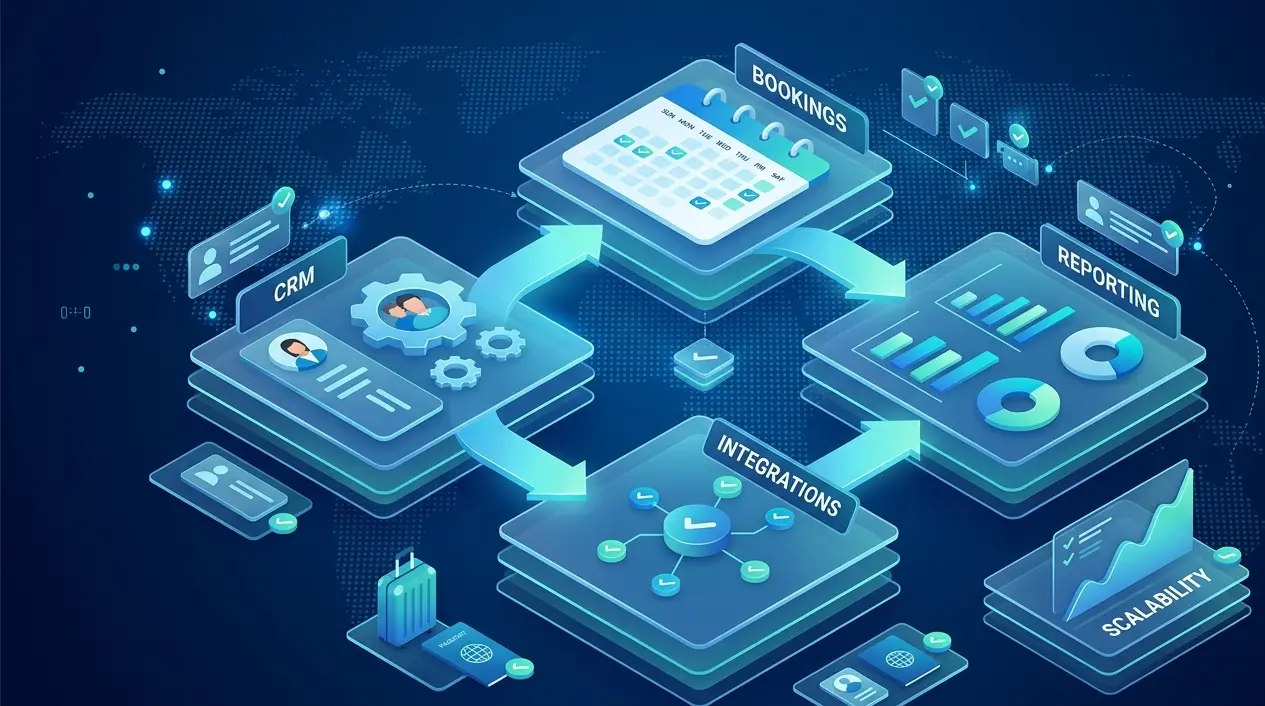
A CRM for travel agencies fulfills a structural function: it centralizes commercial information, organizes the pipeline and allows visualization of the entire process from the first contact to confirmation. As volume increases, this structure is no longer optional and becomes necessary to sustain growth without losing control.
Signs that your agency needs a more robust CRM
Many companies start looking for a tourism CRM when they already feel operational saturation. However, there are previous signs that indicate that the current system has outgrown the actual sales volume.
Commercial follow-up is not standardized
If each agent uses its own method of tracking, the consistency of the process is weakened. Business management studies show that companies that formally structure their follow-up processes tend to improve their conversion rates compared to those that operate with informal methods. The improvement does not come from the technology, but from the discipline that the tool allows to implement.
You can’t clearly measure your sales funnel
A CRM for agencies allows you to visualize how many quotes are generated per month, how many are moving forward and where opportunities are being lost. If this information is not available in real time, business decisions are based on perceptions rather than hard data.
Growth begins to generate disorder
When the monthly volume of quotations increases, so does the complexity: more suppliers, more commercial conditions, more after-sales follow-up and greater need for coordination between areas. Without an adequate CRM system, each new customer increases the administrative burden and the margin of error.
CRM for small, medium and large agencies: real differences
Size is not only defined by the number of employees, but also by sales volume and operational complexity. Choosing a CRM based on company size means understanding which processes you need to structure today and which you will need tomorrow.
| Agency size | Estimated monthly volume | Operational complexity | What a basic CRM solves | What a more complete CRM requires |
| Small (1-3 persons) | 20-50 quotations | Manual tracking, simple database | Centralizes contacts, organizes opportunities and tasks, visualizes pipeline | Tracking automation, reporting per agent, conversion metrics |
| Medium (4-15 people) | 50-200 quotations | Lead distribution, multiple agents, higher volume | Shared control of the funnel, basic reporting, centralized history | Advanced segmentation, automations, integration with reservations, control by channel |
| Large / Wholesale / DMC | +200 quotations | Separate teams, B2B and B2C, multiple markets | Insufficient to coordinate areas | ERP integration, full traceability, multi-currency, profitability analysis |
A basic CRM usually offers a customer database, opportunity management, task assignment and simple pipeline visualization. For a small agency that still works with spreadsheets, this structure can be a major change because it tidies up information and reduces reliance on individual memory.
However, as volume grows, the CRM must evolve. A more complete CRM incorporates reminder automation, customer segmentation by trip type or behavior, advanced reporting by agent and channel, integration with reservation systems, and the ability to operate in multiple currencies and markets. At this point, CRM ceases to be a digital agenda and becomes a process coordinator.
In large structures, CRM no longer serves only a commercial function, but is integrated with reservations and operations to maintain consistency throughout the organization.
Common problems when choosing a CRM without considering size
One of the most common mistakes is to choose a generic CRM because it seems sufficient in the initial stage. With growth, limitations begin to appear: lack of integration with reservation systems, lack of multi-currency support, difficulty in differentiating between B2B and B2C customers or the impossibility of analyzing actual performance by segment. The result is often the creation of parallel solutions that fragment the information that was intended to be centralized.
At the other extreme, implementing from the beginning a CRM software that is too complex for a small structure can generate internal resistance, low adoption and a feeling of technological overload. The central criterion is not the number of available functionalities, but the alignment between the tool and the agency’s operational maturity stage.
What to analyze before choosing a CRM for your travel agency
Before evaluating tourism CRM software providers, it is a good idea to take an honest look at your own operation.
Actual volume of quotations
The monthly number of opportunities determines the level of automation required and the type of reports to be generated.
Business Model
Selling exclusively B2C is not the same as operating also with partner agencies. A CRM for tour operators or DMCs must contemplate more complex business dynamics than a purely retail model.
Markets and currencies
If you work in several countries, the CRM must support multi-currency and facilitate international management without relying on external systems.
Projected growth
The CRM you choose must match the current size of your company, but also allow you to scale without completely replacing the tool in the short term.
Difference between a generic CRM and a CRM designed for tourism
A generic CRM is designed for sales in multiple industries. A CRM designed specifically for travel agencies understands that a quote can turn into a booking, that booking involves suppliers and that each step impacts the operation.
In the tourism sector, traceability is key. A CRM system adapted to this logic makes it possible to connect the commercial process with subsequent management without duplicating information. When CRM understands the logic of tourism, coordination between sales and operations no longer depends on cross mailings and becomes integrated into the system.
In more advanced stages of research you will find platforms specialized in tourism, such as Toursys, that integrate CRM with booking and operation modules. The difference is not only in functionalities, but also in the human support during the implementation and in the deep understanding of the flows of the sector.
Choosing a CRM is defining the structure of your growth
At this initial research stage you don’t need to compare prices or make immediate decisions. You need to understand how your business process works and what level of structure it requires to grow without losing control. Choosing a CRM for travel agencies based on the size of your company involves designing the business architecture that will sustain your operation for years to come. The right tool not only organizes clients, but defines how your agency can scale with strategic clarity and order.