Choosing an ERP for a travel agency is not a technical decision, it is a strategic decision. A good system not only organizes information: it defines how you sell, how you operate and how you control your business. This checklist is designed to help you evaluate if an ERP really accompanies the complexity of today’s tourism and the growth of your company, no matter if you are an outbound agency, a DMC, a multi-country company or a marketplace.
Why not just any ERP works for a travel agency
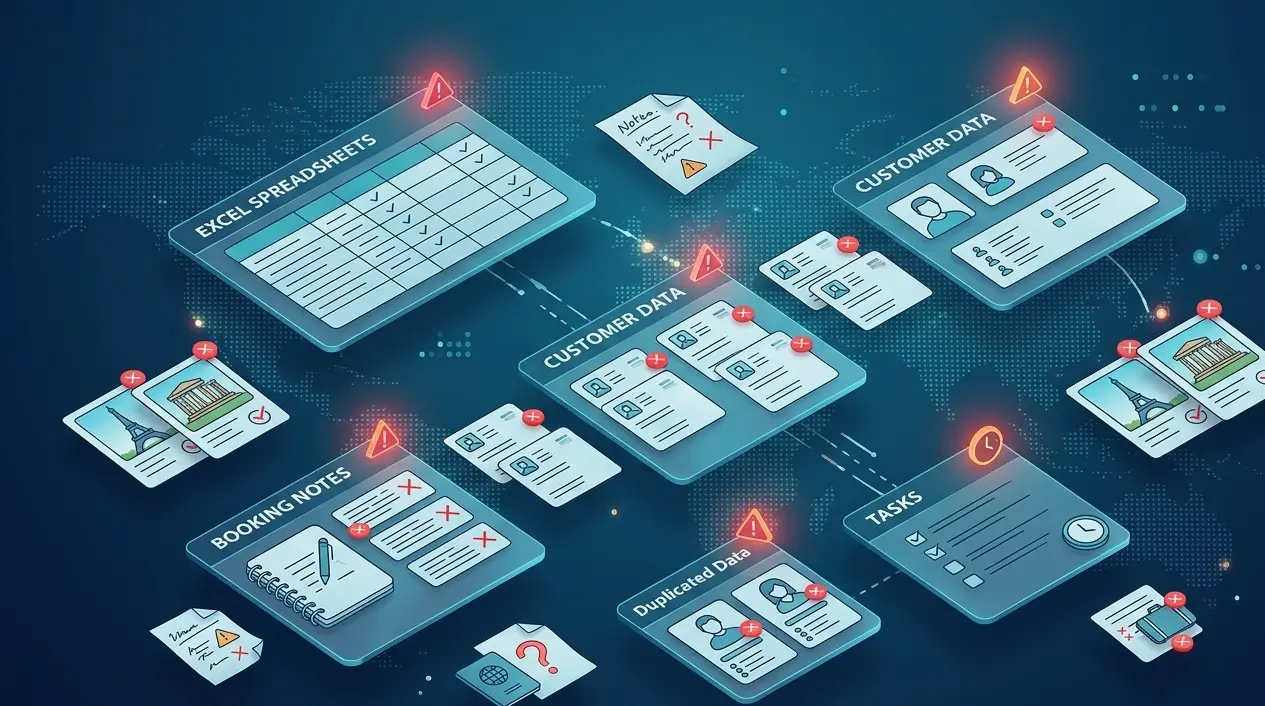
Tourism has its own logic that many generic systems do not contemplate. Agencies work with future reservations, services provided on different dates, multiple suppliers for each sale, prepayments, commissions and operations in several currencies. When an ERP does not understand these dynamics from its design, it forces to create parallel processes, support spreadsheets and manual controls that end up generating errors and waste of time.
A tourism ERP, in addition to the above, must be designed from its origin for this industry, so that the accounting modules are reflected from a tourism reality (for example, accounts receivable based on accepted direct bookings) to the operational modules designed for this purpose (moving products in a factory is not the same as a MICE booking).
Essential checklist of an ERP for travel agencies
This checklist does not seek to add functionalities by accumulation, but to identify the pillars that allow managing a tourism company in an orderly and scalable way.
1. Integrated modules that centralize the entire operation.
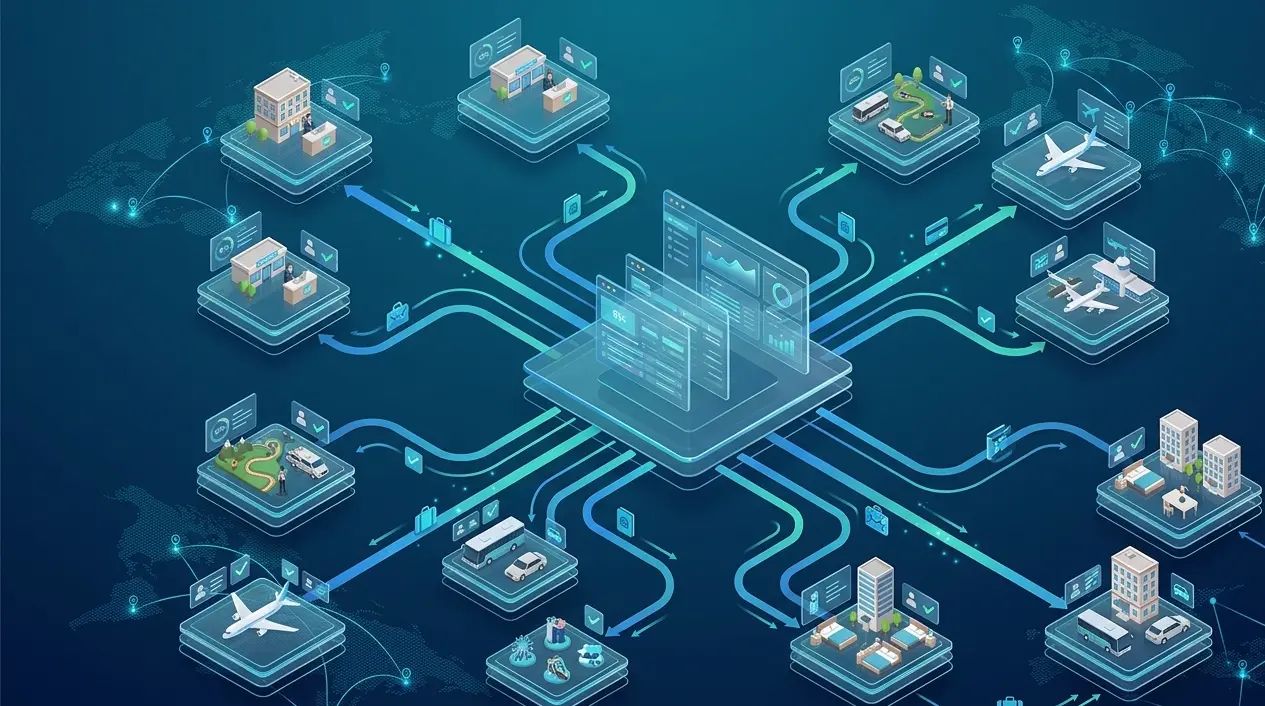
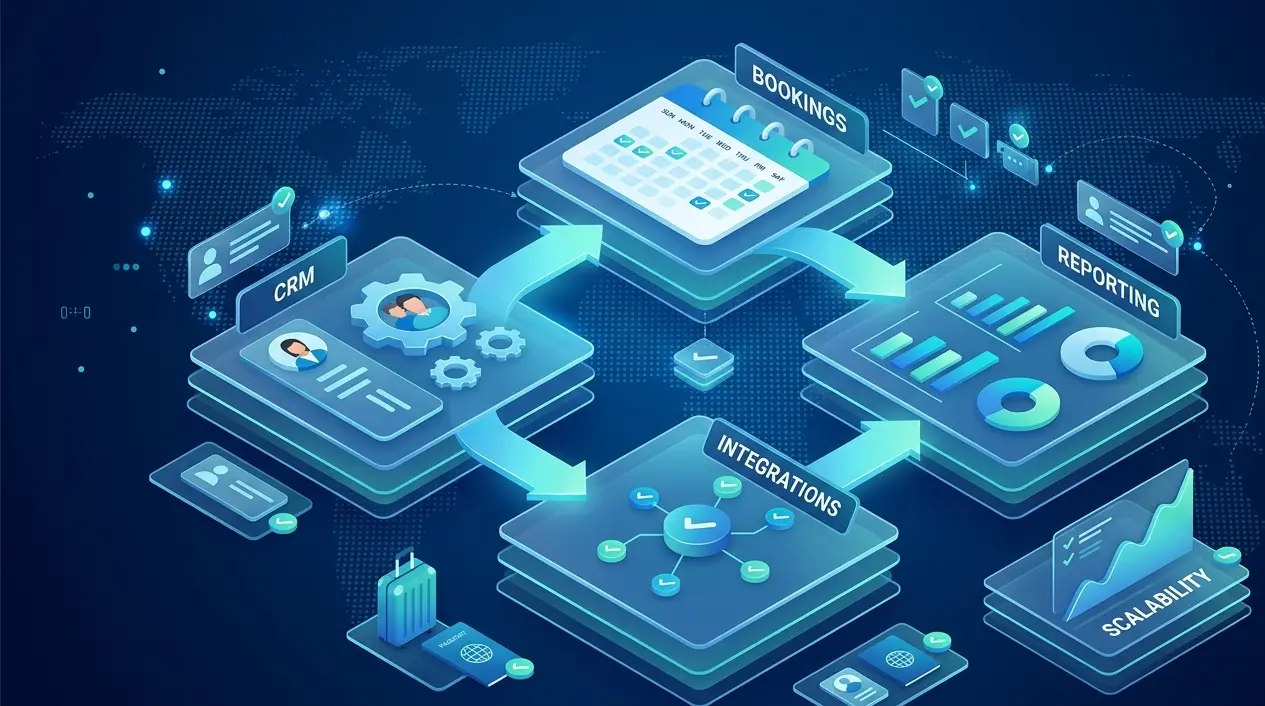
A good ERP should work as a single system, where sales, operations and finance are fully connected. Information is loaded only once and reused throughout the process, avoiding duplication and misalignment between areas. When modules are not integrated, every change becomes an operational risk.
Actual management of reservations and tourism operations.
The system must allow managing reservations with multiple services, confirming with suppliers, making changes, reassignments and daily follow-ups without losing traceability. This is key for outbound agencies as well as for inbound tourism companies, operators and marketplaces that handle volume and operational complexity.
Accounting connected to each reserve
Accounting cannot live in isolation from the operation. A solid tourism ERP automatically generates financial movements from each booking, reflecting customer collections, payments and prepayments to suppliers, commissions and real margins. This allows for financial visibility without reprocessing or endless manual reconciliations.
CRM integrated to the commercial process
Customer and opportunity tracking must be connected to quotations and actual sales. An ERP with integrated CRM allows you to know the complete customer history, follow up on each proposal and analyze the conversion without losing information in external mailings or spreadsheets.
Support and implementation: the defining factor of ERP success
Technology alone does not guarantee results. The way it is implemented and the way it accompanies the team is decisive.
Guided and progressive implementation
A good ERP must be implemented in an orderly manner, without slowing down daily operations. The implementation must be adapted to the actual processes of the company and allow a progressive adoption, incorporating modules and flows as the team needs them.
Human support and continuous training
Support is not an extra, it is part of the product. An ERP for agencies must offer human accompaniment, in the language of the team, with constant training to ensure that the system is used correctly and evolves along with the business.
Key integrations that a tourism ERP must offer
An isolated system limits growth. Connectivity is a basic condition in today’s tourism.
Integrations with suppliers and external systems
The ERP must be integrated with bed banks, activity providers, payment gateways and other key systems in the tourism ecosystem. This allows you to automate availability, confirmations and collections, reducing manual tasks and errors.
B2B and B2C channels connected to the operation
Online sales, both to the end customer and to other agencies, must be directly connected to the internal operation. A well-designed ERP avoids duplicating loads and keeps all information synchronized, without creating data islands.
Cloud technology, security and scalability
The technological infrastructure defines the system’s capacity for growth and adaptation.
ERP in the cloud with real-time access
Working in the cloud allows access to information from anywhere, with always up-to-date data and automatic backups. This is especially important for companies with distributed teams or operations in different countries.
Scalability according to company growth
An ERP for travel agencies must keep up with the evolution of the business. The possibility of activating new modules, operating in multiple languages and currencies, and adapting to more complex structures avoids having to change systems when the company grows.
How to use this checklist to choose the right ERP
This checklist serves as a guide to evaluate whether an ERP is ready for real tourism. It is not a question of choosing by price or by an endless list of functions, but by the system’s ability to centralize the operation, reduce errors and accompany growth without friction.
Platforms such as Toursys were designed under this logic: a complete, modular, cloud-based tourism ERP that integrates sales, operations and finance in a single environment and adapts to different business models.
Request a demo and discover how a well-implemented tourism ERP can transform the management of your agency, optimize processes and give you real control over your operation.