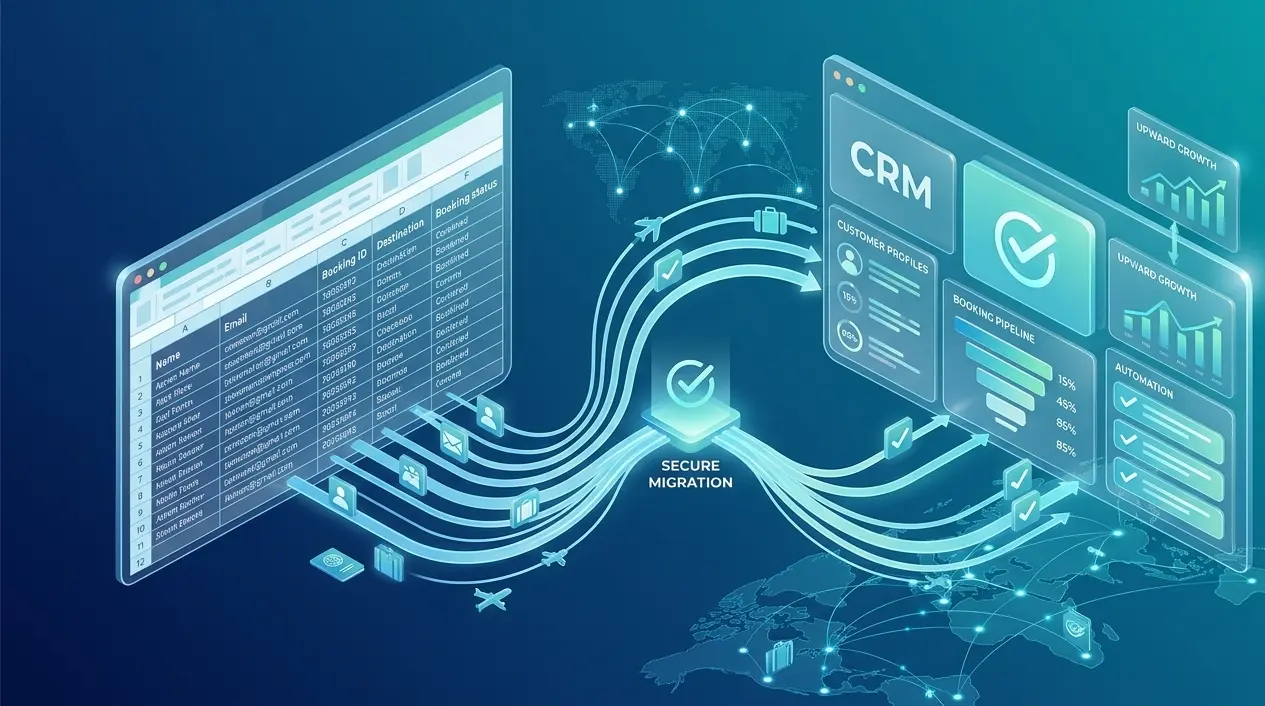
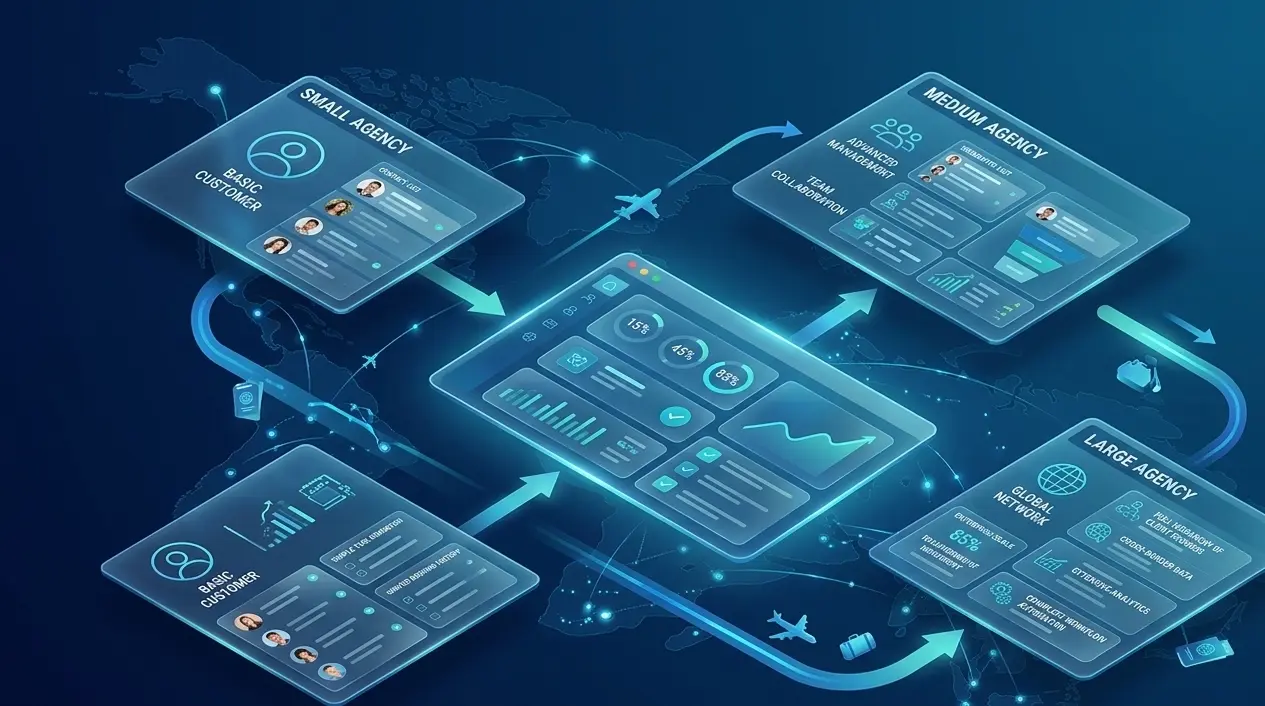
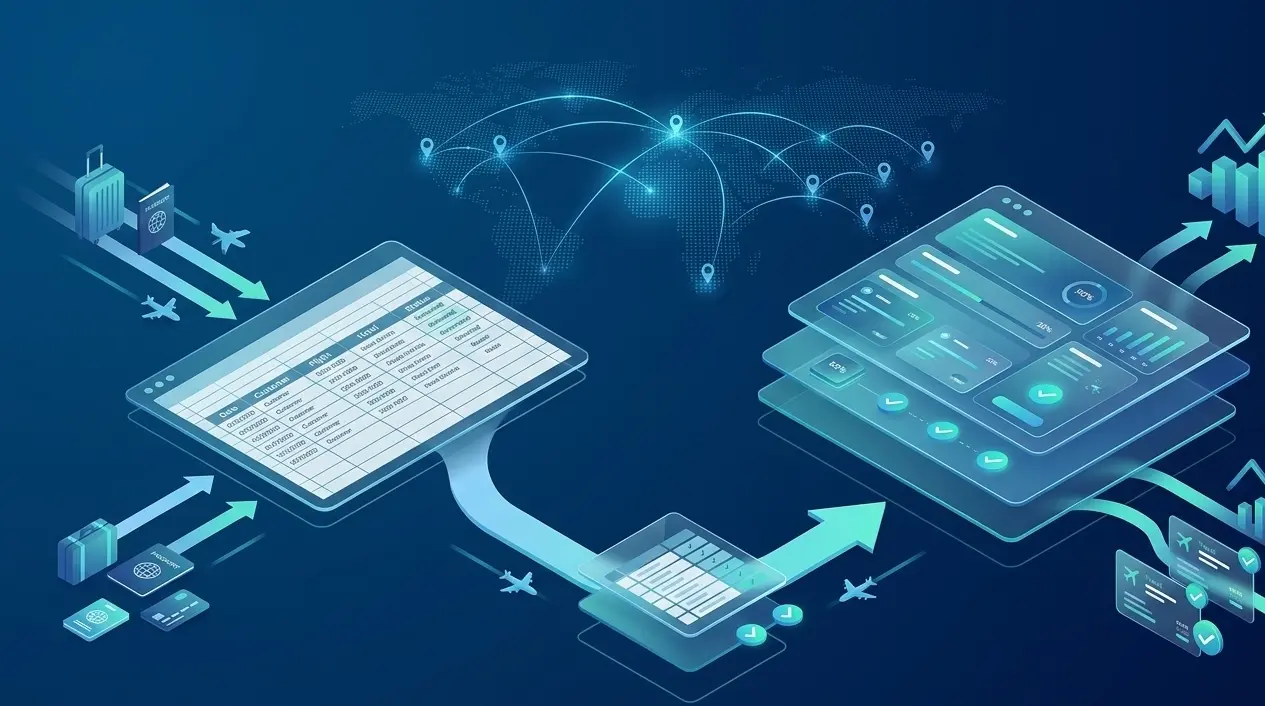
The migration of booking software in the operation of a travel agency is not simply a technological change. It is a process that impacts internal flows, response times, coordination with suppliers and, above all, customer perception.
When a tourism company evaluates modernizing its system, the question is not usually whether it needs to digitize, but how to do it without affecting active reservations, payments in progress and commitments made. Understanding that the migration can be organized in stages, with clear cut-off dates and controlled parallel operation, helps to reduce risks and avoid hasty decisions that generate unnecessary friction.
Approaching the migration of software reserves operation from a strategic logic implies looking first at the internal structure before looking at the tool.
When the operation starts to strain the customer experience
Many agencies do not detect the need to migrate by internal indicators, but by external signals. The client perceives delays in adjustments, different versions of the same proposal or responses that depend excessively on a specific person.
In tourism, the digital experience is a determining factor. Various studies of online purchasing behavior indicate that more than 70% of travelers consider the ease and clarity of the process as a key factor when deciding to make a reservation, and close to 60% abandon a transaction when they perceive a lack of professionalism or inconsistencies in the information. Although these figures are usually associated with e-commerce, their impact also extends to the personalized work of agencies and operators.
If a date change involves redoing manual calculations or reviewing multiple files before responding to the customer, the internal friction ends up being transferred outward. The migration of booking software not only aims to tidy up management; it also protects buyer confidence.
Looking at operational maturity from a market impact perspective
Rather than asking yourself if you have too many forms, it is better to analyze how your brand is perceived.
When response times vary depending on who handles the request, or when the customer receives documents in different formats for each shipment, the problem is not aesthetic. It is structural. Consistency is part of the experience.
It is also relevant to look at scalability. If accepting a new group involves manually reorganizing schedules, recalculating margins one by one and reviewing agreements with suppliers in different documents, the operation starts to show limits.
At that point, the migration of software reserves operation ceases to be a technical improvement and becomes a strategic decision to sustain reputation and growth.
Understand the real scope of a migration in the operation.
Migration does not necessarily imply intervening all active reservations at the same time. In fact, in many cases it is advisable to establish a cut-off date from which all new reservations are managed in the new system, while those previously confirmed continue their cycle in the previous environment until the end.
This approach reduces risks on sensitive operations already committed. Ongoing reserves maintain their original traceability, avoiding duplication or accounting inconsistencies.
Instead, new quotes and confirmations begin to be generated in the new software, allowing the team to adapt progressively without compromising the passenger experience.
In strictly accounting areas it may be necessary to make a more defined cut, since financial integrity requires consistency in the records. However, this does not require migrating every active reserve in full operational development.
Steps to implement a system without affecting the customer experience
An orderly migration is usually organized in phases that combine technical preparation with operational adjustment.
Diagnosis and mapping of real processes
Before configuring any tool, it is essential to understand how your operation works today. Not from the formal organization chart, but from the actual workflow.
By identifying how quotes are generated, how payments are allocated, how changes are managed and how profitability is controlled, it is possible to anticipate which processes should be digitized first and which can temporarily remain in their current scheme. This analysis avoids transferring inefficiencies to the new environment.
Base configuration and strategic parameterization
At this stage, structural data is loaded: frequent suppliers, main services, business rules, payment policies, seasons and tariff categories.
Daily operations continue in parallel. The objective is not to migrate ongoing reserves, but to prepare the environment in which the new ones will operate.
For example, an inbound operator may start by loading the hotels and tours with the highest turnover, leaving occasional products for a second phase. This prioritization allows the team to start using the system in familiar scenarios.
Start with new bookings as of a defined date
One of the safest practices in the migration of software booking operations is to set a clear date: from that day on, all new bookings are managed in the new system.
Previous reservations remain where they were created until their natural closure. This avoids intervening active itineraries that already have payments, confirmations and documentation issued.
This way, the team does not face the pressure of moving sensitive information while learning the new platform.
Progressive adjustment and internal evaluation
With the system already operating for new bookings, it is possible to observe concrete indicators: quotation generation times, ease of recalculating changes, traceability of payments and clarity of financial information.
For many agencies, the improvement is not only seen in efficiency, but in reduced operational stress. Visibility into margins, payment status and confirmations reduces reliance on manual controls. Migration ceases to feel like an uncertain transition and begins to consolidate as a natural evolution of the business.
Typical risks when migration is executed without method
When there is no clear planning, problems soon arise. Migrating active reserves without distinguishing their status can generate duplication of records or inconsistencies in payments. Starting the operation in a new system without the team understanding its flows produces internal resistance. Choosing a tool that does not take into account the particularities of tourism forces to create parallel solutions, which ends up replicating the original mess in digital format.
The importance of initial parameterization is also often underestimated. If business rules are not configured correctly from the start, errors multiply as bookings increase.
Technology does not correct weak processes on its own; it needs a coherent structure behind it.
The difference between digitizing and transforming the operation
Not all software responds to the specific logic of tourism. Agencies and DMCs work with deferred payments, services with future dates, variable commissions and international suppliers. A generic system can record movements, but not necessarily integrate them with the actual operation.
Therefore, rather than comparing lists of functionalities, it is better to analyze whether the tool understands the complete flow: from quotation to confirmation and the subsequent financial impact.
In this context, some systems designed specifically for the sector, such as Toursys, structure the implementation under a progressive model that combines initial configuration, human support and gradual adoption. Beyond the supplier chosen, the key criterion is that the migration be guided and contextualized in the reality of each company.
Thinking about migration as part of a growth strategy
The migration of a travel agency reservation system should not be driven by volume pressure alone, but by a vision for the future.
Digitizing with method allows consolidating processes, improving the customer experience and preparing the structure to scale without losing control. When the transition is organized in stages, with clear cut-off dates and continuous evaluation, the operational risk decreases considerably.
Before looking at suppliers, it’s worth reflecting on your own structure: which processes need visibility, which tasks take more time than necessary, and which aspects of the experience could be strengthened. It is a planned evolution that, if well managed, can be executed without slowing down the operation or compromising the trust of those who travel with you.