In inbound tourism, much of the work does not happen in front of the passenger. It happens before and after: coordination of services, confirmations with suppliers, rate adjustments, last-minute changes, payment follow-up and operational control.
When that invisible fabric becomes fragile, the operation begins to rely more on individual effort than on clear processes. Understanding the benefits of using a platform in inbound tourism involves looking precisely at that: at how the day-to-day operation is sustained when the volume, diversity of services and customer demands begin to increase.
Many agencies, DMCs and operators do not fail because of lack of experience. They fail when the way they work fails to keep up with the real complexity of their business.
The limit is not always in the market, but in the operation.
It is common to attribute operational problems to external factors: more demand, more demanding customers, more complex suppliers. However, in practice, many tensions arise because the internal structure has not evolved at the same pace as the business.
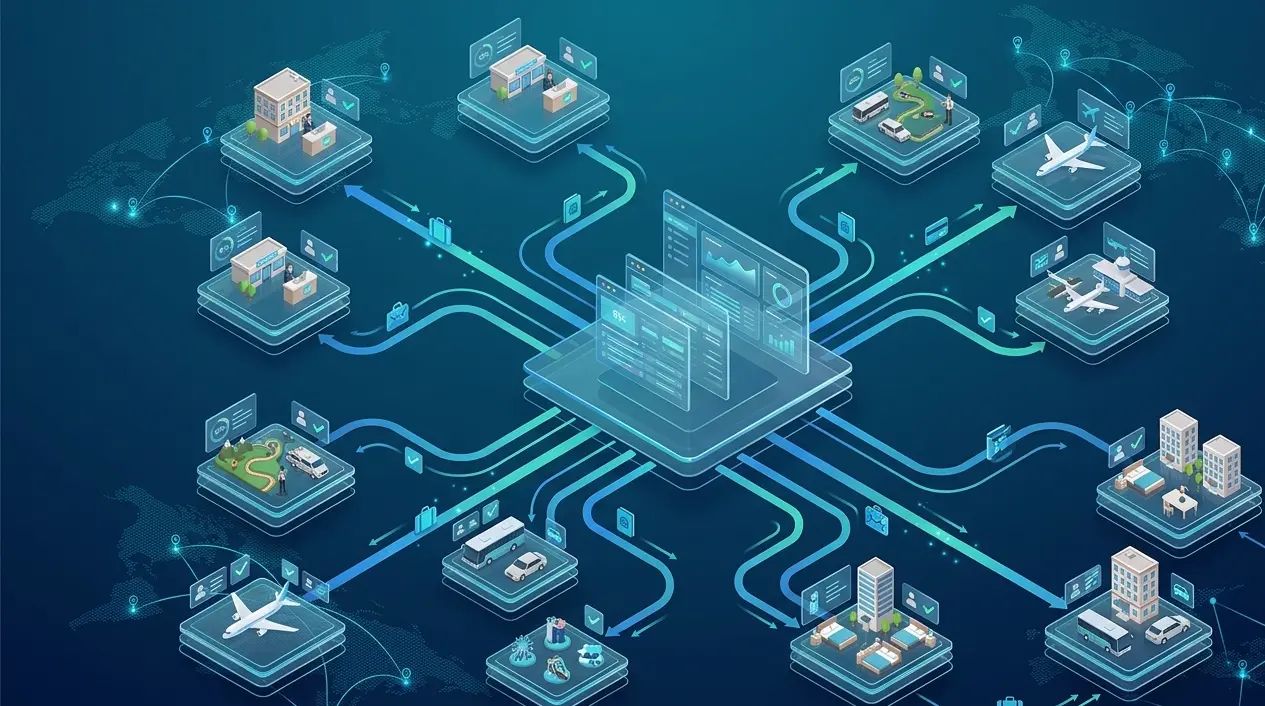
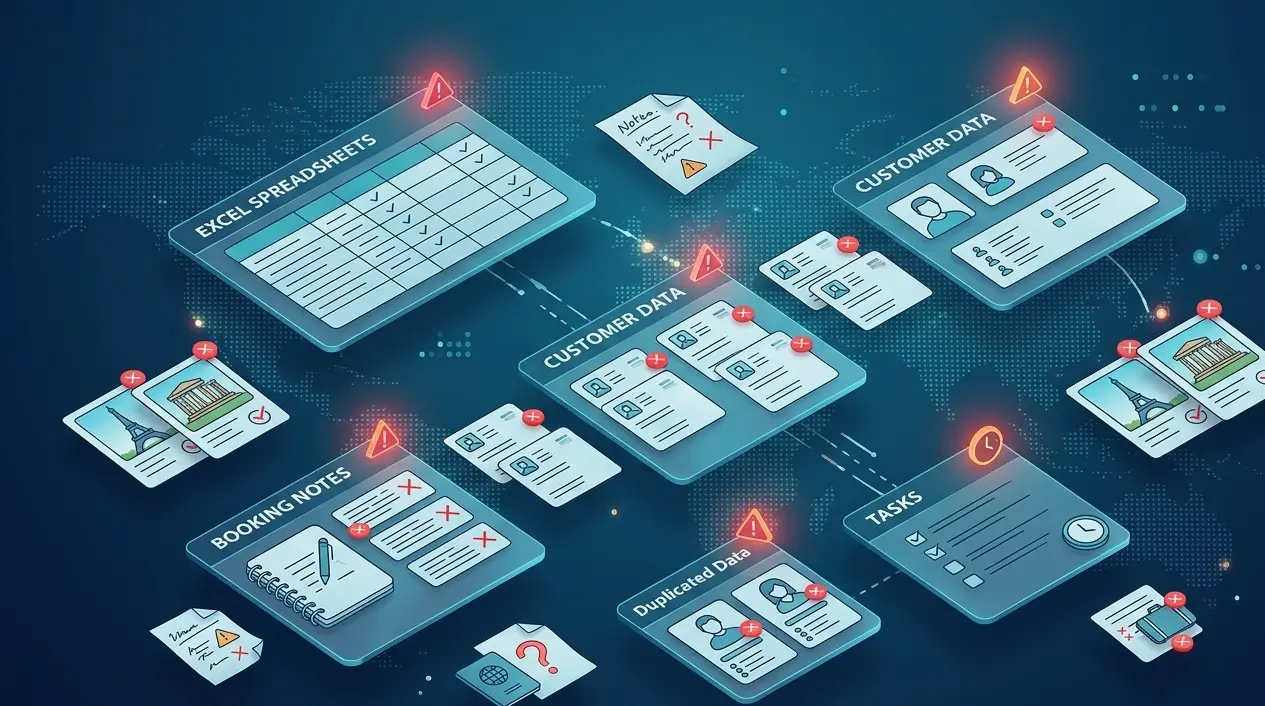
When information is distributed among emails, files and people, each decision requires reconstructing the context. The problem is not only the time invested, but the loss of coherence. The platform begins to add value when it allows the company to function as a system, not as a sum of isolated efforts.
This is one of the central benefits of an inbound tourism platform: to organize operational information so that decisions do not depend on memory or urgency.
Errors that are not perceived as errors
In inbound tourism, errors rarely present themselves as obvious faults. They usually appear disguised as “normal adjustments”: a fare that is corrected at the last minute, a confirmation that is resent, a change that forces a redo of part of the operation.
The real cost is not just in the one-time error, but in the accumulated rework and energy the team spends putting out fires. Over time, this dynamic impacts supplier relationships and the customer experience, even if it is not always immediately visible.
One of the benefits of using a platform in inbound tourism is to reduce this type of silent friction, not because it eliminates complexity, but because it makes it manageable.
Processes with and without a platform: differences that become evident
Even without full implementation, certain changes are quickly perceived when the operation is supported by a centralized platform. These are not abstract promises, but concrete contrasts on a day-to-day basis.
| Operating variable | Without platform | With platform | Expected result |
| Reservation management | Manual and dispersed tracking | Centralized flow per operation | Less reprocessing |
| Tariff control | Multiple versions and reactive adjustments | Unified and traceable rates | Fewer commercial errors |
| Coordination with suppliers | Fragmented confirmations | Clear states by service | Increased predictability |
| Customer service | Information reconstructed on a case-by-case basis | Immediate access to history | Consistent answers |
| Financial control | Subsequent reconciliation | Visibility linked to the operation | Better decision making |
These improvements do not depend on complex automation, but on something more basic: working with a single source of reliable information.
Customer service: consistency before speed
In inbound tourism, good service is not just defined by responding quickly. It is defined by responding well, even when there are changes, unforeseen events or unexpected requests.
When the team has access to a complete history – contracted services, modifications, payments, preferences – care ceases to depend on who is attending at that moment. It becomes consistent. This reduces internal tensions and conveys greater professionalism to the end customer.
Here, the platform does not automatically “improve” attention. What it does do is decrease the likelihood of contradiction, which is one of the main sources of conflict in the passenger experience.
Financial control: watch while it happens, not after
One of the less visible but more strategic benefits of using a platform in inbound tourism is the impact on financial control. In many companies, economic information is analyzed once the operation has already taken place.
When financial movements are directly linked to reserves, services and suppliers, control is no longer retrospective. It does not mean having perfect figures at all times, but detecting deviations while it is still possible to correct them.
This change is often critical in companies that begin to handle higher volume, multiple currencies or international suppliers.
Climbing without losing control
A company can grow sales for quite some time without a platform. What it can’t do is sustain that growth without increasing internal friction.
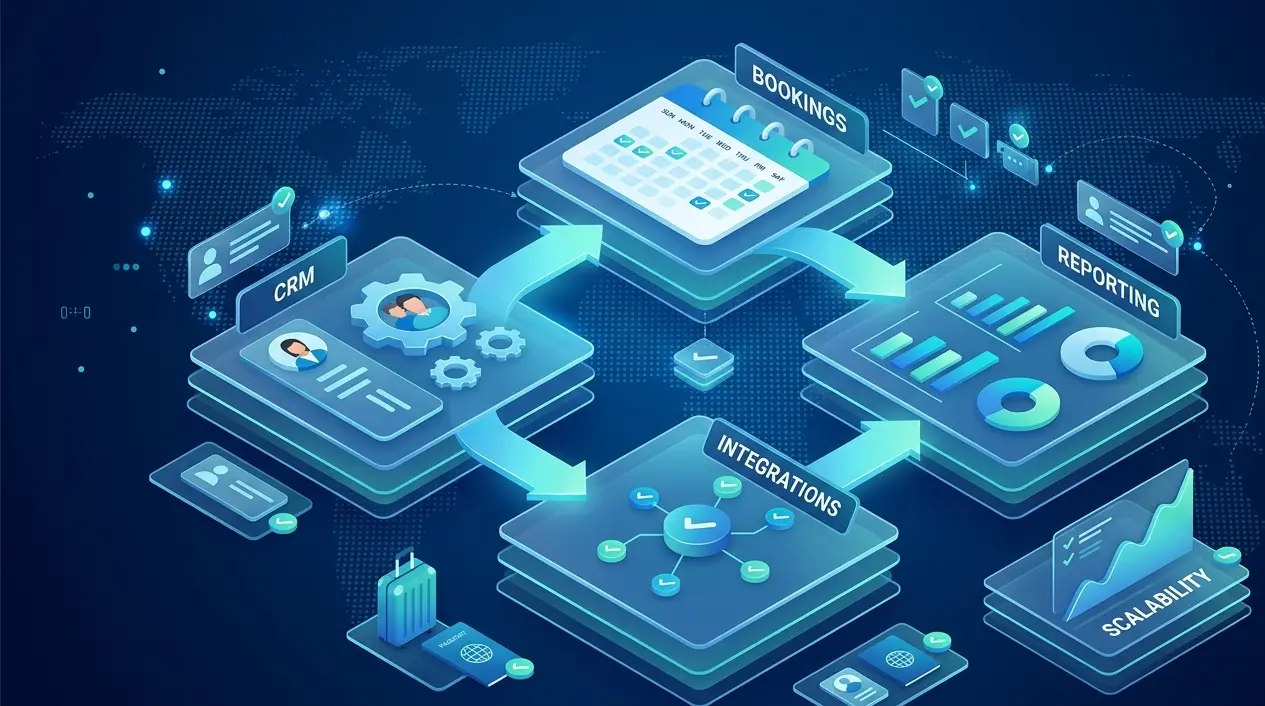
Real scalability is not about selling more, but about absorbing greater complexity without multiplying operational chaos. At this point, the platform ceases to be an incremental improvement and takes on a structural role: allowing growth to not depend on adding urgencies.
Signs that the operation is starting to ask for a platform
Not all companies need a platform at the same time. However, there are clear signs of operational stress that often appear before the decision is made:
- Important decisions require consulting several people to validate the information.
- The team spends time confirming data that “should already be clear”.
- Last minute changes generate more stress than solutions.
- Daily coordination depends on parallel messages, calls and follow-ups.
- Visibility of the operation comes when the impact has already occurred.
These signs do not speak of a lack of capacity, but rather of a structure that is beginning to be required by the evolution of the business itself.
When tools no longer follow business logic
Many companies start by solving their management with tools that were not designed for tourism: spreadsheets, isolated accounting systems or generic CRMs. In the initial stages, these solutions may be sufficient.
The difficulty arises when the operation becomes more dynamic: services that are sold today and provided weeks later, suppliers with variable conditions, seasonal rates and operations in different currencies. In this scenario, the tool no longer accompanies the business and the business begins to adapt to the tool.
It is not that these solutions are incorrect, but that they were not designed for the specific logic of inbound tourism, where future operation and coordination are central.
Tourist platforms and adoption support
In this context, there are platforms developed specifically for travel agencies, operators and DMCs, such as Toursys, which are based on understanding this operational logic. Beyond the technology, the differential lies in how it is integrated into real processes and in the support during implementation.
Digitizing a tourism operation is not just installing a system. It involves organizing information, reviewing flows and accompanying the teams in the change. When this process is approached gradually and with human support, adoption tends to be more natural and sustainable.
A strategic decision, not an urgent one
Implementing a platform does not in itself define the direction of a company, but it does condition the way in which that direction can be sustained over time. Understanding the benefits of using a platform in inbound tourism before evaluating suppliers allows more conscious decisions to be made, aligned with the actual stage of each operation.
In many cases, the platform does not come to change how a company works, but to organize what already exists. Understanding this role transforms digitization into a logical evolution, not a rushed response to day-to-day problems.