Adopting cloud management software for a travel agency is not simply “going digital”. It is a structural change that modifies how information flows, how decisions are made and how the company grows over time.
At this initial research stage, the question is often not which system to choose, but something deeper: what does it really mean to leave behind manual processes or generic tools.
This article seeks to answer these questions. Not from commercial promises, but from the real operational logic of tourism.
When manual management begins to limit growth
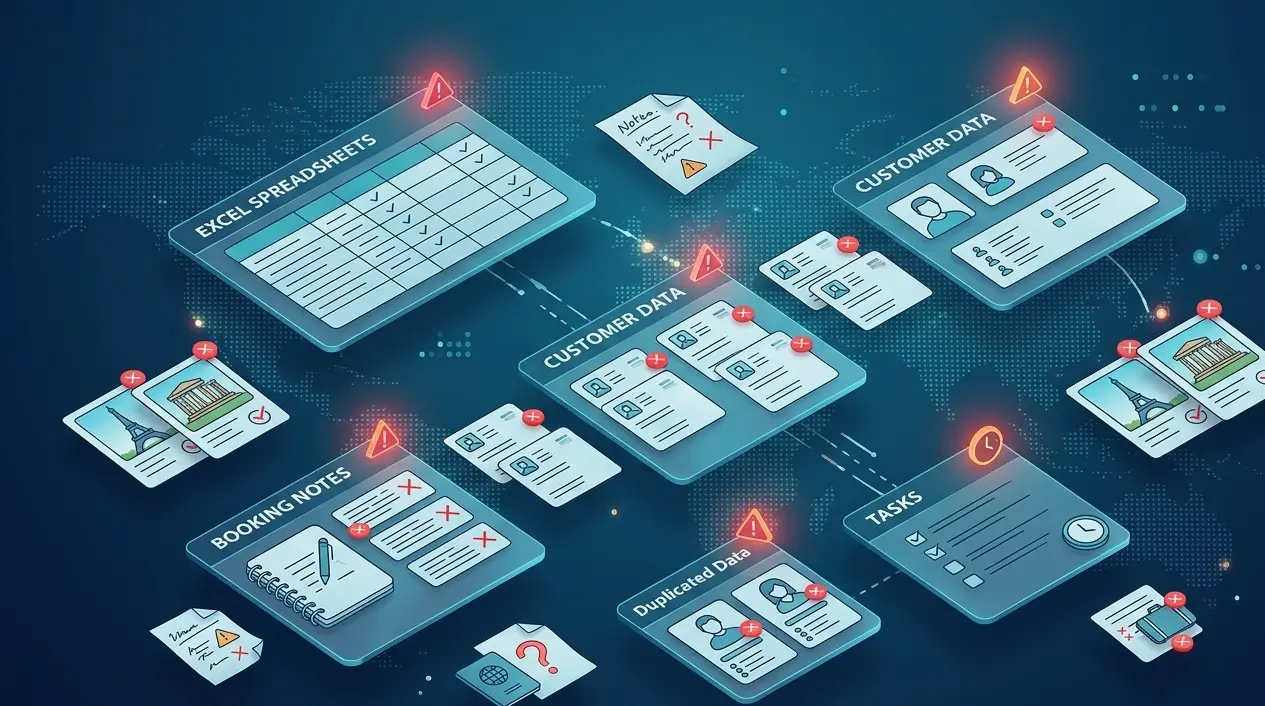
Many agencies operate for years with spreadsheets, mailings, shared folders and isolated accounting systems. At the beginning, this scheme seems sufficient. The problem arises when the operation grows and the complexity accumulates.
Information is duplicated. Data does not always match. Decisions are made with delay or intuition, rather than with reliable data.
It is not an equipment failure. It is a structural limitation of the management model. In tourism, where suppliers, future dates, early payments, last-minute changes and tight margins are involved, this fragmentation starts to cost time, money and control.
What changes when an agency is managed with software in the cloud
Online software doesn’t just move information to the Internet. It changes the way the agency thinks and organizes its operation.
Information is no longer dependent on individuals
In manual schemes, knowledge is usually “in the head” of one or two key profiles. When that person is absent, the operation suffers. With a cloud system, information becomes institutional, not personal. Processes continue, even when teams change.
Time is no longer wasted in invisible tasks
Much of an agency’s day-to-day work is unseen: copying data, checking versions, searching for old emails, recalculating quotes. Digitization does not eliminate work, but it drastically reduces low-value tasks, freeing up time to sell better, negotiate with suppliers or design products.
Real impact on operating times: manual vs. digital
The difference between managing with manual processes and with cloud software is clearly reflected in the daily times.
| Operational process | Manual management / generic tools | Management with cloud software |
| Creation of quotations | 30-60 min per quote. It is assembled in Word/Excel, rates are copied from e-mails or PDFs, checked several times to avoid errors. Example: changing a hotel involves revising the entire document. | 5-10 min. Services, rates and margins are already loaded. The system calculates automatically. Example: adding an extra night recalculates the total without redoing the document. |
| Modification of dates or services | Additional 20-40 min. Redo calculations, adjust rates manually and resubmit the proposal. High risk of inconsistencies between versions. | 2-5 min. Change of dates or services with automatic recalculation. The history is recorded and the new version is generated instantly. |
| Customer payment tracking | 10-15 min per case. Review of emails, attached vouchers and spreadsheets. Difficult to know quickly who paid and who did not. | Immediate visualization. Payment status updated in real time. Example: see in seconds which reserves have outstanding or overdue balances. |
| Payments and supplier control | Fragmented management. Prepayments noted in spreadsheets, final payments in mails and manual reminders. Risk of forgetfulness or duplicate payments. | Centralized control. Each booking shows which supplier is paid, what is missing and when it is due. Reduces errors and operational stress. |
| Sales and performance report | 2-4 hours per week. Consolidate data from various sources to understand sales, margins or best-selling destinations. | Minutes. Automatic reports with updated data. Example: view sales for the month by agent or product without creating spreadsheets. |
| Access to information | Dependent on local files or key persons. If someone is not there, the information is not always found quickly. | 24/7 cloud access. Information available from anywhere, with permissions according to role. |
| Operational change management | Slow and reactive. Last minute changes require manual notifications and multiple checks. | More predictable. The changes have a direct impact on the operation and are visible to the entire team. |
The difference is not just one of speed. It’s about predictability.
Fewer errors does not mean less work, but better work.
One of the most underestimated changes of cloud management is the reduction of operational errors. Not because the system is “perfect,” but because it eliminates critical points of human failure.
Typical errors in manual schemes:
- Different versions of the same budget
- Poorly updated rates
- Payments not recorded on time
- Incomplete information when moving from sales to operations
Online software acts as a single source of truth. It does not replace human judgment, but reduces friction between areas and streamlines the operation.
Scalability: the point where many systems break down
An agency can handle 10 to 20 operations per month with basic tools. The problem arises when the volume grows.
More customers, more suppliers and more destinations do not multiply complexity linearly. They multiply it exponentially.
Without a solid digital foundation, growing means adding people to support the clutter.
The cloud allows something key: to grow without losing control. It is not about doing the same thing faster, but about operating with a logic that is ready to scale.
When is an agency ready to make the leap?
Not all agencies need to go digital at the same time, but there are clear signs of operational maturity:
- Quotation volume can no longer be controlled with spreadsheets
- Payment tracking starts to generate internal friction
- Information is not available in real time
- Growth depends too much on key people
- Decision-making is based more on perception than on data
When these symptoms appear, the problem is no longer one of effort, but of structure.
Thinking digitalization as a structural decision
Managing an agency with cloud software is not a technical change. It is a strategic decision that defines how work is organized, how operational risk is reduced and how the company is prepared to grow.
Before evaluating suppliers, it is worth answering a simpler and deeper question: does my current management approach match the business I want to build in the coming years? Technology is no substitute for expertise. But when it is well thought out, it enhances it.