Accounting is often one of the messiest areas in many travel agencies. Invoices that are recorded late, reconciliations that are done by hand, commissions that are calculated in different spreadsheets or financial reports that depend entirely on the external accountant.
For years, this model was normal. Accounting management was separated from the tourism operation. First you sold, then you sorted out the numbers.
However, digitalization, artificial business intelligence (BI) and integrated management systems are changing that logic. Today, many agencies can automate a large part of their accounting processes without needing to be accounting experts, as long as the information is organized within software that connects the operation with financial data.
For an issuing agency, incoming agency or tour operator, this does not mean replacing the accountant. It means ordering the accounting information from the daily operation through an integrated system, reducing errors, improving control and facilitating the work of the accounting area.
Why travel agency accounting often becomes chaotic
In tourism, accounting is particularly complex. It is not just a matter of recording income and expenses. Each transaction may involve multiple suppliers, different currencies, commissions, prepayments, canceled reservations or services that are settled weeks after the trip.
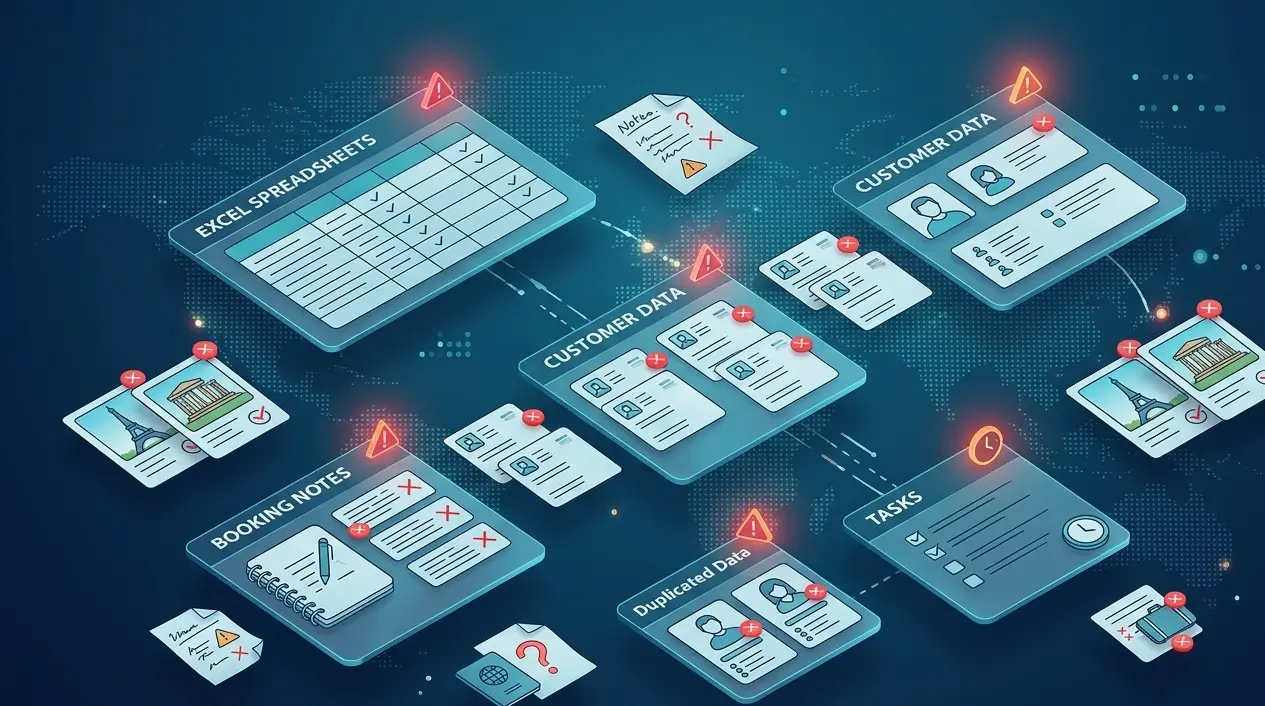
When this information is managed with separate tools – Excel, e-mail, file sharing – accounting ceases to be a continuous process and becomes an afterthought.
The result is usually predictable:
- differences between what was sold and what was collected
- commissions that are calculated manually
- delayed bank reconciliations
- untidy billing
- financial reports that are late
The problem is not the accounting itself, but the way in which information is generated within the tourism operation. When sales, bookings and payments are disconnected, the accounting area always works with incomplete or delayed information.
What does it mean to automate an agency’s accounting with an integrated system?
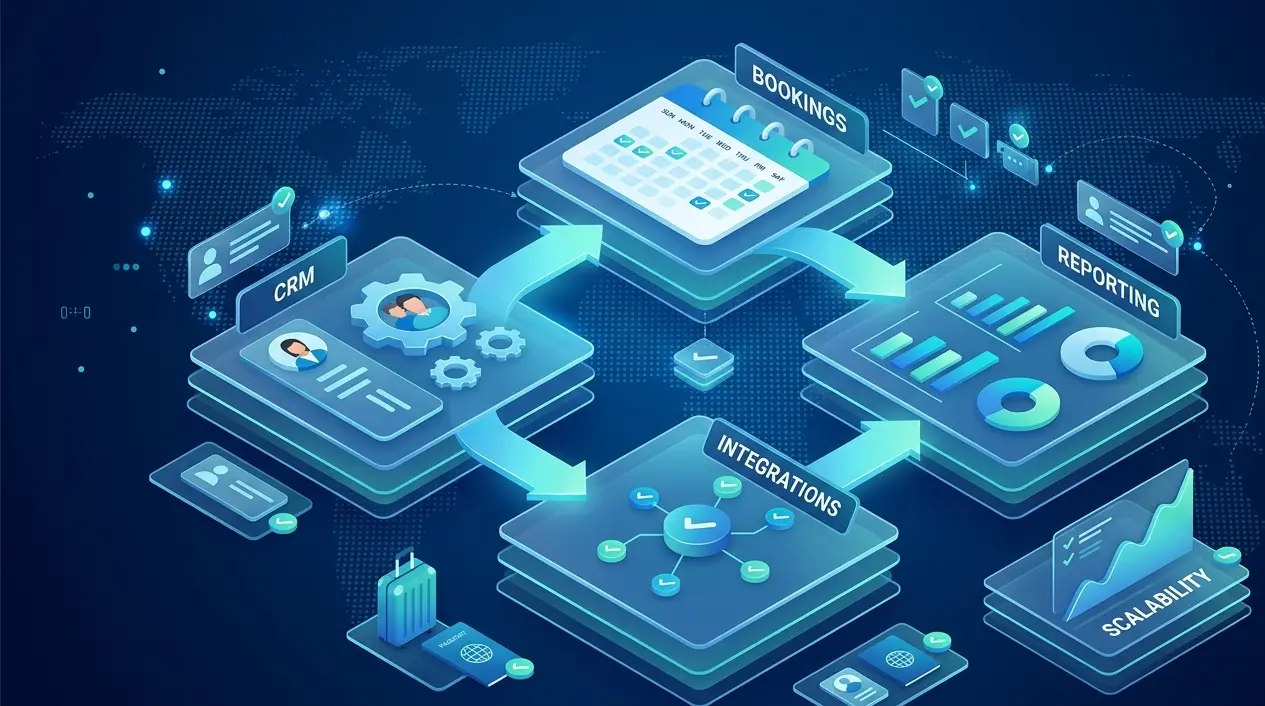
Automating the accounting of a travel agency does not mean that a software “acts as an accountant”. It means that the accounting information is automatically generated from the operation recorded in an integrated tourism management system.
Each time a quote is created, a reservation is confirmed or a payment is recorded, the system organizes that data so that it can be reconciled, analyzed or exported to the accounting area.
In practice, this completely changes the way of working.
A tour operator confirming services for an itinerary can automatically see the financial impact of that operation: costs, margins, outstanding payments or commissions.
An issuing agency that sells flights or packages may record collections and invoicing within the same operational flow.
When the operation is managed within an integrated system, accounting is no longer a manual job afterwards. It becomes a natural consequence of the agency’s daily activity.
Business intelligence and accounting automation in travel agencies
Business intelligence (BI) is accelerating this accounting automation process. Today, many tasks that previously required manual review can be simplified: classification of movements, detection of inconsistencies, data reconciliation or generation of financial reports.
This does not mean that the role of the accountant disappears. Professional accounting is still necessary for tax, regulatory and strategic aspects. What changes is the upstream operational work.
An integrated system can structure accounting information at the source, saving the administrative team from having to manually sort through hundreds of scattered data. In a travel agency, where each transaction combines multiple services and suppliers, this automation can save a significant amount of time and errors.
How an integrated system organizes the accounting information from the operation
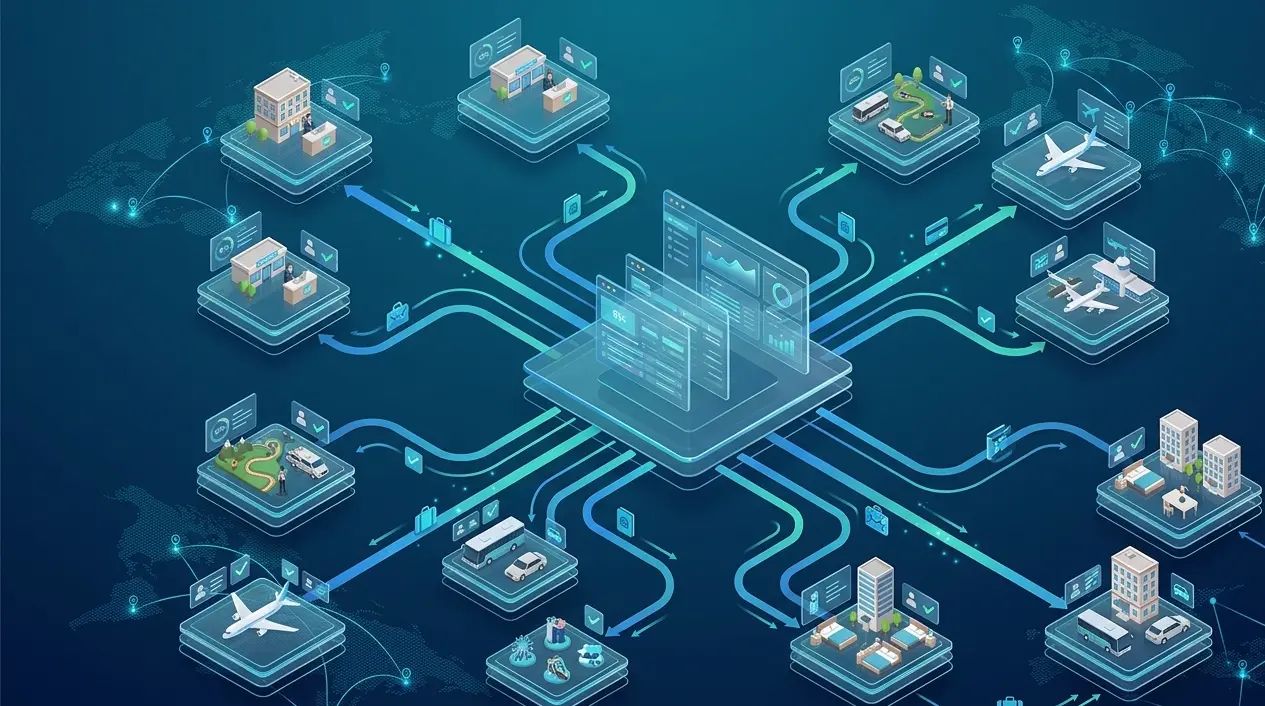
True accounting automation does not occur in the accounting area. It happens in the operation. When an agency works with an integrated tourism management system, financial data is generated automatically as the team works.
For example:
An incoming agency organizing a destination program records transportation, accommodations and activities within a booking. The system can automatically calculate total costs, margins and outstanding payments.
An issuing agency selling international packages can record customer collections, agency commission and vendor payments within the same workflow.
A tour operator coordinating complex itineraries can visualize in real time which services are paid for, which are pending and how they impact the profitability of each operation.
When sales, reservations, suppliers and payments are managed within the same system, the accounting starts to sort itself out.
Why many agencies believe they need more administrative personnel
When accounting becomes chaotic, many companies come to a quick conclusion: they need more people to sort the information. However, in many cases the problem is not the number of people but the structure of the information.
When data is recorded in multiple tools, each task is duplicated: copying information, reviewing errors, reconciling spreadsheets, confirming payments manually. This consumes time, generates errors and increases operating costs.
Automating accounting with an integrated system does not always mean hiring more staff, but reducing unnecessary manual work. A well-structured operation allows the management team to concentrate on analysis and control, not on sorting data.
Signs that your agency needs a system to sort out its accounting
Many agencies normalize certain operational problems without realizing that they are symptoms of disorderly accounting management.
Some common signs include:
- financial reconciliations that are performed only once a month
- differences between sales and invoiced amounts
- difficulty in calculating reserve margins
- total reliance on the accountant for reporting
- multiple versions of the same information in Excel
These problems usually arise when the operation grows and the initial tools are no longer sufficient. When financial information is not connected to the operation, growth begins to generate friction.
At that point, implementing an integrated system for travel agencies is no longer a technological improvement but an operational decision.
Automating accounting also improves agency professionalization
To the end customer, accounting may seem invisible. However, it has a direct impact on the perception of professionalism. Invoices sent late, errors in collections, delays in confirmations or lack of clarity in payments generate distrust.
An integrated system allows you to work with greater precision: clear confirmations, orderly documentation and greater transparency in operations. This is especially important for incoming agencies or tour operators working with international partners.
Organized accounting is also part of the quality of service. When the operation is internally ordered, the customer perceives greater security when buying.
Generic accounting systems vs. specialized software for travel agencies
Many companies try to solve accounting management using traditional accounting software or generic management tools. The problem is that these solutions do not always understand the operational logic of tourism.
Bookings with multiple suppliers, payments in different currencies, variable commissions or services that are confirmed in stages are common situations for an agency, but not for most standard accounting systems.
This is why more and more companies are looking for management software designed specifically for travel agencies and tour operators.
Platforms such as Toursys work on this logic: connecting the tourism operation with financial information so that accounting is automatically built from the operational flow.
In addition to the technology, this type of system usually includes human support during implementation, which is key when a company is reorganizing processes that for years were managed manually.
Automating your agency’s accounting starts with getting your operation in order.
Automating the accounting of a travel agency does not mean turning your team into accountants or replacing the professional work of the fiscal area. It means managing the operation within an integrated system that automatically organizes accounting information.
Artificial intelligence and specialized software are enabling many agencies to work with greater control without increasing their administrative complexity. In tourism, where every operation involves multiple players, currencies and suppliers, sorting information from the start can make the difference between improvised management and a truly professional operation.
And often, the first step to improving accounting is not changing the accountant. It’s implementing a system that connects your entire agency operation in one place.