When a travel agency begins to digitize its operation, one of the first concepts that often generates confusion is the difference between a travel agency management software and a tourism reservation system.
Both tools are part of an agency’s technological infrastructure, but respond to different needs within the operation. While the travel agency reservation system manages the tourist services that make up a trip, the administrative software controls the financial and accounting dimension of the business.
Understanding this difference is important because many agencies adopt isolated tools that solve only part of the problem. In the short term this may seem sufficient, but as the operation grows, technological fragmentation begins to generate errors, duplication of tasks and loss of control over profitability.
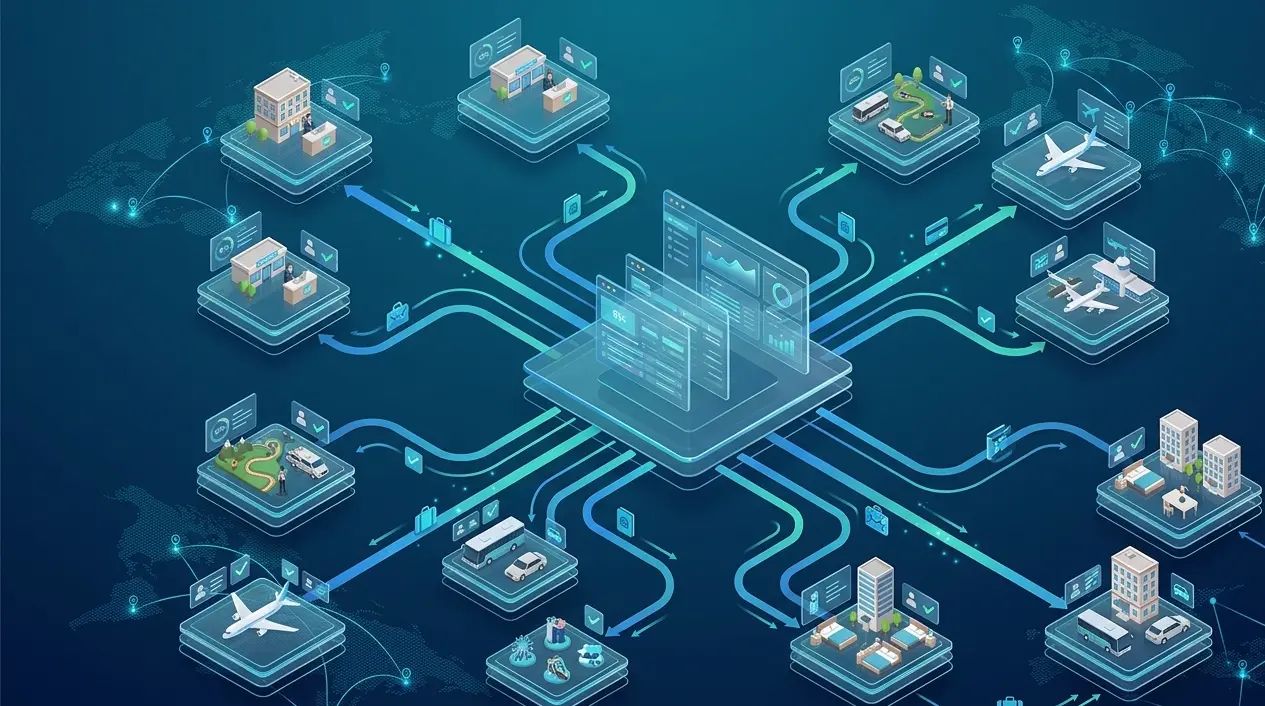
For this reason, more and more inbound and outbound agencies and tour operators are moving towards integrated platforms that combine booking, operation and administration modules within a single system.
What does a travel agency reservation system do?
A travel agency reservation system is designed to manage the direct travel operation. Its main function is to organize the availability of travel services, record reservations and coordinate confirmations with suppliers.
In practice, this system becomes the tool that transforms a travel proposal into a concrete operation. Through the reservation system, services such as accommodation, excursions, transfers or activities are managed, keeping the information in order to execute the trip.
Depending on the type of tourism company, the reservation system fulfills different functions.
In an issuing agency, for example, the system allows managing the reservation of services that the client will hire at destination, coordinating availability and confirmations with operators or suppliers.
In an inbound agency, the tool organizes bookings that must then be handled locally, such as transportation, guides or excursions.
In the case of a tour operator, the system facilitates the management of multiple services combined into tour packages that will then be distributed to other agencies.
Although this tool is fundamental to the daily operation, a reservation system alone does not provide insight into the company’s financial status or control the profitability of each sale.
What does an administrative software do in a travel agency?
The administrative software for travel agencies fulfills a different function within the organization. Instead of managing tourism services, it is in charge of organizing the financial and accounting information that arises from the commercial operation.
This includes processes such as invoicing, payment recording, accounts receivable management, accounts payable control and financial reconciliation of each transaction.
In the travel industry, this task is particularly complex because a single sale can involve multiple suppliers, commissions, intermediaries and different currencies. When administrative information is not connected to the booking operation, the agency ends up manually reconstructing the financial data to understand how much money came in, how much it has to pay and what the actual margin is for each trip.
For this reason, administrative software becomes essential to maintain financial control of the business, although it does not solve the operational complexity of tourism on its own.
Why reserves and management must work within an integrated system
In a travel agency, booking and administration are not separate processes. Both are part of the same operational flow that begins with the creation of a travel proposal and ends with the financial reconciliation of the operation.
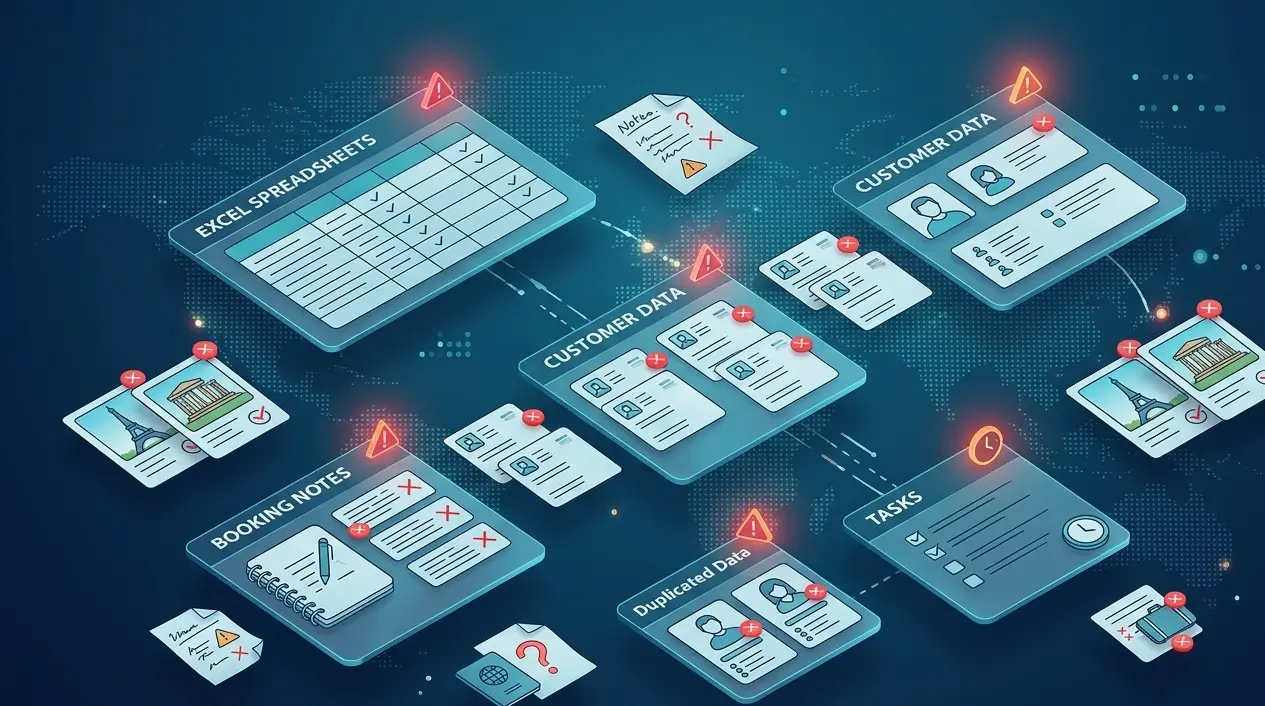
When these functions are managed in separate tools, information is often fragmented between different systems. The team ends up manually copying data between platforms, which increases the risk of errors and slows down day-to-day work.
An integrated system avoids this problem because each module shares the same information base. This means that data generated at one stage of the process can be used automatically in the next, without the need to duplicate tasks.
In operational terms, the flow usually follows a clear sequence:
- creation of the travel itinerary
- quotation and proposal approval
- confirmation of reservations with suppliers
- operational coordination of services
- customer billing
- payments to suppliers
- financial reconciliation
When all these stages are managed within a single platform, the agency can work with greater accuracy, reduce administrative errors and maintain complete visibility over each operation.
The problem of using generic software in tourism
Many agencies begin their digitization process using tools that were not designed specifically for the tourism sector. Among the most common options are traditional accounting systems, commercial CRMs or independent booking platforms.
These solutions may work well in industries with simple processes, but tourism has a much more complex operational structure.
A trip often combines multiple travel services that may involve different suppliers, varying commission structures, rates in different currencies and destination-specific operating conditions. Generic systems are not set up to handle such logic, so they end up forcing the team to make multiple manual adjustments.
The result is often a fragmented operation in which reserves are managed in one tool, accounting in another and financial tracking in spreadsheets.
As sales volume grows, this model becomes difficult to sustain and begins to generate inefficiencies that directly impact the agency’s ability to grow.
How a travel agency software works organized by modules
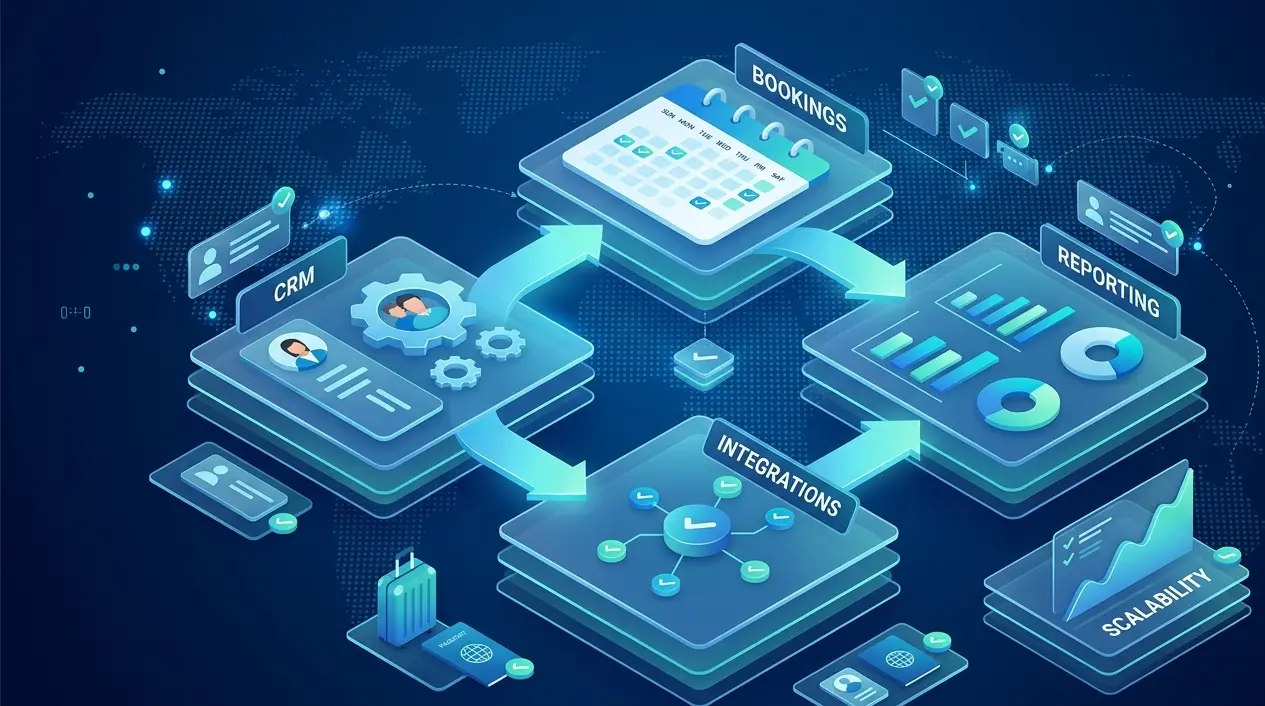
Systems designed specifically for the tourism sector are usually structured in interconnected modules, where each one fulfills a function within the operational flow of the agency.
The most common modules include:
- itineraries
- reservations
- operations
- accounting management
- financial management
Each of these modules solves specific problems that arise when the operation is managed with dispersed tools.
Key travel agency software modules and the problems they solve
| Module | Main functions | Operational problems solved |
| Itineraries | Allows you to design structured travel proposals with services, rates and descriptions organized within a single operational document. Facilitates the rapid creation of professional quotations that can be sent directly to the client. | It avoids building itineraries manually in scattered documents, reduces errors in quotations and allows reusing information from previously uploaded tourism products. |
| Reservations | Manages the confirmation of tourist services, controls availability and organizes the relationship with suppliers. It allows to register reservations, dates of service and specific conditions of each tourist product. | It avoids losing information on confirmed reservations, centralizes the relationship with suppliers and reduces the risk of duplicate bookings or making mistakes in dates and services. |
| Operations | Coordinates the execution of services at destination, organizing transportation, guides, activities and travel logistics. Allows the operational team to visualize the status of each service and anticipate operational needs. | It avoids disorganization in the coordination of tourism services, improves internal communication between departments and allows detecting operational problems before they impact the customer experience. |
| Administrative accountant | Manages invoicing, accounts receivable, accounts payable and financial reconciliation of each tourism operation. It allows you to relate each financial movement with the services that are part of a trip. | It avoids keeping accounting in separate systems or spreadsheets, reduces administrative errors and facilitates the financial control of each sale. |
| Financial | Allows to analyze cash flow, operating margins and financial status of the agency. Integrates information on sales, payments and costs associated with each operation. | It allows you to understand the real profitability of each trip, anticipate financial needs and make strategic decisions based on complete information. |
When these modules work within the same platform, information flows automatically between them. An approved quotation can be transformed into a booking, then into an operation and finally into a financial record without the need to duplicate data.
This model allows the agency to work with a single source of information, which simplifies daily management and improves the business analysis capacity.
The importance of adopting specialized tourism software
As an agency grows, the need to integrate reservations, operations and administration becomes more and more evident. Digitization is no longer just about recording reservations, but about building a system to understand and control the entire business operation.
For this reason, technological platforms designed specifically for travel agencies, tour operators and inbound companies have emerged. This type of software considers from its initial design the operational logic of tourism, allowing to connect the different areas of the company within the same tool.
These solutions include platforms such as Toursys, which organize the operation through interconnected modules covering everything from itinerary creation to administrative and financial management. This approach allows the agency to evolve towards a more structured management, where each stage of the process is connected to the next and information flows in an orderly fashion between the various teams.
Instead of working with isolated tools, the company can build a technological base ready to accompany the growth of its tourism operation in the long term.